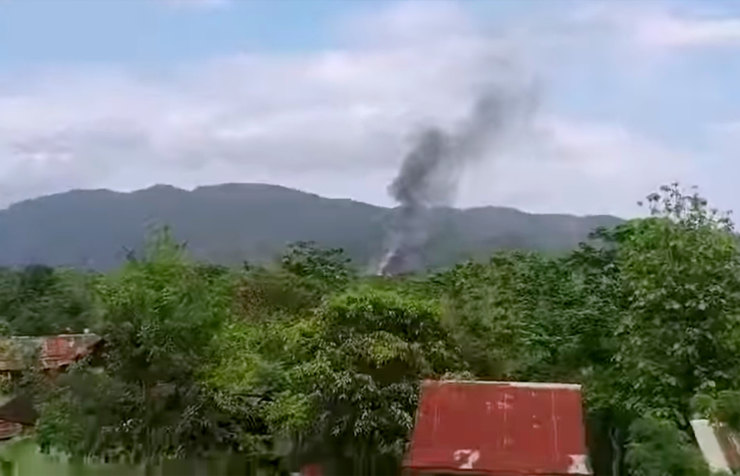
A Kuki village inside Myanmar was reported burnt on 12 May, deepening fears of a wider conflict between two predominantly Christian communities along Manipur’s volatile frontier with Myanmar.
Manipur Police confirmed that Molnoi, located approximately two kilometres inside Myanmar from Border Pillar No. 113 near Kamjong district, was the scene of a reported burning around 3 pm. Police stated that “the incident is not related to India.”
News reports differed on who was responsible. Reporting by Bit Irom attributed the burning to cadres of the NSCN-Eastern Frontier. Kukiland Media, citing journalist Nitin Thusoh of Daily News, named the NSCN-IM, or National Socialist Council of Nagaland (Isak-Muivah), a major Naga armed-political organisation under a formal ceasefire with the Government of India since 1997. The two reports did not agree, and no official confirmation was available by end of day.
The Naga Village Guards (NVG) of the Eastern Command denied any Tangkhul Naga involvement, called the allegations baseless, and suggested the attack may have been a consequence of Myanmar’s ongoing civil war rather than cross-border ethnic targeting.
The Molnoi reports came five days after a more serious attack on Indian soil. On 7 May, three Tangkhul Naga villages, Choro, Wanglee, and Namlee, in Kamjong district were struck before dawn. The Working Committee of the Tangkhul Naga Long (TNL) said attackers crossed the international border carrying automatic weapons and explosives.
At least 30 houses were burnt, shops looted, and vehicles taken or destroyed. At least two civilians were wounded by gunfire. A woman allegedly abducted during the attack was later returned to Assam Rifles personnel on 9 May. Residents fled into surrounding forest areas.
Manipur Home Minister Govindas Konthoujam visited the affected villages on 9 May to assess the damage. On 12 May, fresh tension flared at Wanglee village, where residents reportedly blocked an Assam Rifles convoy heading toward the border. Videos also circulated showing Assam Rifles personnel stopping vehicles at Shangshak Khullen in Ukhrul district.
The United Naga Council condemned the 7 May attack as a “barbaric cross-border invasion” and urged the Government of India to act immediately. The Village Volunteers Eastern Zone (VVEZ), a group that emerged from the Kuki-Kathe conflict in Myanmar, claimed responsibility, saying the assault was retaliation for the burning of Lanchah village on 2 May.
The Kuki National Army-Burma (KNA-B), the Myanmar-based wing of the Kuki National Organisation, denied any role. In a press release dated 12 May, it said VVEZ “is not affiliated with our Kuki National Army.” KNA-B also disputed the account of the abducted woman, saying she had not been rescued by Assam Rifles but formally handed over by KNA-B itself on 9 May, along with 21 other civilians from Tamu district.
Kamjong and Ukhrul are hill districts where Tangkhul Naga and Kuki communities have lived as neighbours for generations, both predominantly Christian. Myanmar’s civil war has made the frontier increasingly unstable. The broader Kuki-Meitei conflict that erupted in Manipur’s valleys in May 2023 has deepened existing fault lines, and both communities carry the memory of a violent Kuki-Naga conflict in the 1990s.
Against that backdrop, a church-led peace effort deserves notice. On 4 May, the Nagaland Joint Christian Forum (NJCF) convened a dialogue at Kohima, bringing together church and civil leaders from both communities. The Kuki Organisation for Human Rights (KOHR) welcomed the initiative, calling it “wise, timely and commendable,” and urged both sides “to refrain from violent confrontation, to reject the language of hatred, and to give peace and dialogue a sincere chance.”
Security forces have not issued an official statement on the Molnoi burning or the wider pattern of violence in Kamjong and Ukhrul. With events unfolding in remote border terrain, independent verification remains difficult. Community representatives say displaced families are sheltering in nearby villages while organisations on both sides harden their positions.