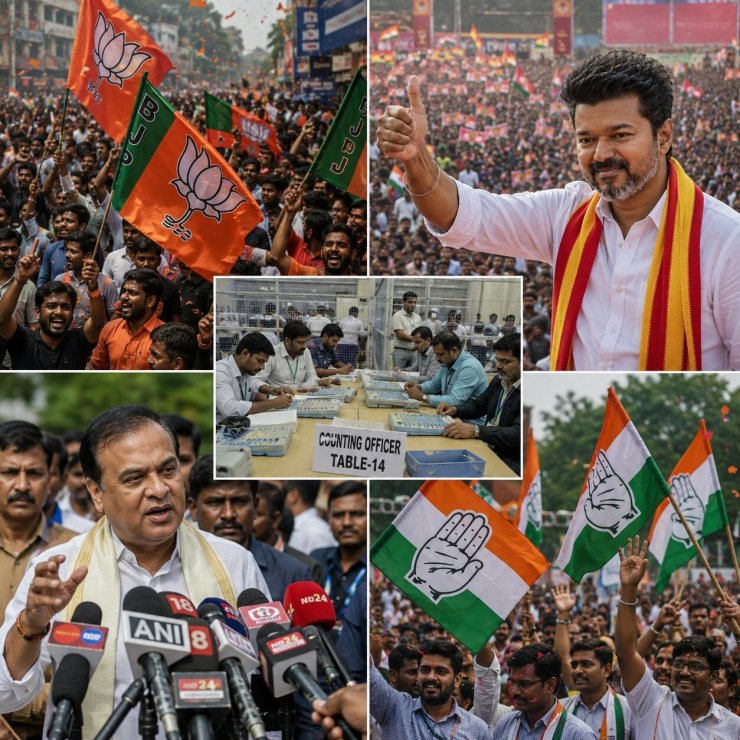
The Election Commission of India on Monday, May 4, declared results for assembly elections held across West Bengal, Tamil Nadu, Kerala, Assam, and the Union Territory of Puducherry. Three of the four states saw a change of government, making it one of the most consequential rounds of state elections in recent years.
West Bengal
The Bharatiya Janata Party won West Bengal, ending 15 years of Trinamool Congress rule. The BJP secured 207 of the 293 seats counted, comfortably crossing the majority mark of 148. The Trinamool Congress fell to 80 seats, down sharply from its 215-seat tally in 2021. The election recorded a voter turnout of 92.93 per cent, the highest ever in the state.
Chief Minister Mamata Banerjee lost her Bhabanipur stronghold to BJP's Suvendu Adhikari by a margin of 15,105 votes. Banerjee, who has governed the state since 2011, alleged "loot of seats" and said her party would "bounce back." Adhikari described his win as a decisive moment. "This was very important. Defeating Mamata Banerjee was crucial. This is Mamata Banerjee's retirement from politics," he told ANI.
Speaking of what he called "massive Hindu consolidation," Adhikari, who is being discussed as a frontrunner for chief minister, told reporters that "Hindu ne TMC ko muh tor jawab de diya" (Hindus of Bengal gave a befitting reply to TMC). He also said Hindus had been "discriminated against and tortured" under TMC rule. Adhikari further claimed that the "entire Muslim vote bank" shifted to the TMC during the Bhabanipur contest and vowed: "I will work for those who voted for me, the Hindus."
Prime Minister Narendra Modi said in an evening address that "Bengal has been freed from fear." BJP Union Minister Sukanta Majumdar told reporters that "the wind has blown in our favour," adding that the party had fulfilled its long-standing goal of crossing 200 seats in the state. The BJP's oath-taking ceremony is scheduled for May 9, coinciding with Rabindra Jayanti, the birth anniversary of Nobel laureate Rabindranath Tagore. BJP state president Samik Bhattacharya confirmed the date.
The election was the first in West Bengal held after the Election Commission's Special Intensive Revision of electoral rolls, which resulted in the deletion of more than 90 lakh (9 million) voters. The TMC accused the BJP of engineering the deletions to alter the demographic composition of the electorate, a charge the BJP denied. Repolling for one seat, Falta, has been postponed to May 21 following an Election Commission order.
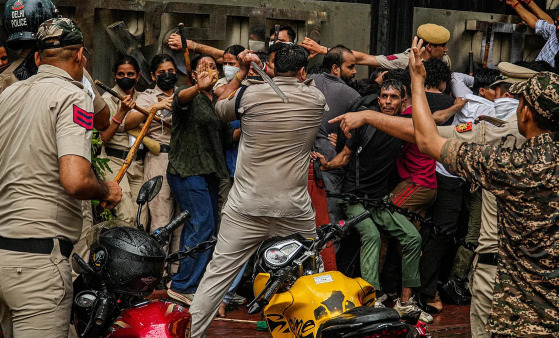
Following the results, incidents of violence were reported across the state, with both the BJP and the TMC trading charges over multiple incidents. A BJP worker, Madhu Mondal, died after being allegedly beaten up by TMC workers during a victory procession in New Town on Tuesday evening and was declared brought dead at hospital. A TMC worker, Abir Sheikh, was hacked to death allegedly by BJP activists at Nanoor in Birbhum. Both parties denied involvement in the other's deaths. TMC offices in Kolkata's Tollygunge, Kasba, Baruipur, Kamarhati, Baranagar, Howrah and Baharampur were vandalised. BJP denied its workers were involved. The Election Commission sought reports from local police and asked security forces to maintain peace. The Supreme Court refused a plea to deploy central forces to prevent post-poll violence. Banerjee announced a 10-member fact-finding committee to visit affected areas.
Tamil Nadu
Tamil Nadu delivered what commentators are calling one of the most significant upsets in the state's electoral history. Actor-politician Joseph Vijay's Tamilaga Vettri Kazhagam, contesting its first-ever election, emerged as the single-largest party, winning 108 seats in the 234-member assembly. The majority mark stands at 118, and the result produced a hung assembly, the first time in Tamil Nadu's history that no party or alliance achieved an absolute majority.
The incumbent Dravida Munnetra Kazhagam won 59 seats. Chief Minister M.K. Stalin lost his Kolathur stronghold to TVK's V.S. Babu by approximately 8,000 votes, becoming only the second sitting Chief Minister in the state's history to lose an assembly election. Stalin had held the seat since 2011 and resigned as Chief Minister on May 5, saying the DMK would function effectively in the opposition. The DMK-led Secular Progressive Alliance won 72 seats in all. The All India Anna Dravida Munnetra Kazhagam secured 47 seats and the Pattali Makkal Katchi won four. The AIADMK-led National Democratic Alliance won 53 seats in total. Congress won five seats and the BJP one. Vijay himself won from Perambur, defeating DMK's R.D. Shekar.
Tamil Nadu had not voted a non-Dravidian party to form government since 1962, when the K. Kamraj-led Congress won. The election recorded a voter turnout of 85.1 per cent, the highest in the state's assembly election history.
With TVK short of a majority, Vijay moved quickly to stitch together a coalition. Congress, which won five seats, is expected to be a key ally, with DMK-aligned parties including the VCK, CPI, CPI(M) and IUML also likely to join the ruling coalition. Vijay is scheduled to be sworn in as Chief Minister on May 7 at Nehru Indoor Stadium in Chennai, with more than 5,000 people invited to the ceremony.
AIADMK leader Edappadi K. Palaniswami accepted his party's defeat. "I wholeheartedly accept the decision given by the people," he said.
Kerala
The Congress-led United Democratic Front returned to power in Kerala, winning 97 seats in the 140-member assembly against a majority mark of 71. The CPI(M)-led Left Democratic Front, which had governed the state for two consecutive terms since 2016, was reduced to 35 seats. Congress alone won 63 seats, while its key ally the Indian Union Muslim League secured 22.
The LDF's bid to win a third consecutive term, a feat without precedent in Kerala's post-independence history, fell to a strong anti-incumbency wave. The National Democratic Alliance won three seats, one of the first times the alliance has opened its account in the state. During counting, Congress MP Shashi Tharoor described the result as "historic."
Assam
Assam returned the BJP-led NDA to power for a third consecutive term. The NDA secured 102 of 126 seats, with the BJP winning 82 on its own. Allies Bodoland People's Front and Asom Gana Parishad won 10 seats each. The Congress-led opposition was reduced to 21 seats. The All India United Democratic Front and Raijor Dal won two seats each. The All India Trinamool Congress won one seat, opening its account in the state for the first time.
Chief Minister Himanta Biswa Sarma retained his Jalukbari seat, winning by a margin of 89,434 votes against Congress's Bidisha Neog. Polling was held on April 9, with a voter turnout of over 85 per cent. The election was the first in Assam after the 2023 delimitation exercise.
The campaign was marked by sharp rhetoric. An AI-generated video shared by the BJP's Assam unit in February, which merged real footage of Sarma handling rifles with images depicting Muslims as targets, was deleted after public uproar. The BJP's own Assam unit president called it "unauthorised" and "immature," and a party social media official was sacked. Sarma, responding to a hate speech complaint filed against him by rights activist Harsh Mander in January, said he would file "at least 100 cases" in return. The Gauhati High Court issued notice to the Chief Minister over his remarks. Congress and the AIMIM filed police complaints over the video. The CPI and CPI(M) moved the Supreme Court.
Puducherry
In Puducherry, the All India NR Congress-led National Democratic Alliance returned to power, winning 18 of the 30 elected seats. The AINRC won 12 seats and ally BJP secured four. In the opposition, the DMK won five seats, TVK won two on its electoral debut in the Union Territory, and Congress won one. The Latchiya Jananayaka Katchi and Neyam Makkal Kazhagam won one seat each, and three independents were elected. The AIADMK won one seat.
Incumbent Chief Minister N. Rangaswamy of the AINRC won from the Thattanchavady constituency by a margin of 4,441 votes. Puducherry voted on April 9.
With BJP's oath-taking ceremony in West Bengal set for May 9 and Vijay scheduled to be sworn in as Tamil Nadu's Chief Minister on May 7, the transfers of power set in motion by Monday's verdicts are already underway.