The Baptist Church in West Garo Hills has offered its premises in Tura for a government rehabilitation centre, as Meghalaya’s anti-drug mission steps up efforts to tackle the state’s growing substance abuse crisis in partnership with faith-based institutions.
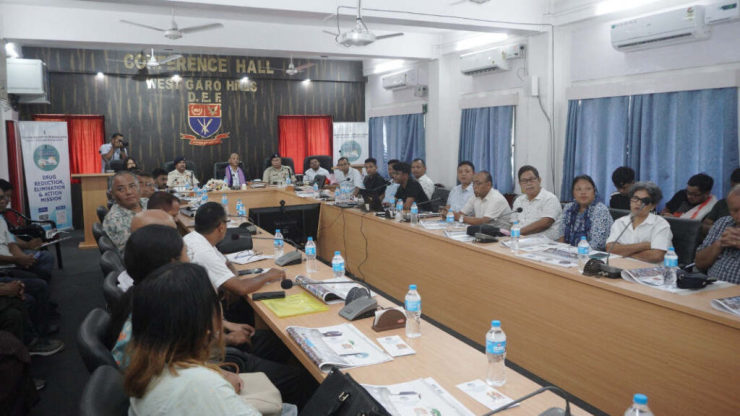
The Drug Reduction, Elimination and Action Mission (DREAM) conducted a site inspection of the proposed premises on April 23. A day later, its director Francis Kharshiing chaired a high-level coordination meeting at the office of the Superintendent of Police, West Garo Hills, to map out the next steps.
The meeting brought together the Deputy Inspector General of Police (Western Range), Deputy Commissioners, District Social Welfare Officers, partner NGOs and representatives from faith-based institutions and civil society across all districts of Garo Hills.
Kharshiing said the partnership with the churches was an important step toward a more compassionate response to the crisis. “Tackling such a deep-rooted issue will require not just the Church and government, but the active involvement of civil society as a whole,” he said.
The scale of the problem gives the initiative its urgency. Official estimates put the number of drug users in Meghalaya at nearly 3 lakh, up from 2 lakh the previous year, amounting to close to 10 per cent of the state’s 3.2 million population. Christians constitute approximately 83 per cent of that population, and with churches being the dominant community institution in the state, the partnership carries significant reach.
Meghalaya’s geography compounds the difficulty. The state lies close to the Golden Triangle, the border region spanning Myanmar, Thailand and Laos, one of the world’s principal sources of illicit narcotics. The drug trade has consequences beyond addiction: health authorities have flagged rising cases of HIV and Hepatitis B and C linked to needle sharing among intravenous drug users.
At the April 24 meeting, participants reviewed the prevailing drug situation across Garo Hills and identified several new intervention approaches. These included adventure-based counselling, student internship and engagement programmes, and online counselling certification courses through the NIMHANS Eco-platform.
DREAM is working toward establishing at least one detox centre and one rehabilitation centre in every district. Currently, the government runs only two detox centres. Private facilities charge fees beyond the reach of many families, and Kharshiing has previously said the government is particularly focused on ensuring access for those below the poverty line.
“With renewed momentum and strengthened partnerships, DREAM continues its mission towards realising a drug-free Meghalaya,” Kharshiing said.