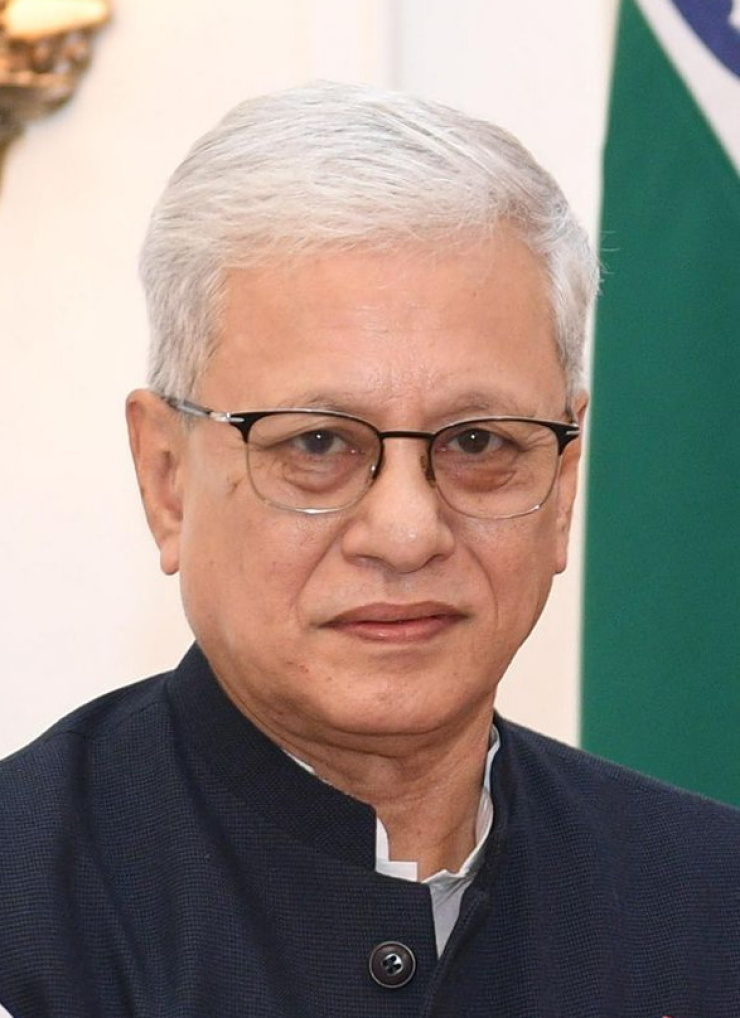
Maharashtra Governor Jishnu Dev Varma has forwarded the state’s Freedom of Religion Bill 2026 to President Draupadi Murmu for consideration and assent, after declining to sign it himself.
Officials said the Governor’s decision to refer the bill rather than clear it at the state level stemmed from its incorporation of provisions linked to the Bharatiya Nyaya Sanhita (BNS) and the Bharatiya Nagarik Suraksha Sanhita (BNSS), both of which appear in the Concurrent List under the Seventh Schedule of the Constitution. Because Concurrent List subjects fall within the jurisdiction of both the Centre and the states, the bill required referral to the President under Article 246. “Since this bill deals with the items on the concurrent list, like BNS, it has been sent to the President for consideration and assent,” an official told the Times of India. The bill can become law only after the President grants her assent.
The Maharashtra Freedom of Religion Act, 2026 prohibits religious conversions carried out through coercion, fraud, allurement, misrepresentation, undue influence or any fraudulent means, including conversions that take place in the context of marriage. Any such conversion is treated as legally void under the bill, as is any marriage entered into solely to facilitate an unlawful conversion.
For those who wish to convert through legitimate means, the bill prescribes a detailed procedure. A person intending to convert, and any institution organising the ceremony, must notify the District Magistrate 60 days in advance. That notice is then displayed publicly for 30 days to invite objections. Where objections are received, the competent authority may direct a police inquiry into the intent behind the proposed conversion. After the conversion takes place, the converted person must submit a formal declaration to the authorities within 21 days, failing which the conversion has no legal standing.
On penalties, the bill prescribes seven years’ imprisonment for a general offence of unlawful conversion, with a fine of one lakh rupees. Where the victim is a minor, a woman, a person of unsound mind or belongs to the Scheduled Castes or Scheduled Tribes, the fine rises to five lakh rupees. Simultaneous conversion of two or more persons, classified as mass conversion, draws the same enhanced penalty. Those previously convicted under the act who offend again face up to ten years in prison and a fine of seven lakh rupees. Offences under the act are non-bailable and will be heard by Sessions Courts. The bill places the burden of proof on the person who carried out the conversion, not on the complainant, a departure from the standard presumption of innocence.
On children born of marriages caused by unlawful conversion, the bill says such a child will be regarded as following the mother’s religion prior to the conversion, will retain succession rights from both parents, and custody will rest with the mother unless a court rules otherwise.
Chief Minister Devendra Fadnavis introduced the bill in the Legislative Assembly on March 13, 2026, during the budget session, and the Assembly passed it by voice vote on the night of March 16. The Legislative Council cleared it the following day. Fadnavis told the House the legislation was “100 per cent constitutional” and applied to all communities equally. “This Bill is not against any particular religion. It applies to all religions. It is meant to prevent religious conversions carried out through coercion, inducement, fraud or deception,” he said, adding that existing laws such as the BNS lacked specific provisions to deal with unlawful conversions.
The bill drew an unexpected political split. The ruling Mahayuti, led by the BJP, voted for it, but so did Shiv Sena (UBT), a constituent of the opposition Maha Vikas Aghadi, breaking ranks with its own alliance partners. Outside the House, Sena (UBT) chief Uddhav Thackeray said, “If anyone is converting by force or by taking advantage of someone’s helplessness and falsely luring them, we are against it. We support that Bill fully.”
The Congress, NCP (SP), Samajwadi Party and CPI (M) opposed the bill and demanded it be referred to a joint select committee. Congress MLA Aslam Shaikh questioned the public notice requirement, asking who would guarantee the safety of a person who declared an intention to convert. NCP (SP) MLA Jitendra Awhad called the title of the bill misleading, saying it represented not freedom of religion but “Dharma Niyantran, controlling religion.” Samajwadi Party MLA Rais Shaikh challenged the government’s data, pointing out that while the government had cited one lakh complaints of forced conversion, departmental records showed only 402 had been formally registered.
Voices from the Christian community, which accounts for less than one per cent of Maharashtra’s population, have been among the sharpest in their criticism. A pastor from the state, who asked not to be identified, told Christian Today: “It is sad that Maharashtra has brought one of the harshest anti-conversion laws in the country. There was no need for it except political dividends and positioning. Christians are not even 1% of the total population of the state and yet have contributed disproportionately to the well-being of our state and its peoples. This law is an attempt to criminalise our social involvement and to strike fear into the heart of the community. The worst part is that this law will embolden anti-social elements who routinely engage in violence against the community. And once accused, the accused must prove that he or she is innocent. It is contrary to the principles of natural justice and constitutional values.”
More than 30 organisations had come together before the bill’s passage to oppose it, arguing that it violated an individual’s right to choose their religion and marriage partner free from public scrutiny or state interference.
With the bill now at Rashtrapati Bhavan, Maharashtra joins a list of states whose anti-conversion legislation faces constitutional scrutiny. The Supreme Court of India is currently examining similar laws from 12 other states. President Murmu was in Maharashtra on April 16 and 17 for a visit to Sevagram Ashram in Wardha, where she met the Governor and state officials, but issued no statement on the bill during her visit.