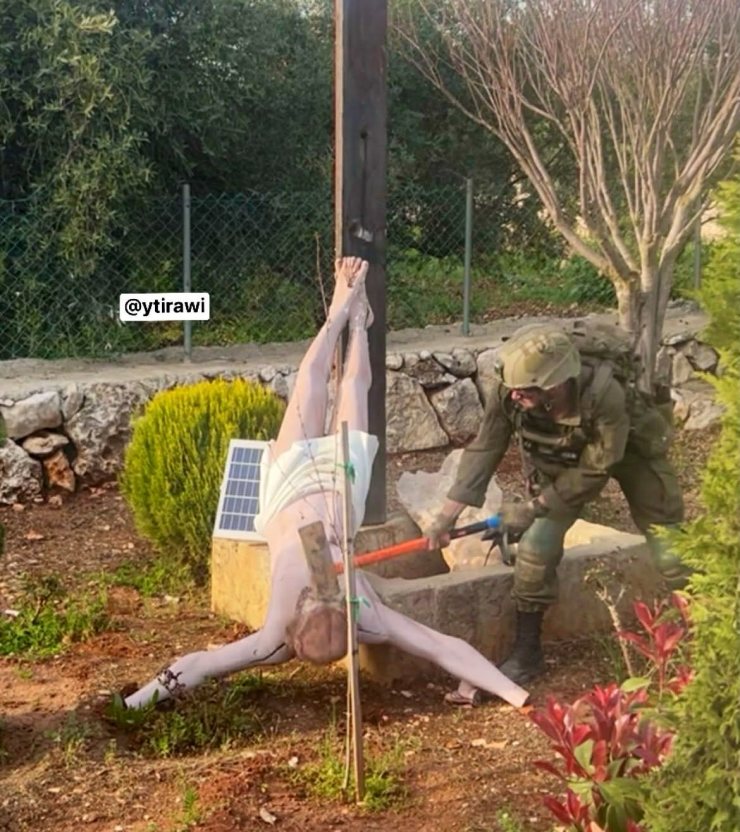
The Israel Defence Forces (IDF) announced on 21 April that two soldiers would be imprisoned and pulled out of active combat after one was photographed destroying a statue of Jesus Christ with a sledgehammer in a Christian village in southern Lebanon. The incident was not isolated: documented records and critics point to a sustained pattern of violence by Israeli soldiers and settlers against religious sites and Christian communities.
The photograph was posted on X on 19 April by Palestinian journalist Younis Tirawi (@ytirawi), showing a soldier attacking a fallen statue of the crucified Christ outside a family home in Debel, a Maronite Christian village near the Israeli border. It garnered over 10 million views. The IDF itself reshared Tirawi’s post when confirming the image’s authenticity the following day.
Father Fadi Flaifel, head of Debel’s congregation, told the BBC: “We totally reject the desecration of the cross, our sacred symbol, and all religious symbols. It goes against the declaration of human rights, and it doesn’t reflect civility.” He added pointedly that similar acts had occurred before. Maroun Nassif, deputy head of the village municipality, told CNN it was “an attack on our sacred beliefs.” The Assembly of Catholic Ordinaries of the Holy Land, in a statement signed by Cardinal Pierbattista Pizzaballa on 20 April, condemned the desecration and placed it within a pattern of attacks on Christian symbols by IDF soldiers in southern Lebanon, demanding accountability and firm assurances against repetition.
These voices find support in documented evidence. The Religious Freedom Data Centre recorded at least 201 incidents of violence against Christians in Israel between January 2024 and September 2025, with Orthodox Jews responsible for the bulk of attacks on clergy and those openly displaying Christian symbols, concentrated largely in Jerusalem’s Old City. A further 44 incidents were recorded in the first three months of 2026. Settlers also attacked or damaged dozens of mosques in the occupied West Bank last year, according to the Palestinian Authority’s Ministry of Religious Affairs. Israeli forces damaged or destroyed numerous mosques and churches during the war in Gaza.
Two Palestinian members of the Israeli parliament drew a direct line between the incident and what they described as a culture of impunity. Ahmad Tibi pointed to Israeli forces destroying places of worship in Gaza and attacking Christian clergy in Jerusalem without consequence. “When the Western world remains silent, racists go further,” he told Al Jazeera. Ayman Odeh was equally pointed. According to Al Jazeera, he wrote on social media: “We’ll wait to hear the police spokesperson claim that the soldier felt threatened by Jesus.”
The IDF said its inquiry found that the soldier who damaged the statue and another who recorded the act had acted in complete contradiction of military orders and values. Both were removed from frontline duty and sentenced to a month in military detention. Six others who witnessed the incident without acting or reporting it face separate proceedings. IDF Chief of Staff Lt. Gen. Eyal Zamir called the episode “a moral failure.” Soldiers subsequently installed a replacement crucifix in Debel in consultation with the local community.
Israeli Prime Minister Benjamin Netanyahu said he was “stunned and saddened” and condemned the act in the strongest terms. Foreign Minister Gideon Sa’ar called it “grave and disgraceful” and apologised to Christians whose sentiments had been hurt. US Ambassador Mike Huckabee demanded swift, severe and public consequences, calling it an “outrageous act.”
The vandalism occurred against the backdrop of an Israeli military campaign in Lebanon that has displaced over one million people and killed more than 2,290, including 177 children and 100 healthcare workers, according to Lebanese authorities. A US-brokered ceasefire is currently in force, though both sides have accused each other of violations.