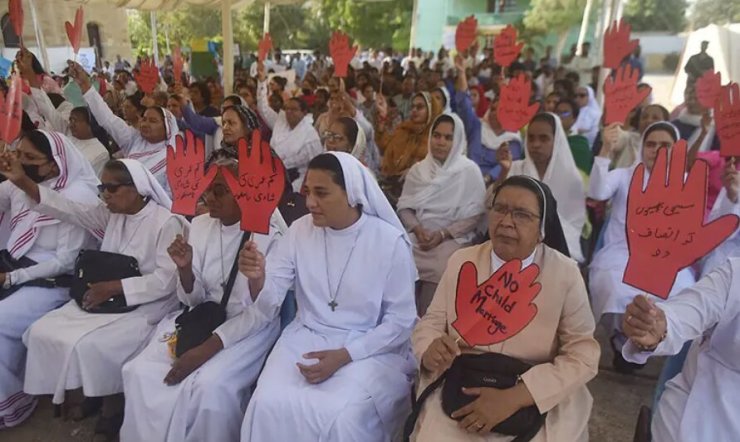
A Pakistani court’s decision to uphold the marriage of a 13-year-old Christian girl to the man accused of abducting her has triggered protests, international concern, and renewed demands for the protection of minority girls across the country.
On March 25, a two-judge panel of Pakistan’s Federal Constitutional Court (FCC) validated the marriage of Maria Shahbaz to Shehryar Ahmad, a 30-year-old Muslim man, and granted him her custody. Maria had disappeared from her home on July 29, 2025. Her family alleged she was kidnapped, forcibly converted to Islam, and married off against her will.
Within two days of her disappearance, Maria appeared before a magistrate and recorded a statement under Section 164 of the Criminal Procedure Code, claiming she was 18 years old, had converted willingly, and had married of her own free will. That statement became the foundation of the case. Her father, Shahbaz Masih, presented documentary proof that Maria was only 12 at the time of the alleged abduction, but the court dismissed the evidence as “unreliable,” with the judges stating she appeared older to them.
The District Sessions Court and the Lahore High Court had earlier dismissed the father’s petitions. The FCC has now upheld those decisions.
The ruling drew immediate condemnation from Pakistan’s Christian community. On April 14, hundreds gathered at St Patrick’s Cathedral in Karachi at a protest organised by the Catholic Archdiocese of Karachi in collaboration with the Catholic Commission for Justice and Peace (CCJP). Priests, nuns, civil society members, and political representatives attended, carrying placards reading “Stop forced conversion,” “Justice for Christian girls,” and “Child marriage is a crime.”
Archbishop Benny Mario Travas, who presided over the gathering, expressed deep concern over the ruling. “As Christians, we are a minority community. Many of us are living in poor economic conditions, which make them vulnerable people. Money and gifts can turn them into victims of their poverty,” he said. He urged lawyers and advocates to ensure the ruling did not become a legal precedent and called for the decision to be reviewed.
Kashif Anthony of the CCJP said the issue extended beyond the Christian community. “None of us can tolerate injustice, especially the injustice done to our little girls. The issue of underage marriages and forced conversion is not only faced by the Christian community but by other minorities also. Therefore, we all stand united against such injustices,” he said.
Human rights advocates described the case as part of a recurring pattern in Pakistan. Nasir Saeed, Director of CLAAS-UK, told Christian Today that girls from minority communities are abducted, forced to convert, and married off, often within days of their disappearance. A conversion certificate emerges, a marriage is claimed, and a statement is recorded before a magistrate asserting consent. Courts then rely on that statement to validate the marriage and dismiss allegations of coercion, frequently discounting official age documents in the process.
The Maria Shahbaz ruling has also cast a shadow over a separate case now before the FCC. Sonia Tariq, a 13-year-old Christian girl, went missing on November 7, 2024. Her father registered a kidnapping case, but when she was found, she gave a statement claiming she had converted to Islam of her own free will. The court accepted that statement and sent her to a government shelter, Dar-ul-Aman, rather than returning her to her family. She subsequently went missing again. Her case is scheduled to be heard by the FCC on April 15, 2026.
Saeed also raised alarm over both cases. “If the court accepts that a minor child can ‘choose’ such life-altering decisions without proper safeguards, it may leave many more girls exposed to manipulation, exploitation, and loss,” he said.
Several prominent voices joined the chorus of condemnation at the Karachi protest. Civil society activist Safina Javed, lawyer Younus S. Khan, social worker Zahid Farooq, and legislator Rooma Mushtaq Matto all criticised the FCC ruling and called for stronger legal safeguards.
Pakistan is a signatory to the Convention on the Rights of the Child and the Convention on the Elimination of All Forms of Discrimination Against Women. Human rights groups argue the FCC’s decision sits in direct conflict with those commitments.
The participants at the Karachi protest urged the FCC chief justice and the federal and provincial governments to review the Maria Shahbaz case and take effective measures to prevent forced religious conversions and underage marriages.