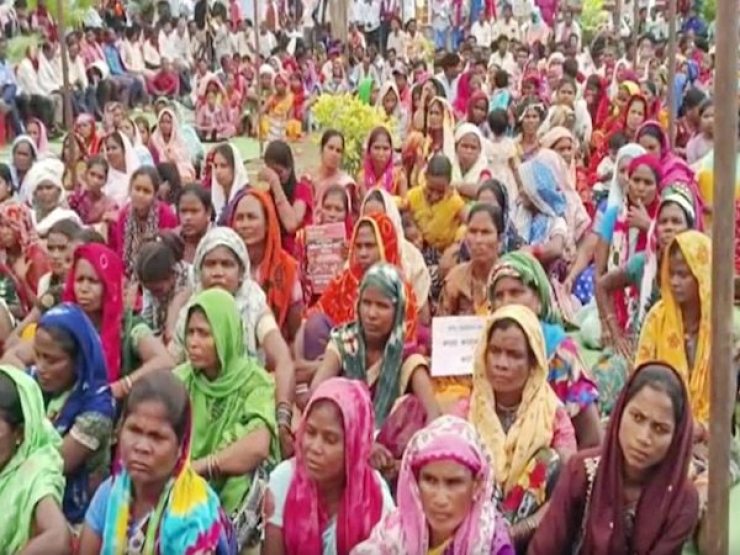
Christians from across Bastar division packed City Ground in Jagdalpur on April 13, marched through the town in a show of defiance, and submitted a memorandum addressed to the Governor and the President of India demanding the repeal of Chhattisgarh’s newly enacted anti-conversion law. Leaders warned that if the law was not withdrawn, the community would escalate its agitation across the state.
The protest was the latest in a series of demonstrations that have swept Chhattisgarh since the state assembly passed the Chhattisgarh Freedom of Religion Bill, 2026, on March 19. Thousands had marched with torches through the state capital Raipur on March 22, carrying placards and calling the legislation a “black law.” On March 28, the Samyukt Masih Samaj attempted to march on Lok Bhavan, the state secretariat, but police stopped the demonstrators 500 metres short of their destination. Protests also took place in Jagdalpur, Soorajpur, and other towns, with demonstrators marching under the banners of the Christian Unity Forum, Bharat Mukti Morcha, Rashtriya Adivasi Ekta Parishad, and Rashtriya Pichhda Varg Morcha.
Community leaders have been forthright in their challenge to the law’s stated premise.
Arun Pannalal, president of the Chhattisgarh Christian Forum, which has documented persecution of Christians across the state for years, spoke to Christian Today: “We have watched this law being built brick by brick over two years, and now the governor has signed it. For the Christian community of Chhattisgarh, this is not an abstract constitutional question. The 1968 law that this replaces was already being used to file false FIRs against our pastors, priests and nuns. This new law is exponentially more dangerous. Two people praying together can now be treated as a mass conversion and their pastor can be sentenced to life imprisonment. The burden of proof falls on the accused. There is no bail. We have seen what organised hostility looks like in Bastar, Jashpur and Raigarh. This law hands those forces a weapon of enormous power. We will challenge it legally and we will not be silent.”
The Rev. Vijayesh Lal, General Secretary of the Evangelical Fellowship of India, the umbrella body for evangelicals in the country and charter member of the World Evangelical Alliance, offered his perspective while speaking to Christian Today: “The State has a legitimate role in preventing coercion or fraud,” he said. “But when that extends into requiring individuals to declare and subject their personal faith decisions to scrutiny, it raises serious constitutional concerns. We have seen in states like Uttar Pradesh how similar laws can be misused, leading to harassment and false accusations against ordinary Christians. These are issues we will continue to examine carefully, including, if necessary, through appropriate legal means.”
Nukesh Baghel, vice-president of Masih Samaj, told the media that not a single case of illegal conversion had been registered in Bastar, and that the law would be used to harass innocent people. He alleged that atrocities against Christians in Bastar were ongoing, and that people were being jailed, while families were being denied the basic right to bury their dead. The new law, he warned, would directly intensify this oppression. Advocate Deveshwar Banjare pointed out that 192 cases had been registered across Chhattisgarh under existing provisions, but that police had failed to prove a single charge. Fulsingh Kachlam of the Rashtriya Adivasi Ekta Manch said Adivasis were coming to Christianity of their own free will, and that the constitutional right to practise and propagate religion was being undermined. Leaders have also demanded that the word “allurement” be clearly defined in the law, warning that its vagueness will allow it to be deployed against any form of Christian charity or outreach.
Multiple petitions challenging the constitutional validity of similar laws in other states are currently pending before the Supreme Court, and Christian legal observers have questioned why the Chhattisgarh government pressed ahead regardless.
Governor Ramen Deka signed the bill into law and it came into effect on April 7. The legislation, which consists of six chapters and 31 sections, replaces the 1968 law. Chief Minister Vishnu Deo Sai said it would “stop conversions carried out by taking advantage of people’s poverty, and lack of education and knowledge.” Deputy Chief Minister Vijay Sharma, who also holds the Home portfolio, told the House that the older law had become inadequate “to effectively control the use of force, greed and fraudulent practices for conversion.” When the bill passed, BJP legislators broke into chants of “Jai Shri Ram” inside the assembly. The main opposition Indian National Congress boycotted the vote, calling for broader consultations and a referral to a Select Committee.
The law prohibits conversions carried out through force, fraud, coercion, inducement, or misrepresentation, including through digital platforms. Inducement is broadly defined to cover monetary benefits, gifts, employment, free education or medical facilities, promises of a better lifestyle, and marriage. Coercion encompasses psychological pressure, physical force, threats, and social boycott. The burden of proof in any prosecution lies with the person conducting the conversion. Anyone wishing to convert voluntarily must file a formal declaration with the District Magistrate at least sixty days in advance, as must the person conducting the conversion ritual. In cases of inter-faith marriages, the officiant must notify authorities at least sixty days before the wedding, and the competent authority may declare the marriage invalid if it finds conversion was its purpose.
Conviction for illegal conversion draws seven to ten years in prison and a fine of at least Rs 5 lakh. Offences involving a minor, a woman, a person of unsound mind, or a member of Scheduled Caste, Scheduled Tribe, or Other Backward Class communities attract ten to twenty years and a minimum fine of Rs 10 lakh. Those found guilty of mass conversion, defined as the conversion of two or more persons, face ten years to life imprisonment and a fine of at least Rs 25 lakh, with repeat offenders liable to life imprisonment. Special courts will be set up in every district to hear cases.
Through 2025 and into this year, hundreds of Christians have been evicted from their villages, attacked during worship, and denied food rations and burial rights across the state. Social boycott, now written explicitly into the new law’s definitions, has long been used as a weapon against Christian Adivasi families in Bastar and other districts, and rights groups warn the legislation will give it fresh legal legitimacy. Chhattisgarh joins several other BJP-governed states that have enacted similar laws in recent years.