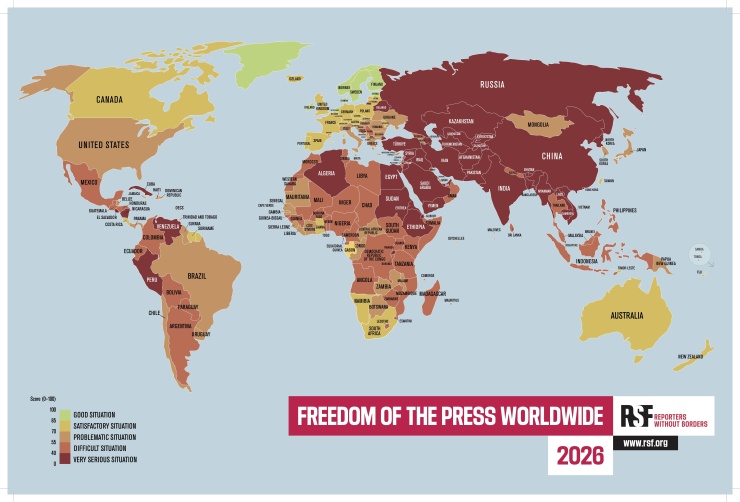
Press Freedom in India has deteriorated sharply according to the latest 2026 World Press Freedom Index released by Reporters Sans Frontières, a media watchdog. Out of 180 countries India ended up on the 157th position. Its position in 2025 was 151.
India ranked below every neighbour except China (178). It lagged behind Pakistan (153), Bangladesh (152), Bhutan (150), Sri Lanka (134) and Nepal (87). It also ranked one place below Palestine (156), where journalists have been killed in an active conflict zone.
The report employs rather strong language noting: “India’s media has fallen into an “unofficial state of emergency” since Narendra Modi came to power in 2014 and engineered a spectacular rapprochement between his party, the BJP, and the big families dominating the media.”
It goes on to point out that Mukesh Ambani described as a “close friend” of PM Modi, “owns more than 70 media outlets that are followed by at least 800 million Indians.” The report also points out to the acquisition of NDTV at the end of 2022 by Gautam Adani and called it the “end of pluralism in the mainstream media.”
The report highlighted the rise of “Godi Media” calling it “a play on Modi's name and the word for ‘lapdogs’”, and alleges that PM Modi who is known for not holding press conferences, “grants interviews only to journalists and YouTubers who cover him in a favourable light, and is highly critical of those who do not show allegiance.” The report also alleges that Indian journalists are targeted by BJP backed trolls.
Calling India one of the world’s most dangerous countries for media professionals the report points out that “an average of two to three journalists killed due to their work every year”, and that “Journalists who are critical of the government are routinely subjected to online harassment, intimidation, threats and physical attacks, as well as criminal prosecutions and arbitrary arrests.”
The legal framework and the Sociocultural context both have deteriorated as per the organization. The report mentions that while freedom of the press is not mentioned in the Indian constitution, it is protected by the fundamental right to freedom of expression. But it notes that governments, present as well as past, have used laws “such as those relating to sedition, defamation and anti-state activities, to suppress the media.”
It especially notes that PM Modi has brought in new legislations “that give the government extraordinary power to control the media, censor news and silence critics, including the 2023 Telecommunications Act, the 2023 Information Technology Amendment Rules, and the 2023 Digital Personal Data Protection Act.”
The report also noted that press freedom is on a downward trajectory in over half of the countries in the world and that they either fall into the ‘difficult’ or ‘very serious categories for press freedom. “In 25 years, the average score of all 180 countries and territories surveyed in the Index has never been so low,” the organization reported.
Out of the top 20 countries in the index 19 are from Europe with Norway topping the charts for the 10th year. Four Nordic countries are in the top 10 i.e. Norway, Denmark (4), Sweden (5), Finland (6) while Iceland is at number 12. Eretria is at the end of the index at the 180th spot just behind North Korea at 179.