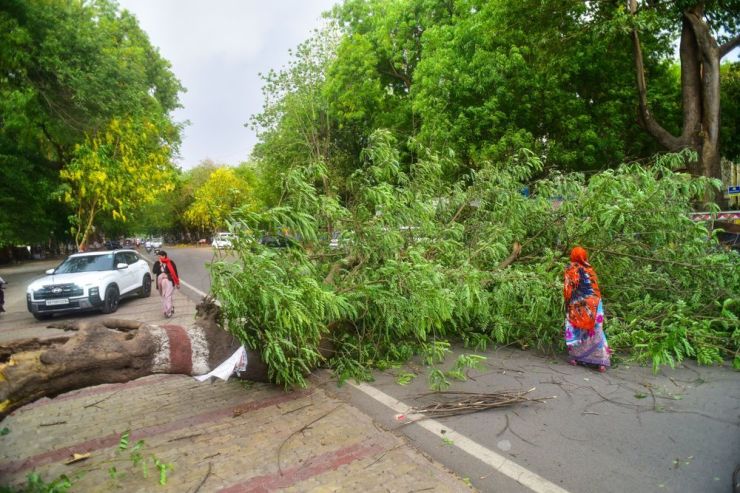
A ferocious thunderstorm tore through Uttar Pradesh, India’s most populous state, on Wednesday, May 13, killing at least 111 people across 26 districts, injuring dozens more, and leaving a wide trail of collapsed homes, snapped electricity poles, and damaged crops in its wake. By Thursday morning, the toll had climbed further as two more people died from live wires brought down by the storm.
The India Meteorological Department recorded wind gusts of up to 130 kmph in Bareilly and Prayagraj, 113 kmph in Chandauli, and over 100 kmph in several other districts. IMD senior scientist Mohammad Danish described the event as a thunder squall, a storm in which wind velocity builds and strikes with sudden, concentrated force. “It gives little time to people to take refuge at a safe place,” he told the media, which explained the extensive casualties across rural and semi-urban areas.
Prayagraj was the worst-affected district, recording 23 deaths. Mirzapur followed with 19, Sant Ravidas Nagar with 16, and Fatehpur with 11. Deaths were reported from 26 districts in all. The state government’s Relief Commissioner confirmed 72 injuries, the loss of 179 livestock, and damage to 227 houses.
The human cost fell hardest on the rural poor, whose mud-brick homes and tin-roofed shelters offered little resistance to winds of this force. Two young girls, Mausami, 10, and Rajni, 9, died in Budaun district after the mud wall of a hut they had sheltered in collapsed on them. In a nearby village, a woman named Laxmi died when a falling tree brought down the roof of a small pump house where several people had taken shelter. In Fatehpur district, eight people, five of them women, were killed in a single administrative block.
Residents described scenes of sudden, overwhelming chaos. “The storm came suddenly and the sky turned completely dark within minutes,” Ram Kishore told the Associated Press in Prayagraj. “Tin roofs were flying and people ran indoors. We could hear trees falling throughout the evening.” In Budaun, Savitri Devi told reporters her family barely escaped before the roof of their mud house caved in. “We rushed outside when the walls started shaking because of the wind. Our roof collapsed moments later,” she said.
One of the storm’s most dramatic episodes involved Nanhe Mian, an electric-rickshaw driver from a village near Bareilly, whose ordeal was captured on video and spread widely on social media. Caught outdoors as the storm struck on Wednesday evening, he tried to hold down a tin shed with a rope to stop it from being carried away. The wind lifted the shed, and Nanhe Mian with it, hurling him some 15 metres into the air before flinging him into a field roughly 100 metres away. He lost consciousness on landing and suffered fractures in one hand and one leg. Speaking to Dainik Bhaskar, a Hindi-language daily, after being discharged from hospital, he said: “When I flew up in the storm, I felt I would not survive. It is a miracle that I am alive.”

Thursday brought fresh casualties from a different hazard. In Rampur, a revenue official named Harish Kumar Gangwar was killed when his neck became entangled in a live wire hanging loose from a storm-damaged pole. In Moradabad, a worker named Salim, heading to a brick kiln at dawn, did not see a fallen high-voltage line lying across a field and was electrocuted.
The storm also disrupted mobile networks across affected areas, hampering rescue coordination and slowing damage assessment.
Chief Minister Yogi Adityanath, the head of Uttar Pradesh’s state government, directed district officials to reach affected areas within 24 hours and warned that negligence would not be tolerated. Each bereaved family will receive 400,000 rupees, approximately 4,800 US dollars, from the state disaster relief fund, with additional compensation for property damage and livestock losses.
The main opposition Samajwadi Party called on the government to mount relief efforts urgently, with its president Akhilesh Yadav posting on X: “The government should immediately carry out relief and rescue work on a war footing.”
Russian President Vladimir Putin conveyed condolences to India’s president and prime minister. The UAE foreign ministry and Singapore’s High Commissioner to India also expressed grief over the loss of life.
Meteorologists noted that hailstorms of such intensity are unusual in mid-May, when Uttar Pradesh, home to more than 240 million people, roughly the population of Brazil, is typically locked in peak summer heat exceeding 40 degrees Celsius, with the monsoon still weeks away. The scale of Wednesday’s destruction was by any measure exceptional.