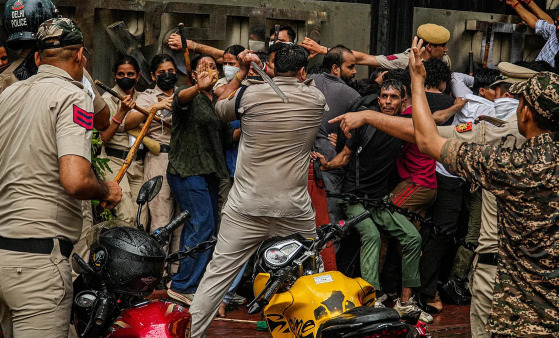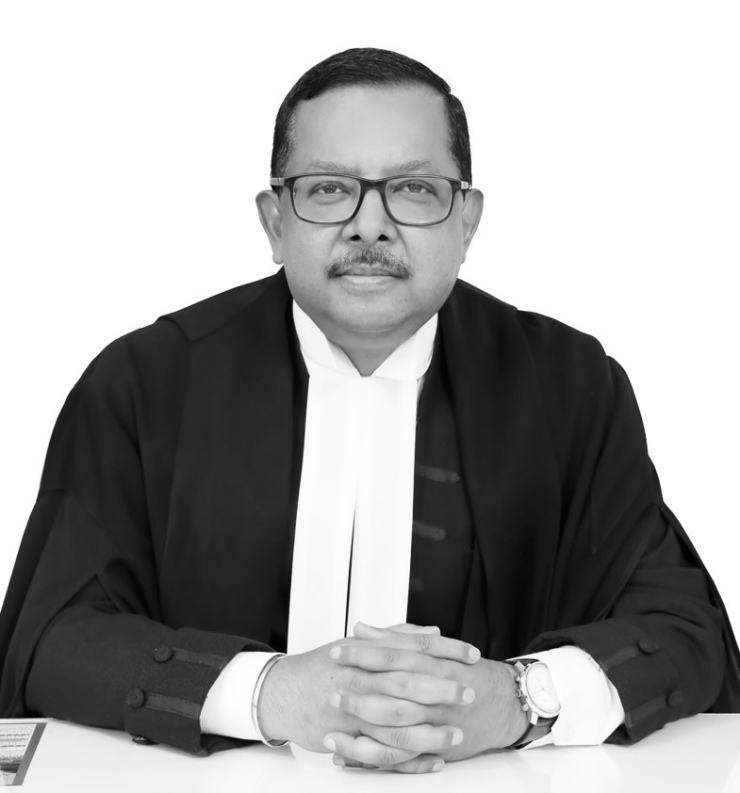
Supreme Court judge Justice Ujjal Bhuyan said on Saturday, July 25, that the room for democratic dissent is narrowing in India, telling an audience at the National Law Institute University (NLIU), Bhopal, that students, activists and ordinary citizens are being turned into accused persons simply for taking to the streets or speaking their mind.
Delivering the 4th Justice G.P. Singh Memorial Lecture, Justice Bhuyan argued that open argument and disagreement, which ought to be the ordinary business of any democracy, are instead drawing arrests, long spells in custody and bail orders loaded with conditions. “It will not be an exaggeration to say that public space for expressing divergent opinion is shrinking in India,” he said, adding that “even formal activities are criminalised.”
He cited the case of 14 Muslim youths arrested in March in Varanasi after they ate chicken biryani on a boat on the Ganga during an iftar gathering in Ramzan. The youths were booked under Sections 298 and 299 of the Bharatiya Nyaya Sanhita for allegedly outraging religious feelings and promoting enmity, besides being accused of violating the Water Pollution Control Act. “I am sure consuming chicken biryani is not an offence. There is no law prohibiting consumption of chicken over the Ganga river; they were arrested for that very reason and they had to remain in jail for three months,” Justice Bhuyan said. “Can people be arrested and denied bail for 3 months for such an activity, I ask myself! Citizens are watching, people are watching.”
The judge also referred to a case where a person was booked after posting on Facebook about a minister’s remark calling a serving Army officer “a daughter of a terrorist.” He noted that although the person was granted anticipatory bail, the court directed him to deposit his passport despite there being no flight risk, and barred him from posting on Facebook. He additionally pointed to the Gulfisha case linked to the Delhi riots, where student activists granted bail were restrained from attending or addressing public meetings, physically or virtually. “Imposing such restrictive conditions severely undermines their fundamental freedoms and liberty,” he said.
On student protests, Justice Bhuyan said campus demonstrators are frequently arrested and kept without bail for 30 to 40 days. Such students are often suspended by their institutions too, he said, leaving them with no option but to move court to get back into their studies. He also referred to environmental protesters being “chased away as if they are criminals.” Separately, he brought up the Supreme Court’s 2024 ruling against punitive “bulldozer justice,” calling it welcome but “two years too late.”
Turning to the Bombay High Court’s refusal to permit a demonstration in solidarity with Palestine, sought by the Communist Party of India (Marxist) in Mumbai, Justice Bhuyan said he found the court’s observations “very amusing.” He recalled the high court asking petitioners why they wanted to protest events in Gaza instead of issues in India, and remarks suggesting that speaking for Gaza was not “patriotism.” Justice Bhuyan pointed out that India has traditionally recognised Palestine and hosts a Palestinian Embassy, and referred to South Africa’s genocide case at the International Court of Justice as well as a UN-accepted report by Justice Muralidhar, a former Orissa High Court judge, on violence in Gaza.
On the judiciary, Justice Bhuyan said judges who take up political roles right after retiring end up blurring the line between the judiciary and the executive, referring to a former Chief Justice of India’s stated plan to join the Rajya Sabha to “bridge the gap” between the two. “If we have two legs at one place, the stool will fall apart,” he said, describing the remark as a violation of the separation of powers. He further defended the Kesavananda Bharati judgment, which held that the basic structure of the Constitution cannot be altered, criticising former Vice President Jagdeep Dhankar and the former CJI for questioning its jurisprudential legitimacy.
Justice Bhuyan closed by telling students and young lawyers to keep questioning institutions, including the judiciary. “Judgments, after being delivered, are required to be critically examined and criticised if necessary. Criticism of a judgment does not amount to criticism of a judge,” he said, adding that he saw “great hope” in the current generation of law students.