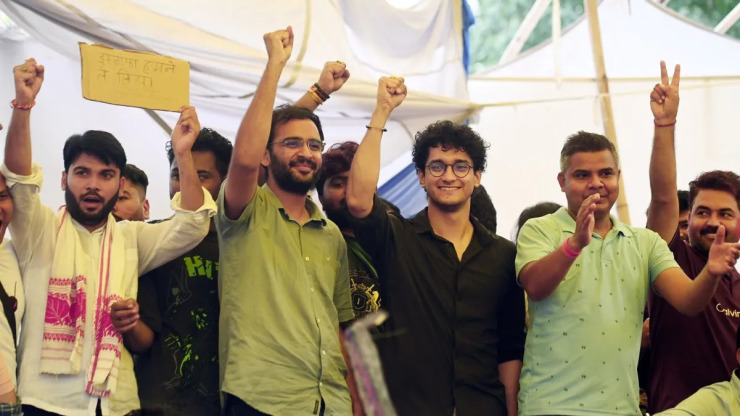
The Cockroach Janta Party’s stand-off with the Modi government appeared to end on July 25, when Union Education Minister Dharmendra Pradhan resigned and CJP called off its 36-day protest at Jantar Mantar. Over the following days, the truce came under strain from several directions at once: CJP accused state governments of detaining protesters despite Centre assurances, a Bihar policeman was caught on video firing an AK-47, a police diary entry contradicted Delhi Police’s own public denial that pellet guns had been used on July 20, and pellet-injury victims moved the Supreme Court.
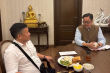
The breakthrough followed two rounds of talks. On July 24, CJP spokespersons Saurav Das and Ashutosh Ranka met Union Ministers J.P. Nadda and Jitendra Singh and placed three demands in writing: Pradhan’s resignation, compensation for the families of students who died by suicide over the NEET-UG irregularities, and withdrawal of all FIRs against protesters. On compensation and FIR withdrawal, the government signalled it could go along; on Pradhan’s resignation, it asked for a further day before responding. Ranka warned that a bigger, nationwide round of protests would follow within a day or two if the minister did not go, and Dipke said the youth would next start demanding Prime Minister Narendra Modi’s own resignation. Sonam Wangchuk had already ended his 26-day hunger strike late on July 23, in the presence of Nadda and Jitendra Singh, after written assurances from the government.
Hours before the two sides were due to meet again on the afternoon of July 25, police used tear gas on protesters still camped at Jantar Mantar. Pradhan announced his decision on X around the same time. “I have sent my resignation letter to Prime Minister Narendra Modi,” he wrote, adding that the situation at Jantar Mantar and elsewhere should not be exploited by “antinational forces,” and that he deeply respected “the aspirations, feelings, and legitimate expectations of the country’s youth.”
That evening, Nadda and Jitendra Singh appeared alongside Das and Ranka at a joint press conference, where the government confirmed it would withdraw FIRs against protesters and consider compensation for the NEET-related deaths. “All our demands have been accepted, so we request the protesters to withdraw immediately and return home peacefully,” Ranka told reporters, and CJP said it was ending the agitation “in good faith.” President Droupadi Murmu accepted Pradhan’s resignation that evening under Article 75(2), and gave Union Cabinet Minister Pralhad Joshi additional charge of the Education Ministry, alongside his existing portfolios. Joshi said he would discharge the responsibility “with complete humility and a strong sense of responsibility.”
The calm did not last. On July 25 itself, opposition parties and student organisations called a Bihar Bandh over the paper leak and the police crackdown, and clashes broke out between demonstrators and police in several districts. Footage that spread rapidly online that day captured a Bihar police constable, later named as Abhishek Patel, discharging an AK-47 in the direction of students protesting in Siwan; he was suspended two days later, Superintendent of Police Puran Kumar Jha confirmed to ANI, with a departmental inquiry ordered. Bihar police have offered a different account of the same clashes, saying officers opened fire into the air after protesters struck first, that three people were wounded by bullets, that Jha himself was among several officers injured, and that police detained more than 400 people in the district.
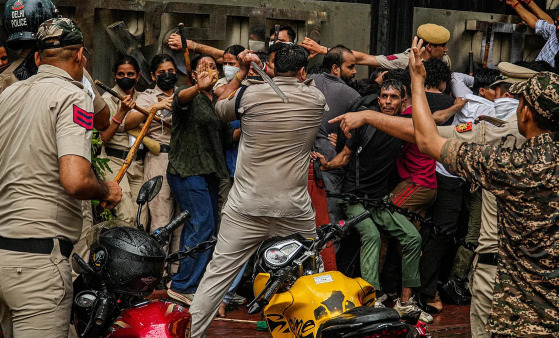
A parallel and more contested dispute developed over how Delhi Police had handled July 20. In the days that followed, the Deputy Commissioner of Police for New Delhi posted on X that “reports claiming that police forces are using pellet guns against peaceful protesters are completely false and misleading. The public is strongly advised not to share or circulate unverified content.” An internal CRPF inquiry later found that an RAF trooper stationed near Connaught Place had fired at least seven pellet rounds that evening, of which five hit people and two struck the ground; CRPF Director General Gyanendra Pratap Singh said a formal post-event assessment would follow.
Then, on July 28, The Hindu reported it had examined a general diary entry, filed at Parliament Street police station in the early hours after the operation, showing the RAF had fired 55 rounds of non-electrical shells, 15 of electrical shells, five tear gas shells, and two rounds of ballistic cartridges loaded with plastic pellets that evening, all “on the orders of the DCP.” Separately, RAF Inspector General Seema Dhundhia is reported to have told colleagues privately that the force’s handling of the crowd did not meet its own training benchmarks, a judgment that followed an internal review turning up a number of operational lapses.
Among those hit was Irshad Sheikh, 25, also named in some reports as Shaikh Irshad Mansoori. Sahil Lochab, a 19-year-old Delhi University student, was also struck; his family says a pellet pierced his pupil and left him at risk of losing vision in his right eye. A third victim, a 28-year-old journalist with Outlook, was not publicly named. A 32-year-old Gurugram resident, Nutan, has separately told The Hindu she suffered a gunshot wound to her right ear near a fountain in the park by Jantar Mantar, and that she was discharged from RML Hospital only 15 minutes after a two-hour surgery; her discharge summary records “trauma to right ear by gunshot.”
Delhi Police said her Medical Legal Report attributed the injury to a blunt weapon rather than a firearm. On July 27, Sheikh and Prashant Kumar Singh, another of those hurt, filed a public interest litigation in the Supreme Court along with Yashovardhan Azad, a former special director of the Intelligence Bureau, seeking a ban on metallic pellet guns for crowd control and compensation for victims. Rahul Gandhi, who had written to Union Home Minister Amit Shah on July 26 over what he called “the barbaric assault on students,” renewed the charge on July 27: “The entire system is downright murderous against students... In Delhi, pellet guns were fired at students, and in Bihar, AK-47s. Whether it’s Uttar Pradesh, West Bengal, Bihar, or Delhi, the pattern is the same everywhere.”
CJP flagged a separate breach of trust the same day. On July 27, Saurav Das posted that CJP was “deeply concerned by multiple reports reaching us of students and other protestors being targeted, detained, or arrested by various state agencies, particularly in Assam, West Bengal, and Bihar,” adding that CJP had called off its protest “only after the Government of India assured us that no punitive action would be taken against any protester.” Ranka warned CJP would be “forced to sit on protest again” if the FIRs were not withdrawn.
The warning was answered within about a day and a half. On the night of July 27, the Bihar and Assam governments issued formal notifications promising that no punitive or retaliatory action would be taken against anyone who had joined the protests before 6 pm on July 26, that all FIRs registered against them before that time would be withdrawn, and that those already arrested or detained would be released. Bihar’s notification, issued by special secretary Kshtranil Singh, and Assam’s, signed by chief secretary Ajay Tewari, used near-identical language. Das, calling it a major win, said shortly after midnight that Rajasthan had given a similar verbal guarantee.
The assurance in Bihar followed newspaper advertisements that had carried photographs of roughly 300 people, including minors, pulled from social media accounts and described as troublemakers, seeking information about them; the student body AISA said its president, Neha Bora, had met Bihar’s Director General of Police, Vinay Kumar, to press for the withdrawal of cases. Thirteen people had been arrested in Assam, including three Muslim men whom The Wire reported had been detained while trying to organise a solidarity protest.
The Supreme Court took up the pellet-gun and police-conduct petitions on July 27, having agreed on July 24 to list them after advocate Gopal Sankaranarayanan told the bench that force was being used against children. A bench led by Chief Justice of India Surya Kant, with Justices Joymalya Bagchi and V Mohana, observed: “The right to peaceful protest is absolutely guaranteed... Merely because there is agitation cannot justify police excess.” Kant also disputed earlier reports that he had refused to fast-track a related brutality complaint, saying those accounts were inaccurate and that no such petition had in fact come before him.
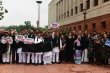
Inside Parliament, the disruption has not fully eased. Opposition MPs, including Rahul Gandhi, Priyanka Gandhi Vadra and Akhilesh Yadav, gathered at the Makar Dwar on July 27, demanding an apology from Amit Shah over the police response. Delhi Police, for its part, denied a separate CJP allegation that Wangchuk’s wife, Gitanjali Angmo, had her hair pulled and was assaulted, along with claims that dozens of other protesters, including a 12-year-old girl, were injured, calling the reports “completely false and misleading” and adding that “no individuals were subjected to targeted assault.”
The political temperature over Pradhan’s exit has spread beyond Delhi. In Kerala, the Central University of Kerala drew a backlash after its official social media accounts praised Pradhan’s tenure and wished him well; former state education minister V Sivankutty accused the BJP and RSS of using such institutions to expand their influence, saying the post “could have been avoided.”
Wangchuk himself was discharged from Medanta Hospital on July 27. In a video message, he said his first stop would be Rajghat to pay tribute to Mahatma Gandhi, “and then back to the mountains,” before returning home to Ladakh.
By July 26, the site itself looked almost unrecognisable from its weeks as a protest camp: the New Delhi Municipal Council had hauled away close to 60 metric tonnes of debris, painted over the stretch of wall protesters had covered with slogans and images of the crackdown, and Delhi Metro reopened every station it had shut for security reasons. Police kept a lighter presence at the site itself, with some barricades still up and entry kept restricted.
Eight days after tens of thousands of protesters first set out for Parliament, and three days after the government’s biggest concession, the question at the centre of CJP’s original march, accountability for the NEET-UG paper leak, has given way to several others: whether the assurances that ended the protest will hold in the states where they are still being tested, and whether the account of what happened to protesters on July 20 will be settled by the government’s public statements or by the paper trail now emerging against them.