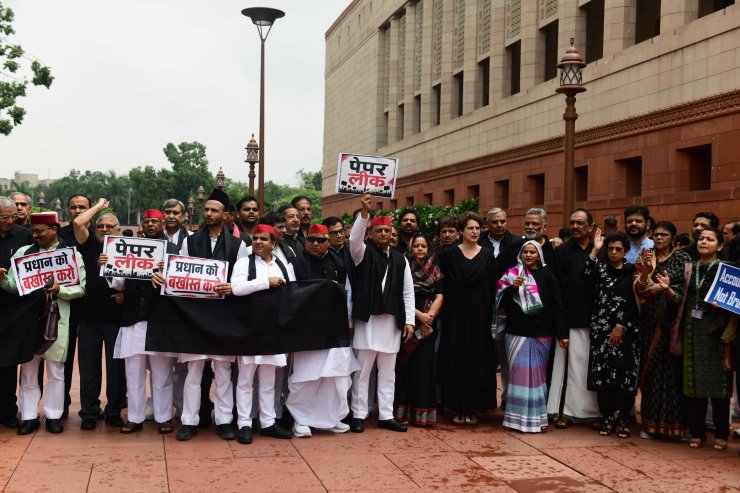
A day after being detained outside the Prime Minister’s residence, Rahul Gandhi and Opposition MPs from the INDIA bloc turned up in Parliament on Wednesday wearing black, marking what they called a “Black Day” over alleged irregularities in NEET and the police action against protesting students.
Priyanka Gandhi Vadra, Mallikarjun Kharge, Samajwadi Party chief Akhilesh Yadav, Trinamool Congress MP Mahua Moitra, JMM MP Mahua Maji and other Opposition leaders gathered in black at Makar Dwar on the Monsoon Session’s third day, raising slogans that sought Education Minister Dharmendra Pradhan’s resignation and justice for students.
Akhilesh Yadav asked what was stopping the government from removing the minister, and called black the colour of both protest and grief: “Black is the colour of protest; it is also the colour of grief.” JMM MP Mahua Maji said the effort was about students, not politics, adding, “Opposition stands united.”
Priyanka Gandhi Vadra told reporters the treatment of Opposition MPs mattered less than the students’ cause: “students have genuine demands and are asking for their rights.” She said the Centre had cleared Rs 16 lakh crore in loans for business houses such as Adani and Ambani against an education budget of Rs 1.4 lakh crore, even as paper leaks recurred, and argued peaceful protest was not undemocratic. Kharge accused the government of behaving “like a dictatorship,” alleged BJP-RSS members were present alongside police, and cautioned against attempts to intimidate the Opposition.
Government sources said earlier on Wednesday that the Centre had acted swiftly once the paper leak surfaced, and called the demand for Pradhan’s resignation “politically motivated.” A CBI probe was under way, they said, with over 13 people already arrested, and the government stood ready for a full Parliament discussion. They also cited Modi’s remark a day earlier calling the paper leak “ghor paap,” a grave sin.
Pradhan himself had attacked Gandhi on Tuesday night, accusing him and the Congress of “exploiting students.” On X, he said the party had chosen political theatre over the government’s offer of talks, and that the real aim was confrontation, not solutions for students.
That followed a day of upheaval on Tuesday, when Gandhi, Priyanka Gandhi Vadra and other Congress leaders were picked up by police during a sit-in near the PM’s residence at Lok Kalyan Marg, and released close to 9 pm. From custody, Gandhi issued a video listing five demands: Shah and Pradhan’s resignations; action against policemen accused of assaulting students and withdrawal of cases against them; a prime ministerial apology for Monday’s crackdown; a Parliament debate on the issue; and prompt reforms to education and examinations.
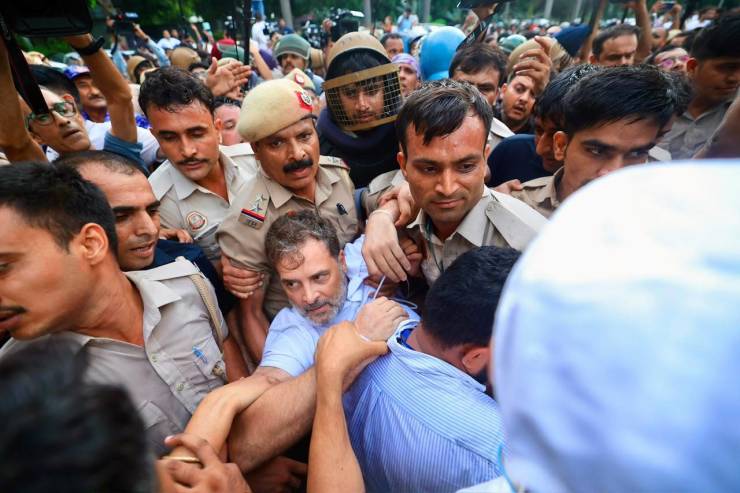
The detentions followed a roughly 100 metre walk by Gandhi’s contingent, joined by Akhilesh Yadav, from Kharge’s residence to the rear gate of the PM’s house, which caught Delhi Police off guard. Officers spent nearly three hours attempting to negotiate before clearing the spot. Gandhi went limp as police tried to move him and was eventually put on a bus, while his sister was driven to Mandir Marg station. From Chhatrasal Stadium, where Gandhi was held, Congress general secretary K.C. Venugopal called it the “beginning of the end” for the government.
Earlier that day, Gandhi and other MPs had asked Lok Sabha Speaker Om Birla for House time to discuss the police response to students. The anger traced to Monday, the Monsoon Session’s opening day, when police moved against Cockroach Janta Party-aligned protesters heading for Parliament, prompting adjournments in both Houses. Gandhi that day called Modi “the most anti-youth Prime Minister India has ever had” and put the number of paper leaks at 152, affecting 7.5 crore students. Priyanka Gandhi Vadra separately called the paper leak “a genuine issue” the party had long sought to raise.