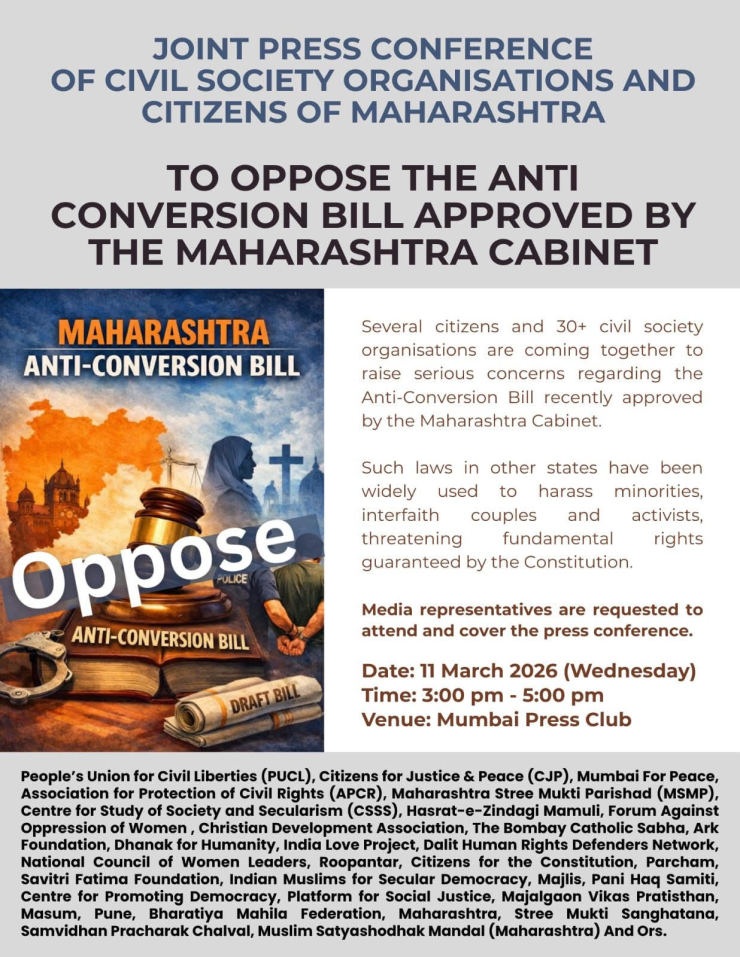
More than 30 civil society organisations, church groups, and legal advocates came together at the Mumbai Press Club on 11 March to oppose Maharashtra’s proposed anti-conversion legislation, even as the bill awaits introduction in the state assembly’s ongoing Budget Session.
The joint press conference, held on Wednesday afternoon, brought together organisations ranging from the People’s Union for Civil Liberties and Citizens for Justice and Peace to the Bombay Catholic Sabha, the Dalit Human Rights Defenders Network, Maharashtra Stree Mukti Parishad, Forum Against Oppression of Women, India Love Project, Indian Muslims for Secular Democracy, and Muslim Satyashodhak Mandal, among others. Together they demanded that the draft bill be released publicly before it is tabled, and that adequate consultation and legislative scrutiny through a Standing Committee follow.
“We are perturbed by the secrecy in which the Bill is being brought in with zero public consultation,” the coalition said in a statement, warning that the bill could be pushed through the assembly without adequate debate or legislative scrutiny. They noted further that laws of this kind in other states had been used to harass interfaith couples and minorities, and had placed women under pressure from family and community in ways that violated their autonomy.
Speaking to Christian Today, John Dayal, veteran human rights activist, editor and Spokesperson for the All India Catholic Union, placed the Maharashtra bill in a wider and more alarming political context. “The Bharatiya Janata Party politicians seem to be in a competitive race in states they govern to see how they can corral Christians and Muslims with increasingly harsh rules and punishments,” he said. “Even as Maharashtra proposes this anti-conversion law, party men in Chhattisgarh are talking of the death penalty for anyone who persuades his wife to join his religion. These are political motives, anti-constitutional in their extreme.” Dayal called the bill “the same old legislation that has failed the constitutional test across twelve states,” adding that it “criminalises conscience and makes citizens prisoners to the bigotry of relatives, neighbours, even strangers.” That the government had brought it in through the back door, without releasing the text or consulting citizens, while the Supreme Court was actively hearing a petition on precisely such laws, he said, “tells you everything about the intent behind it.” He said the bill would be opposed in the public sphere and in court.
Rev. Vijayesh Lal, General Secretary of the Evangelical Fellowship of India, speaking to Christian Today, drew on his organisation’s decade-long documentation of how such laws operate on the ground. “The picture is consistent: pastors arrested, evangelists detained, communities that serve the poor treated as suspects,” he said. “The provision allowing a blood relative to trigger criminal proceedings against an adult’s personal choice of faith hands family pressure the force of law, and makes women especially hostage to patriarchal control dressed up as religious protection. We have challenged such laws in the courts before, and we will do so again.” The EFI has independently challenged anti-conversion laws in the High Courts of Jharkhand, Karnataka and Himachal Pradesh over the past decade.
Advocate Lara Jesani of the People’s Union for Civil Liberties, who has represented many interfaith couples, questioned whether the legislation was necessary at all. She pointed out that demands for an anti-conversion law in Maharashtra had intensified following the 2022 Shraddha Walkar murder case, even though that case involved no marriage and no forced conversion. In fact, she noted, Shraddha had refused to heed her father’s pleas to return home. “Anti-conversion laws only make it more unsafe for such couples,” she said, warning that the bill could prevent young people from exercising their constitutional right to marry across religious lines. For a secular country, she added, this should not be acceptable.
The Bombay Archdiocese said in a statement on 10 March that it had serious reservations about provisions of the draft law that undermine personal freedom of conscience. The 60-day notice requirement, it said, “reduces religion from a matter of conscience to a matter of state permission,” and “no citizen should need state approval to respond to the voice of one’s conscience, or to any sincere conviction.” The provision allowing blood relatives to trigger police action through complaints, without safeguards against malice, “opens the door to abuse,” the archdiocese said, urging the government to reconsider problematic clauses and ensure that any legislation respects both liberty and justice.
Auxiliary Bishop Savio Fernandes of Bombay acknowledged that preventing conversions through force, fraud or inducement were “legitimate concerns in any society,” but cautioned that existing criminal laws could address them, and that laws of this nature could be widely misused. He pointed to a significant Supreme Court ruling in a Uttar Pradesh case where five FIRs filed under the anti-conversion law were quashed, with the bench warning that “criminal law cannot be allowed to be made a tool of harassment of innocent persons.” He called for clear definitions of what constitutes coercion or unlawful inducement, the requirement of credible evidence, transparent procedures, and proportionate penalties when complaints are made in bad faith. Any legislation concerning religious conversion, he said, must apply uniformly across communities and must not intrude on an individual’s autonomy of belief or impose undue burdens on voluntary religious conversion.
The Maharashtra cabinet had approved the draft bill, named Dharma Swatantrya Adhiniyam 2026, on 5 March. It proposes up to seven years in prison and a fine of Rs 5 lakh for unlawful or forced religious conversions. A person wishing to change their religion must give 60 days notice to a designated district authority. The conversion must then be registered within 25 days, failing which it stands null and void. If a blood relative files a First Information Report alleging unlawful conversion, the police are required to register and investigate the complaint. All offences under the bill are non-bailable. The bill’s text has not been made public.
Fisheries Minister Nitesh Rane of the BJP, who announced the cabinet decision, described the bill as a law against “love jihad,” a Hindutva conspiracy theory that Muslim men trick Hindu women into relationships with the aim of converting them to Islam, and a term the Union Home Ministry has told Parliament has no legal definition in Indian law. Rane claimed the bill would be stricter than similar legislation already in force in Madhya Pradesh and Gujarat. “This is a law against unlawful conversion and with this bill no one will be able to forcibly marry and convert Hindu girls,” he told reporters.
If the assembly passes the bill, Maharashtra will become the 13th Indian state to enact such a law. The Supreme Court is already examining a petition contending that anti-conversion laws across twelve states criminalise voluntary change of faith, with notices issued to the governments of Himachal Pradesh, Odisha, Karnataka, Uttar Pradesh, Uttarakhand, Haryana, Arunachal Pradesh, Madhya Pradesh, Chhattisgarh, Gujarat, Jharkhand and Rajasthan. The Union government has responded that states had sufficient grounds for such legislation and that a Constitution bench had already upheld its validity.