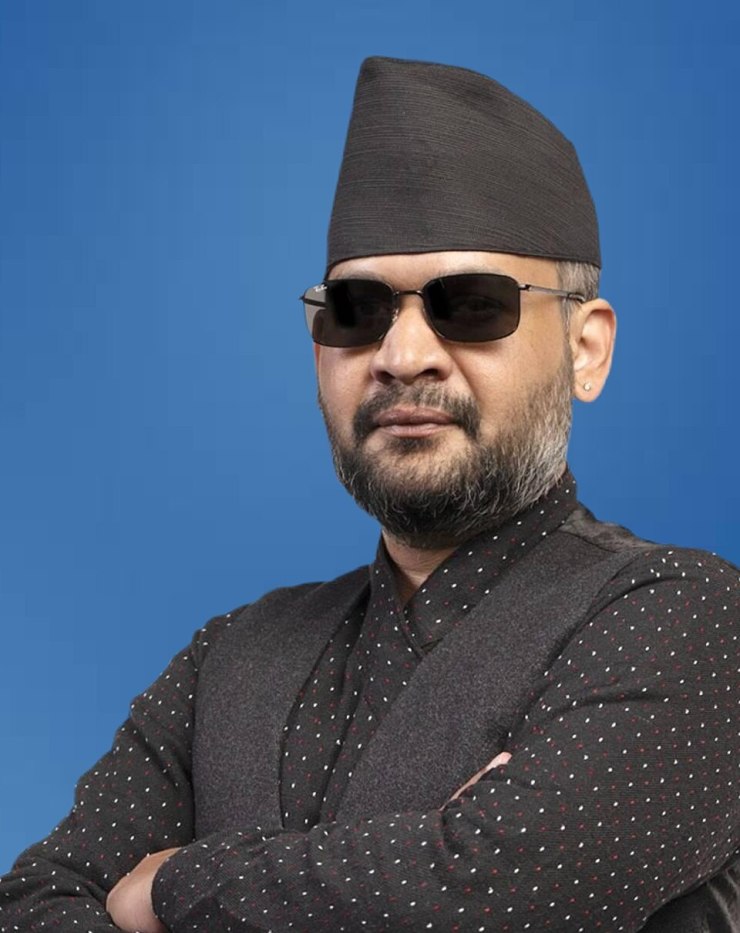
Nepal is on the verge of its most dramatic political transformation in decades. With vote counting nearly complete after the March 5 parliamentary elections, the Rastriya Swatantra Party (RSP) has swept to a commanding majority, and its candidate Balendra Shah, a 35-year-old structural engineer and former rapper, is poised to become the country’s youngest-ever prime minister.
The RSP has secured 182 seats in the 275-member House of Representatives, just two short of a two-thirds supermajority. In the directly elected constituencies, the party won 125 of 165 seats. In the proportional representation count, it has garnered nearly half of all valid votes. With only about two per cent of ballots remaining to be tallied as on March 11, the scale of the mandate is no longer in doubt.
The Election Commission recorded approximately 60 per cent voter turnout among nearly 18.9 million registered voters, with strong participation from first-time young voters.
The result has reduced Nepal’s two dominant political forces to shadows of their former selves. The Nepali Congress, the largest party in the outgoing parliament, won only 18 directly elected seats. The Communist Party of Nepal (UML), led by former four-time prime minister KP Sharma Oli, won nine. The Hindu nationalist Rastriya Prajatantra Party, which had held 14 seats previously and campaigned to restore Nepal as a Hindu monarchy, was reduced to just one directly elected seat. Its proportional representation quota, which stood at 14 seats in the 2022 parliament, is also set to shrink to five.
Shah himself defeated Oli in the UML leader’s own stronghold of Jhapa-5 in eastern Nepal, winning 68,348 votes against Oli’s 18,734, a margin of nearly 50,000 votes.
The new parliament will have six parties: the RSP, the Nepali Congress, the UML, the Nepali Communist Party with 17 seats, the Shram Shakti Party with seven, and the Rastriya Prajatantra Party with five. One independent member also won a seat.
The path to government formation still involves several constitutional steps. Once the Election Commission submits its report to the president, he will call on RSP lawmakers to name their prime ministerial candidate. Constitutional law expert Bipin Adhikari, a professor at Kathmandu University, said the process may take more than a week. “Once the commission submits its report to the president, he will call on RSP lawmakers to name the prime ministerial candidate,” he said. “Only after that will his appointment take place.”
Shah’s journey to this moment is improbable by most measures. Born to a Madheshi (ethnic groups from the southern plains of Nepal) family from the southeastern Mithila region, he first came to national prominence in 2022 when he won the Kathmandu mayoral race as an independent, defeating candidates from both the Congress and the UML. He resigned as mayor in January 2026 to join the RSP, which declared him its candidate for prime minister. During the campaign, he contested Jhapa-5, Oli’s home turf, in a move that was equal parts symbolic and strategic. Videos of Nepalis copying Shah’s dancing during the campaign circulated widely online.
The RSP itself is barely four years old, founded in June 2022 by Rabi Lamichhane, a former television journalist. The party ran on a platform of anti-corruption measures, economic reform, and a pledge to create 1.2 million jobs to stem the exodus of young Nepalis seeking work abroad. It fielded a social media operation of over 660 people and drew heavily on financial support from Nepalis living overseas.
The elections were the first held since youth-led protests in September 2025 brought down the government of KP Sharma Oli, after his administration imposed a ban on social media platforms. What started as anger over that ban soon widened into a mass uprising demanding accountability, clean governance, and economic opportunity for ordinary Nepalis. Police fired on protesters, killing at least 19 people on September 8 alone. At least 76 people died in all, parliament was torched, and Oli resigned. Nepal’s president dissolved parliament and appointed former Chief Justice Sushila Karki as interim head of government, the first woman to hold the position in the country’s history. Young protest leaders who had been at the forefront of that movement threw their weight behind Shah as the election approached.
More than 40 per cent of Nepal’s population of nearly 30 million is under 35, yet the leaderships of the established parties had remained in their 70s. The generational fault line defined the campaign. Manoj Pradhananga, director of the Leadership Training Department of the National Christian Fellowship of Nepal, told Christian Today the youth surge was unlike anything Nepal had seen before. “Never ever in the history of Nepal, we have seen such an involvement of youths in the election and politics,” he said. “The mandate that the civilians have expressed through the ballots certainly reflects the hope of the younger generations. The RSP candidate for the prime minister is a young man. Many candidates who have won the elections are younger generations.”
Among the prominent casualties of that generational wave was Gagan Thapa, the newly elected president of the Nepali Congress and one of its most prominent younger figures, who lost his seat to an RSP candidate. Pushpa Kamal Dahal, the former Maoist leader who now heads the Nepali Communist Party, is the only former prime minister to have survived the RSP wave.
Nepal’s Christian community, which has navigated a complex legal landscape under the country’s constitution, viewed the outcome with particular interest. B P Khanal, a theologian, educator and political leader widely regarded as one of Nepal’s most distinguished Christian thinkers, told Christian Today he was watching the new government’s approach to constitutional rights closely. “My hope is that the new leadership will strengthen the nation’s commitment to constitutional rights, particularly the protection of freedom of religion or belief for all citizens,” he said. “A truly democratic society must ensure that people of every faith can worship, serve, and contribute to national life without fear or discrimination.”
While Nepal became a secular state in 2006 and the 2015 constitution formally enshrined freedom of religion, prohibitions on proselytism remained on the statute books. The Catholic Church, which established a presence in Nepal in 1950, has fewer than 10,000 members. Evangelical and Protestant churches, by contrast, count over one million adherents. Father Silas Bogati, apostolic administrator of the Apostolic Vicariate of Nepal, told EWTN News the result was “a mandate against all the misconduct of politicians and political parties,” adding that the scale of the swing had not surprised him. “This overwhelming change was expected as people were fed up with the leaders playing musical chairs,” he said. Gyan Rai, a retired pilot and head of the Nepal chapter of the Catholic lay network Couples for Christ, told EWTN News he welcomed the shift: “The political leadership has shifted out of the traditional political leaders and the youth takes over now.” Chirendra Satyal, a prominent Catholic convert, noted that the RPP, which had sought to restore Nepal as a Hindu kingdom, “has lost ground further this time,” adding that the results “hold out great hope for the Christians.”
The scale of the RSP victory has also prompted unease among political observers about democratic accountability. Political commentator Chandrakishore warned: “With a weak Opposition, the government may act waywardly and take wilful decisions. This could test democratic norms.” He added that the vigilance parliament should provide may need to come instead from the streets.
Journalist Rajendra Dahal, who has covered Nepal’s parliamentary politics extensively, observed the irony in the outcome. “The culture of Opposition-less governance established then has now become a reality. It was engineered by the old parties, but today it comes by electoral mandate,” he said. Others are more sanguine. Rajendra Phuyal, former secretary of the National Assembly, argued that quality of opposition matters as much as its size. “We need not see the Opposition numerically only; how effectively those on the other side of the aisle can play their role is more important,” he said.
International reactions arrived swiftly. India’s Prime Minister Narendra Modi offered congratulations, describing the elections as a “proud moment” in Nepal’s democratic journey. China’s Foreign Ministry spokesperson Mao Ning said Beijing was “glad to see Nepal advance its political agenda smoothly.”
For now, all eyes are on Shah, the engineer and former rapper from Madhesh, who appears set to walk into the office no one from his region has ever held.