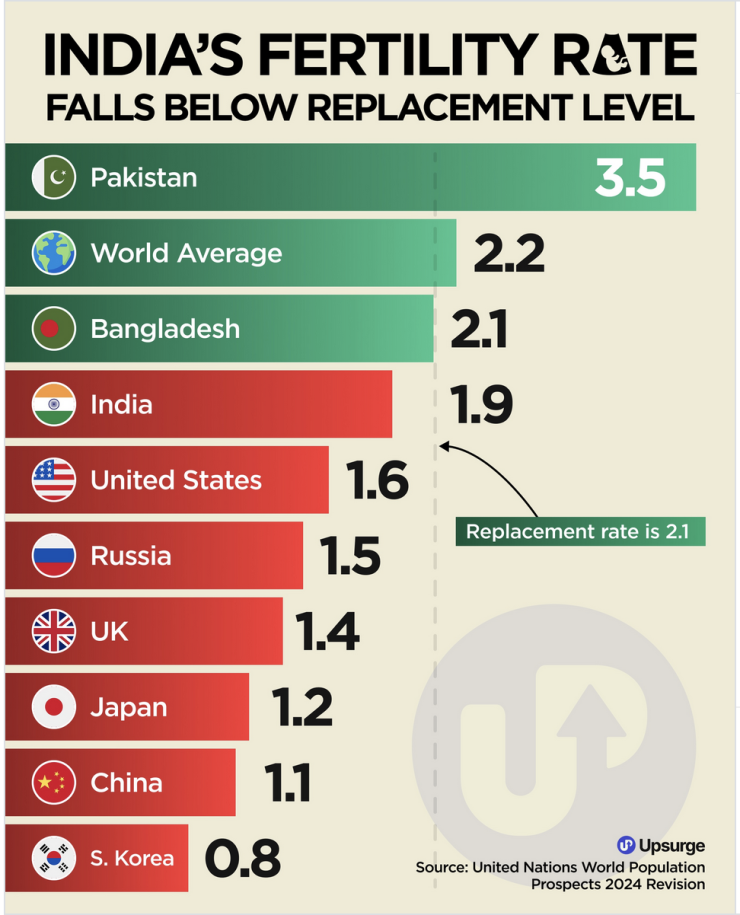
India’s Total Fertility Rate (TFR) has dropped to 1.9 children per woman, falling below the replacement level of 2.1 for the first time in the country’s recorded demographic history, according to the Sample Registration System (SRS) Statistical Report released by the Office of the Registrar General of India in May 2026.
The development drew wide attention after Tesla chief Elon Musk posted about it on X on June 6, writing, “India’s birth rate has fallen below replacement. Among those most educated, India’s birth rate fell below replacement many years ago.” He shared a graphic linked to a piece in The Economist.
The TFR measures how many children a woman is likely to bear across her reproductive lifetime. A figure below 2.1 means a population will eventually shrink without migration. India’s TFR has been declining for decades, from approximately 5.7 in the 1950s to 3.3 in the 2000s, and now to 1.9 during 2022-24, a fall of 17.4 per cent over the past decade alone. India’s infant mortality rate also fell sharply, from 30 per 1,000 live births in 2019 to 24 in 2024, which experts link directly to smaller desired family sizes.
Sharp divides across states and cities
The national figure masks considerable variation. Bihar recorded the highest TFR at 2.9, followed by Uttar Pradesh at 2.6, Madhya Pradesh at 2.4, and Rajasthan at 2.3. These are the only major states at or above replacement level. At the other end, Delhi recorded the country’s lowest at 1.2. Southern states including Tamil Nadu, Kerala, Karnataka, Andhra Pradesh and Telangana, all ranked among India’s better-developed states on the Human Development Index, registered rates between 1.3 and 1.5.
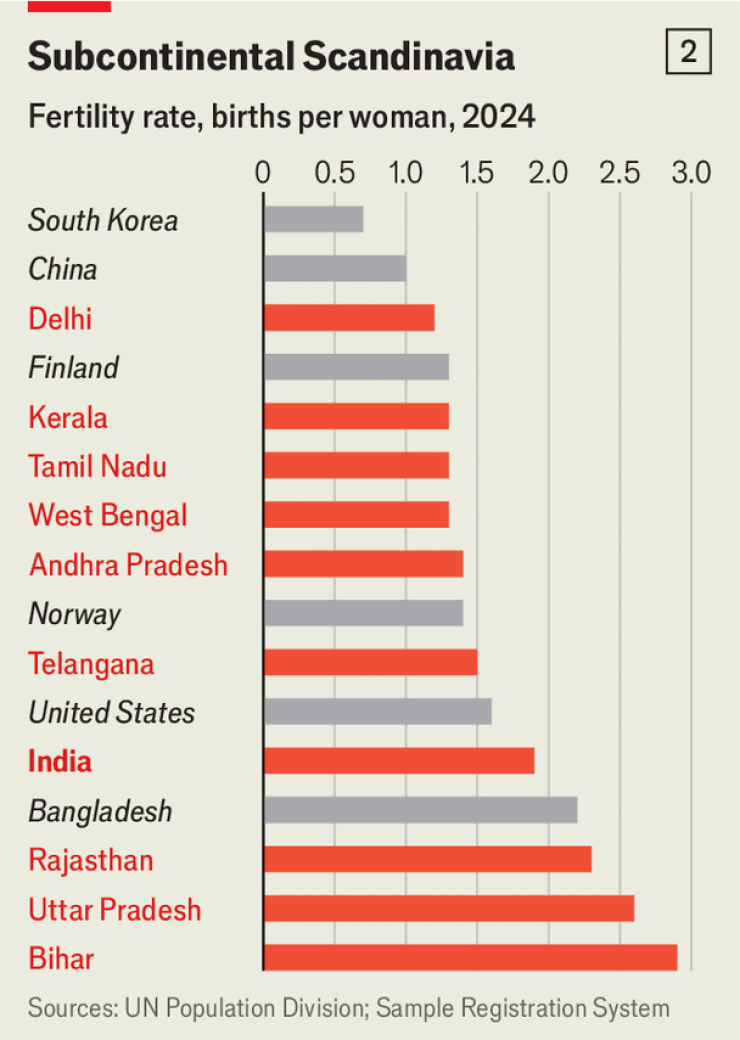
The urban-rural gap remains significant but is narrowing. Urban women averaged 1.5 children against 2.1 for rural women. The SRS report also recorded a strong link between education and fertility: women with no formal schooling had a TFR of 3.2, those who were literate but not graduates registered 1.8, while women with graduate degrees or above recorded 1.6. A 2025 paper by political scientists Nandan Jha and Neena Banerjee, published in the Journal of Population Research, found that higher educational attainment in women consistently reduced fertility, and that greater financial autonomy and media exposure were associated with lower birth rates.
A parallel shift in household structure is also feeding the decline. Around 70 per cent of Indians now live in nuclear families, up from roughly 50 per cent in 2001, according to government data. The retreat of the joint family system has made child-rearing a heavier burden on individual couples, creating a stronger incentive to limit family size. Surveys in several states suggest that desired fertility has itself fallen, to around 1.5 children in many parts of the country.
Experts weigh in
Economists and demographers caution against treating the figure as an immediate crisis but warn that such trends are slow to reverse. Sanjeev Sanyal, a member of the Prime Minister’s Economic Advisory Council, noted that the peak number of live births in India was back in 2001. “It is not a ‘crisis’ yet. These things take a long time to build up,” he wrote on X, adding that absent longevity gains, population would have started declining in the 2030s.
Fellow EAC member Shamika Ravi, speaking on an ANI podcast, pointed to a shift in preferences rather than affordability. “What is troubling, and what money alone will not fix, is the desired number of children. How many children would people like to have? That number itself is falling,” she said, pointing to Japan and South Korea as evidence that high income does not reverse the trend. The global data bears her out: according to the World Bank, China’s TFR stands at 1.0, Taiwan’s interior ministry has reported a rate of around 0.86, and the United Nations places South Korea’s at approximately 0.75, the lowest in the world.
Nilanjan Ghosh, Vice President for Development Studies at Observer Research Foundation, warned of a situation where India could be “ageing faster than getting richer.” He estimates that by 2050, around 20 per cent of India’s population could be above the age of 60, amounting to nearly 30 crore people. Demographers at the University of Washington’s Institute for Health Metrics and Evaluation have produced projections showing India’s population peaking within 21 years and then contracting to just over a billion by the end of the century. Ghosh argued that India should prepare for what economists call the “silver dividend,” keeping older citizens economically productive through reskilling and flexible employment. India entered its demographic dividend phase in 2005, and the UNFPA projects it will last until 2055.
Demographers also flag the “motherhood penalty”: in many households, women still handle most childcare and housework even when employed full-time, making a second child a deterrent for many couples.
Political fault lines
The data carries significant political weight. In February, Rashtriya Swayamsevak Sangh chief Mohan Bhagwat urged Hindu couples to have at least three to four children. However, SRS data shows that the Muslim fertility rate has fallen faster than any other religious group in India, dropping from 4.41 to 2.36 between 1992 and 2021.
The varying rates also feed into the delimitation debate. Southern states, which have lowered fertility faster, fear losing parliamentary seats to more populous northern states when constituency boundaries are redrawn based on the new census, currently underway and due to conclude in 2027.
Policy responses remain limited
No nationwide policy has been announced. Andhra Pradesh last month offered families 40,000 rupees for a fourth child. Goa, Karnataka and Telangana have set up state-funded IVF centres. Development economist Dipa Sinha has called on the government to instead invest in healthcare, pensions and social security for an ageing population, saying the country needs “a policy now which guarantees that they have better healthcare, pensions and social security in old age.”