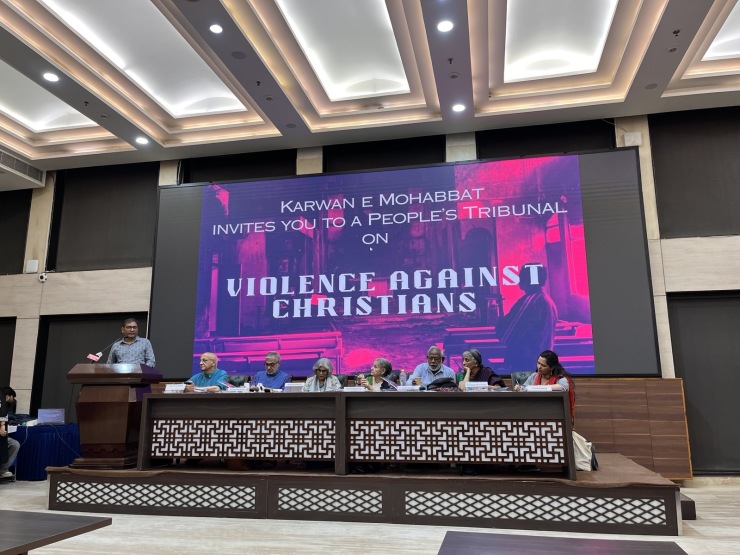
Hundreds of Christians from six states faced social boycott, forced displacement, arbitrary arrests under anti-conversion laws and systematic denial of burial rights, survivors and rights activists told a People's Tribunal convened at the Constitution Club in New Delhi on Monday, June 1. The Tribunal, organised by Karwan-e-Mohabbat and a collective of concerned citizens, heard testimonies from survivors, lawyers, researchers and human rights defenders who documented what speakers described as an alarming escalation of violence against Christian communities across Uttar Pradesh, Rajasthan, Madhya Pradesh, Chhattisgarh, Gujarat and Odisha.
The Delhi hearing marked the culmination of a wider inquiry. Tribunal members had already conducted field visits to Chhattisgarh in April 2026 and Odisha in May 2026, where they met hundreds of affected persons and recorded accounts of violence, social exclusion and denial of constitutional rights, particularly among Adivasi and Dalit populations.
Opening the proceedings, veteran journalist and human rights activist John Dayal placed the current wave of violence in a longer historical arc, recalling the murder of Australian missionary Graham Staines and his two young sons in Odisha and the large-scale killings and displacement during the Kandhamal riots. He warned that constitutional guarantees of freedom of conscience, religious liberty and equal citizenship were facing unprecedented challenges.
A Pattern of Exclusion
Among the most frequently raised concerns was the systematic denial of burial rights. Father Ajay Singh from Odisha presented evidence of funeral processions being obstructed, burial in village graveyards being refused, and in some cases, bodies of deceased Christians allegedly being removed and interred against the wishes of families. The cases he described were not isolated. In 2025, Ramesh Baghel was forced to travel nearly 100 kilometres from his village in Bastar, Chhattisgarh, to bury his father, pastor Subhash Baghel, after residents of Chhindwada refused to permit the burial and local courts ruled against the family. A split verdict of the Supreme Court eventually allowed the burial to proceed, but left the larger question of burial rights unresolved.
In December 2025, the family of Puniya Bai Sahu in Raipur, Chhattisgarh, was compelled to reach a "negotiated compromise" with locals and right-wing outfits following her death. Though Sahu had embraced Christianity, her family was pressured into declaring that the deceased had returned to the Hindu fold. A Christian burial was denied. In Koraput, Odisha, a 15-year-old Christian boy was refused burial on his own family's land by local residents, and the intervention of the local government was required to finally permit it.
Syeda Hameed, speaking at the Tribunal, described the denial of burial rights as "degrading and inhumane," arguing that the denial of dignity in death represented "a profound assault on constitutional values and basic human decency."
Boycotts, Expulsions and Everyday Exclusion
Lawyer and Christian rights advocate Siju Thomas presented evidence of social and economic boycotts targeting Christian families, particularly among the newly converted and members of independent congregations. He described how denial of access to community resources, isolation from village life, restrictions on burial and forced displacement had become regular instruments of coercion. He further alleged that laws designed to protect Adivasi communities, including the Panchayats (Extension to Scheduled Areas) Act (PESA), were being misused in some instances to target Christian Adivasis and curtail their freedoms.
The testimonies placed before the Tribunal corresponded with a series of documented incidents from recent months. In Jharkhand's West Singhbhum, police had to intervene in February 2026 to end the social boycott of four Christian families who were prevented from using a village pond, well, handpump and shops after converting. In Bastar, Chhattisgarh, a report published on 30 May 2026 described how a Christian family was forced to flee its village following threats from RSS and Bajrang Dal members. Govind Mandavi, who along with 15 to 20 other families had converted to Christianity in 2017, was quoted as saying, "Things were better before, however since the last two years RSS and Bajrang Dal have made our lives hell."
Hostility Towards Worship
A.C. Michael, former member of the Delhi Minorities Commission, spoke about what he described as the growing normalisation of hostility towards Christian prayer meetings and places of worship. He noted that peaceful religious gatherings were increasingly portrayed as threats to public order and national interest. He also raised concern about the near-total absence of Christian representation in several statutory minority institutions.
The Tribunal screened a documentary produced by Karwan-e-Mohabbat based on a fact-finding mission carried out in May 2026 across six districts of Madhya Pradesh, namely Jhabua, Burhanpur, Indore, Dhar, Khandwa and Sehore. The team met approximately fifteen survivors and affected families. The film documented attacks on prayer meetings, intimidation of pastors and worshippers, arrests under anti-conversion laws, social ostracisation and a pervasive climate of fear in Christian communities.
Survivor testimonies throughout the day pointed to a recurring pattern: it was house churches and small independent congregations operating in rural and tribal areas that bore the sharpest edge of persecution. These gatherings, often held in private homes and without the visibility or resources of established churches, were repeatedly targeted by organised groups, subjected to police action under anti-conversion laws, and denied the protections that more prominent institutions could sometimes access.
The Rev. Vijayesh Lal, General Secretary of the Evangelical Fellowship of India, pointed to a sharp rise in documented anti-Christian incidents over the past decade, arguing that accusations of religious conversion had become a recurring pretext for violence. The scale of the problem had prompted the Archbishop of Bangalore, Peter Machado, along with the National Solidarity Forum and the Evangelical Fellowship of India, to file a public interest litigation in the Supreme Court in 2022, citing 505 attacks against Christians in 2021 and 250 more by May 2022. In a counter-affidavit filed in April 2023, the Union Ministry of Home Affairs disputed these figures, contending that many incidents had been "wrongfully projected" as communal targeting and that "many" of the accounts cited in the PIL were "trivial disputes between two parties."
Institutional Failures
Rights activist Degree Chouhan from Chhattisgarh told the Tribunal that the number of First Information Reports registered bore no relation to the hundreds of incidents reported annually. He raised concerns about delayed investigations, police inaction and what he called a broader institutional failure to uphold constitutional protections. Participants across the proceedings described instances in which police officers failed to protect victims, filed cases against those who had themselves been attacked, or pressured communities into so-called compromise agreements rather than pursuing criminal action.
Irfan Ali Engineer, Director of the Centre for Study of Society and Secularism, praised the "extraordinary courage and resilience" of survivors who testified despite widespread insecurity. He cautioned that narratives around ghar wapsi and religious conversion were being used to legitimise coercion and discrimination. Historian Tanika Sarkar warned against the normalisation of majoritarian intolerance and the narrowing of space for religious freedom.
Senior journalist and public intellectual Pamela Philipose, reflecting on the day's proceedings, described the testimonies as "markers of deeply disturbing times" and emphasised the need for sustained public engagement, solidarity and new forms of collective action to confront what she called escalating hatred and exclusion.
Concluding the proceedings, rights activist and Karwan-e-Mohabbat founder Harsh Mander said the incidents documented before the Tribunal were not isolated acts of prejudice or spontaneous expressions of hostility. He said they revealed a systematic campaign of exclusion that threatened the constitutional promise of equal citizenship. Referring specifically to testimonies on denial of burials, social boycott, forced displacement and attacks on worship, he warned that fundamental freedoms guaranteed by the Constitution were being steadily eroded and called upon citizens, institutions and governments to act urgently in their defence.