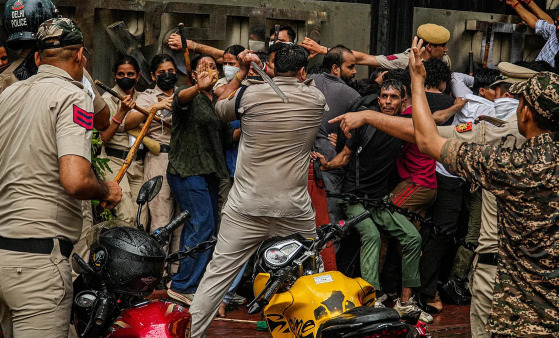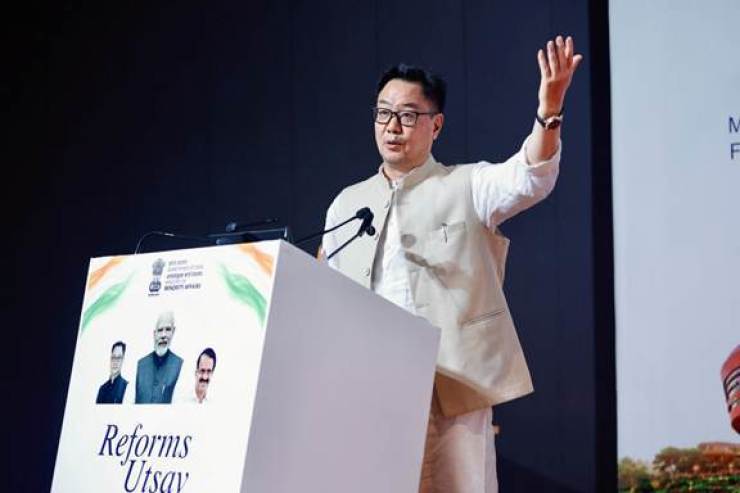
Three days before Union Minority Affairs Minister Kiren Rijiju stood at Bharat Mandapam, New Delhi, on June 4 and declared that minorities in India enjoy “full freedom,” more than 200 people had gathered at the Constitution Club, less than three kilometres away, on June 1, to testify otherwise.
The People’s Tribunal on Violence Against Christians in India, titled “Caravan of Love” and convened by civil society collective Karwan-e-Mohabbat on June 1, 2026, heard survivors, lawyers, researchers, human rights defenders, and representatives of Hindu and Muslim groups document what its organisers described as a systemic, not incidental, pattern of violence, exclusion and institutional failure targeting Christian communities across several states. The tribunal was the culmination of field visits to Chhattisgarh and Odisha in central and eastern India, where members met hundreds of affected persons, particularly among Dalit communities, formerly known as “untouchables” and placed at the bottom of Hinduism’s ancient caste hierarchy, and Adivasi communities, India’s indigenous tribal peoples.
The minister did not mention it.
What Rijiju Said
Speaking at the Ministry of Minority Affairs’ “Reforms Utsav,” a government celebration marking 12 years of the Narendra Modi government led by the Hindu nationalist Bharatiya Janata Party, or BJP, Rijiju rejected what he called a “malicious campaign aimed at tarnishing India’s image.” He said no individual had been compelled to leave the country because of religious identity. He accused opposition parties and groups abroad of amplifying propaganda. “Some people do propaganda even from outside the country,” he said. “They are jealous of the country’s growth and are unable to digest it. They keep spreading poison to create discord and weaken India.”
He pointed to the Jiyo Parsi scheme, a government programme to help India’s dwindling Zoroastrian community survive demographic decline, as evidence of inclusive governance. He told the gathering that India’s Muslim population, if considered a separate country, would rank sixth in the world. He asked his audience to look at the government’s record rather than trust opposition claims. “Do not believe in any propaganda,” he said.
He also made two admissions that complicated his central argument. Minority scholarship delivery, he acknowledged, remains stalled in several states owing to investigations by the Central Bureau of Investigation, India’s federal investigative agency, into alleged fraud involving fictitious students. “We cannot start the scholarships by excluding those institutions which are being investigated for fraud. So we will have to wait until the investigation is finished,” he said. On Waqf property registration, referring to Islamic endowment properties held in trust for community welfare and religious purposes, he admitted that details of nearly 45 per cent of all such properties are yet to be uploaded on the government’s UMEED digital portal, more than a year after its launch. “There are so many shortcomings in different State Waqf boards,” he said. “The documents of properties are faulty. In some places, thousands of acres are recorded on paper, but the land on ground tells a different story.” The admissions sat uneasily alongside his sweeping claims of minority freedom.
What the Tribunal Heard
Father Ajay Singh, former director of the Odisha Forum for Social Action of the Catholic Church, told the tribunal that “there is systematic denial of burial rights, one of the gravest forms of humiliation inflicted upon Christian communities.” He described cases in which funeral processions were obstructed, burial in village graveyards was denied, and the bodies of deceased Christians were allegedly removed and subjected to reconversion ceremonies against the wishes of families.
The tribunal stated in a release on June 2 that “a recurring concern throughout the proceedings was the alleged role of state institutions,” with participants describing instances in which police failed to protect victims, registered cases against those who had been attacked, delayed investigations, or pressured communities into so-called compromise agreements.
Harsh Mander, a prominent civil society leader who concluded the proceedings, stated that the incidents documented could not be understood as isolated acts of prejudice and argued they revealed a systematic campaign of exclusion threatening the constitutional promise of equal citizenship.
The Rebuttal
A C Michael, coordinator of the United Christian Forum, which monitors atrocities against the Christian community and who testified at the tribunal, responded to Rijiju’s claims with sharp irony on Facebook. “Minister Kiren Rijiju is correct when he says minorities enjoy full freedom in India,” he wrote. “Only thing is Muslims are not allowed to eat what they want. Their homes are demolished. They are not allowed to worship or say Namaz,” the Islamic daily prayer. “His party does not give tickets to Muslims to contest general elections. No Muslim Ministers in Modi Cabinet. Christians are arrested for practicing their faith under false allegations of forceful conversions which the Supreme Court at many times found baseless allegations. In fact, reprimanded police officials.”
Meenakshi Singh, National Coordinator of the Minority Department of the All India Congress Committee, the main national opposition party, and in-charge for Punjab, who also deposed at the tribunal, said that if Rijiju’s claim were entirely true, “there would not be so many incidents of discrimination, violence and harassment against minority communities coming from various parts of the country.” She spoke of Christians being stopped from holding prayer meetings, attacks on churches, false conversion charges, social boycott, and the denial of burial rights to Dalit Christians. On Muslims, she noted that food choices were being contested, prayers disrupted, and people targeted for their religious identity. Constitutional religious freedom, she argued, means not only the right to worship but the right to live according to one’s faith without fear and discrimination. “As long as every citizen of the country cannot live according to their faith without fear, discrimination and insecurity, the claim of full freedom will remain incomplete,” she said.
Prof. Emanual Nahar, Former Chairman of the Punjab State Commission for Minorities, a statutory body established to safeguard minority rights at the state level, issued a formal written response to coverage of Rijiju’s remarks. “With utmost respect, I must submit that this statement appears to be far removed from the ground realities faced by millions of minority citizens across the country, particularly Muslims and Christians,” he wrote. He cited the discontinuation of minority scholarships, the ongoing humanitarian crisis in Manipur, where ethnic and communal violence has displaced thousands, and conditions in Chhattisgarh, Madhya Pradesh, Uttar Pradesh and Maharashtra. He pointed to what he called “Bulldozer Politics,” the use of government demolition machinery to raze the homes and properties of minority community members accused of crimes, a practice widely criticised by courts and rights groups as collective punishment without due process. He also cited the encroachment of graveyards, mission lands and minority-run institutions “often with the tacit support of those in power.” “Before making sweeping declarations about freedom and equality,” he wrote, “it is incumbent upon our leaders to confront the lived realities, verified facts, and documented figures that tell a starkly different story.”
Reverend Vijayesh Lal, General Secretary of the Evangelical Fellowship of India, the national umbrella body of evangelical Christians and a charter member of the World Evangelical Alliance, who also addressed the tribunal, said: “We affirm India’s constitutional commitment to religious freedom. But verified documentation, alongside findings from the recent People’s Tribunal, points to a growing gap between that promise and the lived experience of many Christians, particularly among Dalit and Adivasi communities. In Chhattisgarh and Odisha, many are not even treated with dignity in death. The Constitution guarantees this dignity to every citizen. We call on the government to ensure it.”
What the Numbers Show
The testimonies find support in documented data. According to the United Christian Forum, attacks on Christians numbered 834 in 2024, up from just 151 in 2014, the year the BJP came to power nationally. The Religious Liberty Commission of the Evangelical Fellowship of India documented 747 verified incidents of hostility against Christians in 2025, describing “a sustained pattern of hostility” affecting both individuals and congregational life.
The India Hate Lab, a research project tracking organised hate speech, documented 1,318 such events targeting religious minorities in 2025, with 1,289 of those targeting Muslims either explicitly or alongside Christians, averaging four events every single day and representing a 97 per cent increase from 2023.
No Muslim minister serves in the Union Cabinet formed after the 2024 general elections, a historic first in independent India, and Muslim parliamentary representation stands at just 24 seats, or 4 per cent, in the current Lok Sabha, the lower house of Parliament.
The United States Commission on International Religious Freedom recommended, for the sixth consecutive year, that India be designated a Country of Particular Concern, stating that “religious freedom conditions in India continued to deteriorate” in 2024, with attacks including “vigilante violence, targeted and arbitrary killings, and demolition of property and places of worship.” India has consistently rejected these findings as biased and politically motivated.
John Dayal, the veteran journalist and human rights activist who organised the tribunal, had a five-word response when news coverage of Rijiju’s speech appeared in The Hindu. He shared it on Facebook: “Of course. Brahmins. Rajputs. Vaisyas.” The three communities he named are the dominant upper castes of the Hindu social hierarchy, the communities that form the BJP’s core leadership base, and whose experience of freedom in India, Dayal implied, bears little resemblance to that of religious minorities or lower-caste communities.