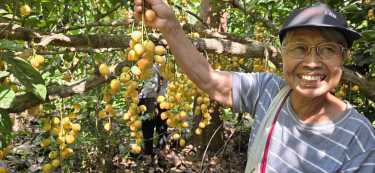
The winding roads through the hills of northern Thailand eventually led me to Pa Miang village in Doi Saket District, Chiang Mai, where I had the opportunity to visit the four-acre agro-farm of Mrs. Jinda. Along with the ECHO Asia team, we spent time walking through the farm, listening to her life story, and observing the rhythms of life that shape her understanding of faith and creation.
Mrs. Jinda originally came from Myanmar and later settled in Thailand with her husband as missionaries. Her studies in Japan and years of cross-cultural service have cultivated a holistic understanding of ministry. Together with her husband, she devoted many years to Bible school ministry and community development — caring for the sick, supporting families affected by addiction, and serving local communities in practical ways. As we walked through the farm, she shared a simple philosophy that has guided her life:
“Grow what you can eat and eat what you grow.”
She explained that when they first purchased the land many years ago, it was largely barren. Through years of patient work and care, they transformed it into a flourishing ecosystem. Today the farm contains nearly one hundred species of plants and trees across four acres, including coffee, lychee, bananas, papaya, mangoes, vegetables, and several local varieties.
What makes the farm remarkable is the vision behind it. Rather than following a monoculture model, different species coexist and support one another. Coffee plants grow beneath larger trees, birds spread seeds naturally, insects thrive, and biodiversity is sustained without the use of harmful chemicals.
One practice that particularly captured my attention was her Bamboo Bank. From every sale of farm produce, she intentionally sets aside a tithe and places it in a large bamboo container. These savings are used to help build churches, support sick people, and assist needy families. What appears to be a simple practice reveals a profound lesson in Christian stewardship: small acts of faithfulness and generosity, sustained over time, can become meaningful instruments of God’s mission.
I asked Mrs. Jinda how she feels about the plants and trees around her. She described her relationship with creation almost as companionship: “They help me, and I help them.” I also raised a theological question often heard in church circles: whether caring for plants and animals diverts attention from the mission of sharing the Gospel with people. Her answer was both simple and profound. Living among creation, she said, allows her to see God through His handiwork. For her, caring for creation is not separate from Christian faith — it is an expression of it. As our time together drew to a close, she urged us to carry these lessons to others, saying, “If we do not share, people will not know.”
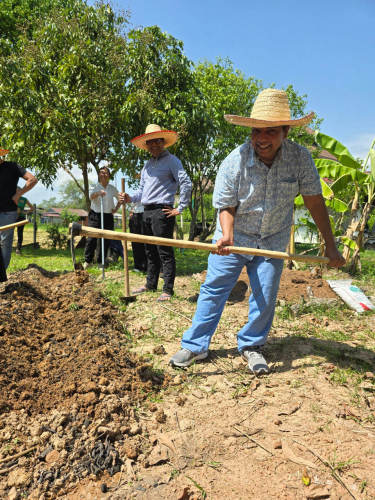
As we celebrate World Environment Day, Mrs. Jinda’s story offers several practical and theological lessons for Christians and churches today. Her life is not merely a story about farming; it is about discipleship that integrates faith, mission, and creation care.
1. Christian Mission Is Holistic, Not Fragmented
The whole ecosystem is interconnected, and human beings are an integral part of it. Yet we behave as though we are strangers to the earth. We often approach the natural world as consumers and exploiters. In this respect, I deeply admire farmers, agriculturists, and individuals like Mrs. Jinda, who do not regard plants and animals merely as useful resources but understand themselves as belonging to one larger family of creation.
Three major frameworks have been used to understand humanity’s relationship with the natural world (see also: Tearfund, “An Abundant Community Theology”):
• The egocentric or anthropocentric model places human beings above the rest of creation in a dominating sense. This perspective frequently generates hierarchical power structures in which nature exists solely for human benefit and exploitation. Such a view easily leads to ecological destruction and is inconsistent with the biblical understanding of stewardship.
• The ecocentric or biocentric model has become influential in many environmental movements and among some Christian environmental thinkers. It rightly challenges human arrogance and reminds us that we are deeply interconnected with nature. However, in its extreme forms it can create theological difficulties: the distinctive identity of human beings as image-bearers of God may become obscured, and the unique relationship between humanity and the Creator may be blurred.
• The theocentric model is the most biblically consistent of the three. It understands humanity’s relationship with creation through the lens of our relationship with God. Creation belongs first to God, and our responsibility toward the earth emerges from our accountability to the Creator. Human beings are neither absolute masters over creation nor merely one species among many; they are stewards entrusted with the care of God’s world. Genesis 2:15 captures the mandate clearly: “The Lord God took the man and put him in the Garden of Eden to work it and take care of it.” Psalm 24:1 adds its own declaration: “The earth is the Lord’s, and everything in it.”
Mrs. Jinda’s life exemplifies this theocentric vision. She understands her connection to the natural environment through her relationship with God. This is a significant lesson for the church today. Churches often divide ministry into separate categories — evangelism, social service, environmental concern — but God’s mission embraces the whole of life. The Gospel addresses not only human souls but the entirety of God’s creation. Christian mission is, by its nature, holistic rather than fragmented.
2. Small Acts Create Lasting Transformation
The life and work of Sam Higginbottom offer a remarkable example of holistic Christian mission and stewardship. When Higginbottom, an American Presbyterian missionary, came to India and began teaching at Allahabad Christian College (now Ewing Christian College), he was deeply moved by what he observed one day while crossing the Yamuna River: barren, uncultivated ūsar soil where poor farmers toiled ceaselessly yet harvested very little, defeated by poor agricultural practices and difficult environmental conditions.
In this, Higginbottom saw an opportunity for Christian service. He envisioned empowering farmers through agricultural education and practical training. Returning to the United States, he mobilised support and came back to establish an agricultural training centre in 1910. What began as a small initiative eventually grew into the Allahabad Agricultural Institute, now Sam Higginbottom University of Agriculture, Technology and Sciences. His vision was captured in a motto that has endured: “Feed the hungry and serve the land through Gospel and Plough.” A small act of faith and compassion grew into a movement that has touched the lives of countless farmers and communities, not only in India but throughout the world.
The story of Higginbottom reminds us that the stewardship of creation does not always begin with large institutions, grand projects, or global movements but with small acts of faithfulness. Jesus reminds us in Matthew 13:31–32 that the Kingdom of God is like a mustard seed — the smallest of seeds, which grows into a tree large enough for birds to nest in its branches. Zechariah 4:10 echoes this: “Do not despise these small beginnings, for the Lord rejoices to see the work begin.”
Our responsibility toward creation begins with simple, practical choices. We can limit unnecessary consumption, reduce waste, use resources responsibly, and practise contentment. We can be more mindful of how much we eat, how much we buy, and how much we discard. These acts may appear insignificant, but they carry transformative potential. Practised faithfully, they shape families, form communities, and gradually alter the culture of society. As stewards of God’s creation, we are called to begin with what God has placed in our hands, trusting that small acts of obedience can become powerful instruments in His kingdom.
3. Generosity: A Mark of Christian Witness and Stewardship
During my participation in the creation care curriculum programme organised by ECHO Asia in Chiang Mai, one insight emerged with particular clarity: the deep relationship between generosity and stewardship. I began to understand that creation care is not merely about protecting the environment; it is also about cultivating a spirit of responsible stewardship and generous living toward both people and the earth. Mrs. Jinda’s Bamboo Bank illustrates precisely this. In a culture shaped by consumerism and accumulation, her practice demonstrates that contentment and sharing can become powerful testimonies of Christian values.
Generosity occupies a central place in Christian witness because it reflects the very nature and character of God. Scripture presents God as the generous Creator who continuously sustains all life through His providential care. The Psalmist declares: “The eyes of all look to you, and you give them their food at the proper time. You open your hand and satisfy the desires of every living thing” (Psalm 145:15–16). Nature itself bears witness to divine generosity through the provision of food, water, sunlight, fertile soil, beauty, and the ecological balance that makes life flourish. Psalm 19:1 reminds us that creation reveals the glory of God — including His creativity, sustaining power, and abundant goodness.
When the concept of dominion is interpreted within the framework of the imago Dei, it acquires a profoundly different character. Human beings are entrusted with stewardship as image-bearers of a God whose rule is characterised not by domination and exploitation but by generosity, justice, and compassionate care. Christian stewardship, therefore, is not merely responsible management of resources; it is participation in God’s own generosity toward creation. This understanding carries significant implications for the church, particularly in the Asian context. Contemporary environmental crises and food injustice are deeply connected to patterns of excessive consumption, economic exploitation, and the unequal distribution of resources. The Sermon on the Mount calls believers toward a different pattern of life — one marked by humility, trust, contentment, and generosity rather than accumulation and self-interest (Matthew 5–6). Christian discipleship therefore shapes how believers consume resources, grow and distribute food, use land and water, and engage with economic systems. Hence, “Grow what you can eat and eat what you grow” is a perfect reminder that disciplines us in how we manage food.
The church is called to become a community of radical sharing that challenges unjust structures and endless accumulation. This requires a renewed commitment to moderation, gratitude, generosity, and responsible stewardship as spiritual disciplines — disciplines that address human need while bearing witness to God’s concern for the well-being of all creation.
4. The Bible and the 17 SDGs
We live in a world facing what may rightly be called a FEW crisis: Food, Energy, and Water. These three interlocking pressures, driven above all by population growth and unsustainable consumption, lie at the heart of the ecological emergency confronting Asia and the wider world.
The Bible and the 17 SDGs is a devotional resource that brings together the timeless truths of Scripture and the contemporary concerns reflected in the United Nations’ Sustainable Development Goals. In a world confronting poverty, hunger, inequality, conflict, and ecological devastation, this book explores how the biblical vision of justice, compassion, stewardship, and shalom speaks meaningfully to the urgent needs of our time.
Through seventeen devotionals — each connected to a specific SDG — different authors reflect on biblical narratives, theological insights, practical stories, and prayerful responses. The book invites readers to see the SDGs not merely as global targets but as opportunities for Christian witness and faithful action. Designed for pastors, students, churches, and communities, it encourages believers to integrate faith with action and participate in God’s mission of caring for both people and creation. The book aims to:
• Provide a biblical foundation for justice and sustainability.
• Connect faith with practical, everyday action.
• Illuminate the relationship between Scripture and contemporary global challenges.
• Inspire Christian witness through compassion, stewardship, and service.
A Call to Plant
World Environment Day is not merely an occasion for reflection. It is a call to action. The church has both the resources and the responsibility to act, and the entry points available to almost any congregation are simpler and more accessible than we often assume.
Creation care, faithfully practised, is not a distraction from evangelism. It is one of its most powerful expressions. When a church tends the land beside its building and shares the produce with neighbours; when a pastor whose family is fed from a garden behind the church can remain rooted in his community without financial anxiety; when a congregation invests in the sustainable livelihoods of farming families around it — the Gospel becomes visible in ways that words alone cannot achieve.
Mrs. Jinda did not abandon her calling as a missionary when she began to plant trees. She deepened it. The farm is her pulpit. The soil is her text. The forty years of faithful labour it represents is a sermon that no one who walks through Pa Miang village can easily forget.
On this World Environment Day, the invitation is simple: plant something. A tree beside the church. A vegetable bed in the courtyard. A seed of ecological conviction in the hearts of the students and young people your ministry is shaping. And plant this truth, deep and firm, in your own soul first: the earth is the Lord’s. Its flourishing matters to Him. And caring for it is among the most natural and necessary expressions of a faith that is genuinely, fully, and unapologetically alive.
Rev. Dr. Samuel Richmond, Executive Director, Caleb Institute, Gurugram; Hon. Secretary EFI-Theological Commission, Lead Representative (South Asia Region) – Lausanne WEA Creation Care Network; Hon. Projector Officer, WEA-Sustainability Centre. He completed his PhD in Creation Care in India and Post Doc from Fuller Seminary, USA.