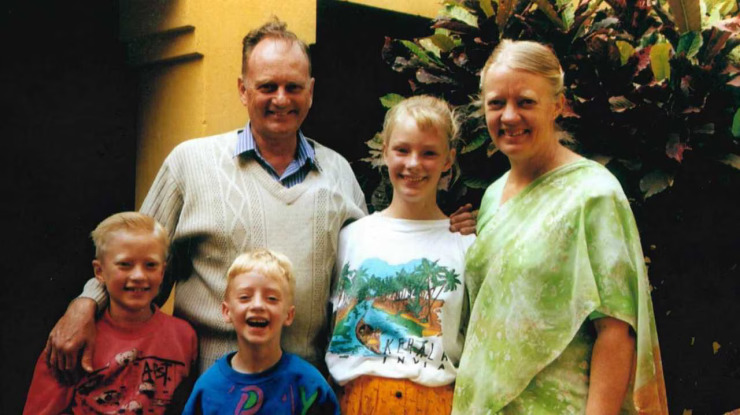
The Odisha State Sentence Review Board has recommended the release of Dara Singh, the prime convict in the 1999 murder of Australian missionary Graham Staines and his two young sons, on grounds of “good behaviour.” Singh, now 63 and lodged in Keonjhar district jail, has spent more than 26 years in custody without a day’s parole. As of now, the state government has not made a final decision, and Singh remains behind bars.
The recommendation came at a Board meeting held on July 6, where 56 life convicts’ cases were taken up for premature release. It followed a proposal from Keonjhar district authorities, endorsed by the Director General of Police (Prison).
On July 14, a Supreme Court bench of Justices Manoj Misra and Vijay Bishnoi asked the Odisha government to decide on Singh’s remission plea by mid-August, remarking, “Let him also celebrate Independence Day. You must take a decision by August 15.” The matter was formally listed for August 19, by when the government is expected to place its decision on record. Recording the state’s submission, the bench observed, “In such circumstances, we deem it appropriate to adjourn this matter to 19.08.2026. In the meantime, we expect that the Committee shall take its decision.”
Singh’s counsel, A P Singh, told reporters the apex court had ordered his client’s release by Independence Day. Legal sources, however, clarified that the court had only directed the government to decide by then, not that release was assured.
Singh’s case had been deferred at the Board’s earlier meeting in September 2025, when 107 cases were considered in all. Of these, 18 were recommended for release, 75 were rejected and 14, including Singh’s, were deferred. The Board had wanted a fresh report from authorities in his home district of Auraiya, Uttar Pradesh, before taking up his case again.
Under Odisha’s 2022 premature-release guidelines, a convict whose death sentence has been commuted to life imprisonment becomes eligible for remission after completing 25 years in custody, subject to the Board’s recommendation and government approval.
Fellow convict Mahendra Hembram, released last year on similar grounds of good conduct, said Singh deserved the same treatment. “Dara is optimistic,” he said.
In his petition before the Supreme Court, Singh said he deeply regretted the offences committed over two decades earlier and sought an opportunity to “give back to society” through service-oriented work. He described his actions as the result of “youthful rage.” He was 37 at the time of his arrest.
Singh, formerly associated with the Bajrang Dal, was convicted of leading a mob that set fire to a station wagon in which Staines and his sons Philip and Timothy were sleeping at Manoharpur village on the night of January 22, 1999, allegedly shouting “Jai Bajrang Dal” as they did so. A judicial commission led by Justice D P Wadhwa later found no evidence that Staines, who ran a leprosy shelter in the state, was involved in forced conversions, and no evidence of the Bajrang Dal’s institutional involvement in the crime.
Fifty-one people were originally arrested in the case. Thirty-seven were acquitted at the initial trial, while a CBI court convicted 14, including Singh, in 2003. The Orissa High Court later acquitted 11 more of them on appeal.
A trial court convicted Singh and 12 others in 2003, sentencing Singh to death. The Orissa High Court commuted this to life imprisonment in 2005, a decision the Supreme Court upheld in 2011. Besides the Staines case, Singh is serving life terms for the 1999 murders of Catholic priest Arul Das and Muslim trader Sheikh Rahman.
Singh’s remission plea had been rejected five times previously, most recently in February 2024. If released, no one convicted in the murder of Graham Staines and his sons will remain in prison.