Four little-known political parties in Gujarat are under criminal investigation over an alleged political donation racket that authorities say caused a prima facie loss of about Rs 680 crore (US$71.6 million) to the government exchequer.
The Gujarat Criminal Investigation Department (CID) Crime branch said on September 28 that it had registered four cases over three days following complaints from the Income Tax Department. Investigators allege that registered unrecognised political parties, or RUPPs, were used to receive large political donations, allowing donors to claim income tax deductions before much of the money was returned to them in cash after commissions were deducted. RUPPs are parties registered with the Election Commission of India but which do not have recognition as national or state parties.
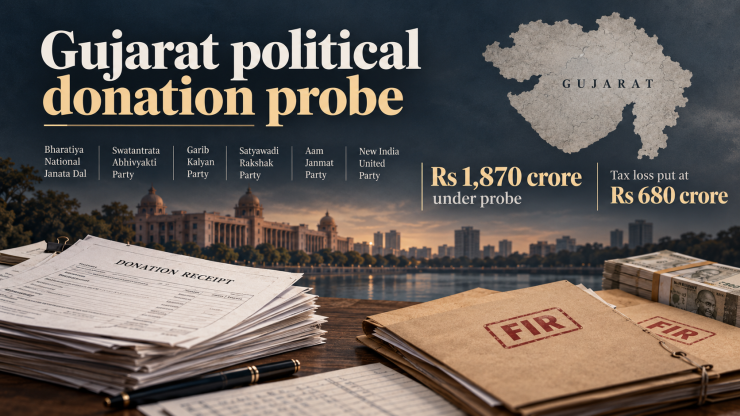
Three First Information Reports (FIRs), the police documents that formally initiate criminal cases in India, were registered on September 25 against the Bharatiya National Janata Dal, Swatantrata Abhivyakti Party and Garib Kalyan Party. According to The Indian Express, the Income Tax complaints covered nearly Rs 1,870 crore (US$196.8 million) in alleged bogus political donations and estimated the loss to the exchequer at more than Rs 560 crore (US$58.9 million).
A fourth case was subsequently registered, taking the preliminary estimated loss across the four cases to about Rs 680 crore (US$71.6 million). Gujarat CID said the cases arose from Income Tax investigations and searches conducted around 2022-23.
The FIRs allege that donations entered the political parties through banking channels before funds were routed through intermediary or shell entities and returned to donors in cash after commissions were retained. In some cases, investigators have also alleged the use of fictitious transactions, fake bills and false financial records submitted to the Election Commission. Chartered accountants have been named in the cases over allegations that audit reports were prepared or signed without proper verification.
The Bharatiya National Janata Dal received Rs 1,143.85 crore (US$120.4 million) covered by the investigation, while Swatantrata Abhivyakti Party received Rs 519 crore (US$54.6 million) and Garib Kalyan Party Rs 206.76 crore (US$21.8 million), according to The Indian Express. Despite the volume of money involved, candidates fielded by these parties had little electoral success and repeatedly lost their security deposits, which candidates forfeit if they fail to secure the required share of votes.
The criminal cases follow a series of reports that had already drawn attention to unusually large financial flows through small political parties in Gujarat.
A BBC investigation published earlier in September examined six Gujarat-based RUPPs which together reported about Rs 1,700.78 crore (US$179 million) in donations during 2023-24. Together, the six parties put up only 15 candidates in the 2024 Lok Sabha election, elections to the lower house of India’s Parliament, and none was elected.
By comparison, five recognised national parties other than the Bharatiya Janata Party (BJP), the Congress, Aam Aadmi Party, Bahujan Samaj Party, Communist Party of India (Marxist) and National People’s Party, together received about Rs 1,480 crore (US$155.8 million) during the same financial year and fielded 893 candidates in the general election.
The six parties investigated by BBC included the four now linked to the reported CID cases, as well as Aam Janmat Party and New India United Party.
Aam Janmat Party alone reported receiving Rs 620 crore (US$65.3 million) in donations in 2023-24, after receiving Rs 216 crore (US$22.7 million) the previous year. It fielded only one candidate in the Lok Sabha election.
BBC traced the party’s founding president, Anamika Paswan, to Bihar. Paswan is now a vice-president of the BJP’s Bihar unit. She told BBC that she had resigned from Aam Janmat Party in 2022. Her husband later showed reporters what he said was her resignation letter and another document stating that the party had shifted its headquarters to Ahmedabad under a new president.
When BBC reporters visited addresses associated with the six parties, several did not appear to be functioning political offices, while some office-bearers could not be reached or offered little information about their organisations. BBC, however, did not accuse the parties of financial wrongdoing and said it had not established that donations had been returned to donors.
Concerns about the finances of RUPPs had surfaced even earlier.
In July 2025, the Association for Democratic Reforms reported a 223 per cent increase in the declared income of registered unrecognised political parties in 2022-23. Five Gujarat-based parties were among the 10 highest earners and together reported Rs 1,158.11 crore (US$121.9 million) in income that year. ADR also found that financial records for more than 73 per cent of registered unrecognised parties were not available in the public domain for the period it examined.
Across the five years from 2019 to 2024, five Gujarat-based RUPPs examined in the reporting declared cumulative income of about Rs 2,316 crore (US$243.8 million) while fielding 17 candidates across two Lok Sabha elections and one election to the Gujarat state legislature. None of the candidates won.
In August 2025, Dainik Bhaskar had also reported that 10 little-known Gujarat parties received around Rs 4,300 crore (US$452.6 million) between 2019-20 and 2023-24. Those parties fielded only 43 candidates across the 2019 and 2024 Lok Sabha elections and the 2022 Gujarat Assembly election, securing a combined 54,069 votes. Five of those parties later featured in the BBC investigation.
The Gujarat CID investigation is continuing. No court has yet ruled on the allegations against the parties, their office-bearers or others named in the cases.