Two retired Indian ambassadors in the northern state of Punjab have been asked to prove their own citizenship as part of a nationwide voter roll verification drive, even as election officials in the capital, Delhi, prepared to release a draft voter list on Monday, August 31, that leaves out nearly 4.77 million names.
The exercise causing the trouble is called the Special Intensive Revision, or SIR. It is a state-by-state re-verification of India’s electoral rolls, in which every registered voter is required to reconfirm their details in person with a local election official, known as a Booth Level Officer or BLO. To do this, officials cross-check each voter’s current paperwork against an old electoral roll from decades ago, treated as the baseline “master list.” In Punjab, that baseline is the 2003 roll. In Delhi, it is the 2002 roll. Anyone who cannot be clearly linked back to a name on that old list, including people who happened to be living or working outside their home state, or outside India altogether, at the time, is flagged for further scrutiny and asked to produce fresh proof that they are Indian citizens entitled to vote.
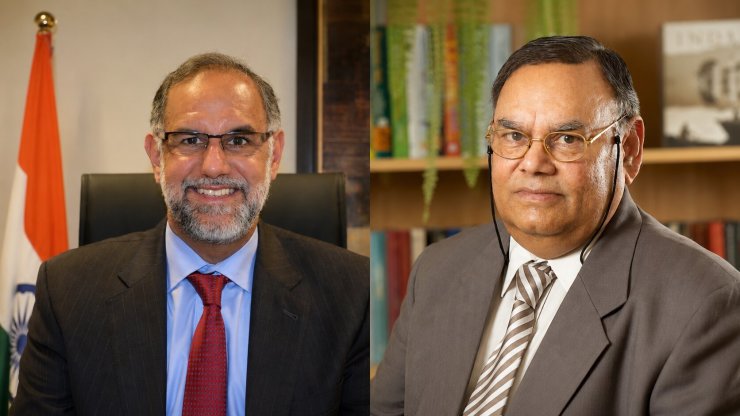
The first case to draw attention involved Navdeep Suri, a former Indian diplomat who held the rank of Ambassador to the United Arab Emirates (UAE) and Egypt, and served as India’s High Commissioner to Australia (the title used for an ambassador posted to another Commonwealth country). On August 24, Suri wrote on the social media platform X that he had gone to his local BLO a few weeks earlier with his Voter Card and his Aadhaar card, India’s biometric national identity card, which carries a unique 12-digit number linked to a person’s fingerprints and photograph and is commonly used as general proof of identity. He said he was initially told his papers were in order. He later received a message from a volunteer saying his details did not match the 2003 baseline roll.
“Dear @ECISVEEP, sharing my experience with #SIR in Punjab. Went to BLO, submitted a Voter Card and Aadhaar Card, and was assured that everything was in order. Got a message today from a volunteer saying some details don’t match with SIR in 2003!” he wrote.
Suri said the BLO asked him to collect a formal notice and return with proof of his Indian citizenship, without specifying which documents would be acceptable. Since he was posted at the Indian High Commission in London in 2003 and had therefore not taken part in that year’s exercise back home, officials asked him for his passport as proof.
“I happen to have documents other than voter ID and Aadhaar card. But I can’t help asking: If I have trouble establishing my citizenship after representing India in three countries, what’s the fate of the common citizen? Ease of Living, I presume!” Suri wrote.
Suri, grandson of the well-known Punjabi novelist Nanak Singh, spent much of his career abroad, with postings that included Cairo, Damascus, Washington, Dar es Salaam, London and Johannesburg, where he was Consul General. His decades of service also earned him the Order of Zayed II, the UAE’s second-highest civilian award.
Responding to the matter, Punjab’s Chief Electoral Officer (a state-level election official, not a corporate title, appointed to oversee voter roll matters), Anindita Mitra, clarified that Suri’s name had at no point been struck off the rolls and continued to figure in the draft list published on August 13. According to her, he had only been asked to provide certain documents in response to the notice, after which his name went through to the electoral roll. She confirmed that his vote, registered in the city of Amritsar, remains registered there.
A day after Suri’s account became public, a second former diplomat, 75-year-old Ramesh Chander, said he too had been asked to furnish additional documents. Chander, who served as India’s Ambassador to Belarus and held postings in Japan, Prague and Edinburgh, is a resident of Deol Nagar in Jalandhar, another Punjab city, and has voted there in every election since 2007.
Chander said his Aadhaar card, voter ID and other papers had already been handed over to the BLO, yet a notice from the Additional Electoral Registration Officer, a district-level election official, for Jalandhar (West), directed him to turn up with further proof at an office on Ladowali Road on August 27. He pointed out that he was serving in Japan in 2003, the year now used as the baseline for the exercise in Punjab, which is why his current records did not automatically link back to it.
“I read about Suri’s case and, ironically, found myself sailing in the same boat,” Chander said.
The Deputy Commissioner of Jalandhar, Varjeet Walia, a senior district administrative official, said the notice followed the standard procedure being applied across the exercise, and that voters were being flagged under two categories: those who remained “unmapped,” meaning their old and new records could not be automatically linked, and those whose records showed other discrepancies. He said BLOs had been directed to collect Chander’s documents from his home so that he would not need to appear at any office in person.
According to figures cited in reports on the exercise, around 2.069 million voters (20.69 lakh), nearly 10 per cent of Punjab’s electorate, remained unmapped after the first phase of the SIR, including 146,000 (1.46 lakh) in Jalandhar alone. The follow-up verification process for unmapped voters is set to continue until September 12, with the final electoral roll to be published on October 12.
Meanwhile, in Delhi, the Chief Electoral Officer’s office said its enumeration exercise, which involved going door to door to collect forms from voters, covered about 14.5 million people (1.45 crore, an Indian unit equal to 10 million). Of these, forms for around 9.75 million voters (97.5 lakh), or 67.18 per cent, were successfully collected and entered into the system. The remaining 4.77 million voters (47.7 lakh) were categorised as absent, shifted to a new address, dead, duplicate entries, or otherwise could not be reached during the door-to-door exercise. Officials said exclusion from the draft list due on Monday does not mean these voters have been finally left out. Anyone affected can file a claim or formal objection between August 31 and September 30, before India’s Election Commission publishes the final roll on November 4.
Some Delhi neighbourhoods fared worse than others in the door-to-door count. Okhla recorded the highest proportion of uncollected forms, at 45.32 per cent, followed by Chandni Chowk at 38.98 per cent and Ballimaran at 32.65 per cent, all older, densely populated parts of the city. Officials pointed out that Shaheen Bagh and Jasola Vihar were among the areas where the exercise ran into particular trouble, since many migrant families settled there, originally from the states of Bihar, Uttar Pradesh, Assam and West Bengal, could not get their present details to match the 2002 baseline voter list. Rohini, a more established residential district, recorded the highest form collection rate in the city, at 83.43 per cent.