Security forces in the Indian state of Manipur have recovered the missing severed head of a Naga man killed a week ago, ending a tense search. The relief was brief. A tribal council is still demanding arrests, and fresh violence has been reported near the border with Myanmar.
Ethnic violence has gripped Manipur since May 2023, first between the Meitei and Kuki communities and now between the Nagas and Kukis. It has displaced more than 60,000 people and killed at least 320. Since the Naga-Kuki clashes began in February this year, at least 22 Nagas and 30 Kuki-Zo people have died.
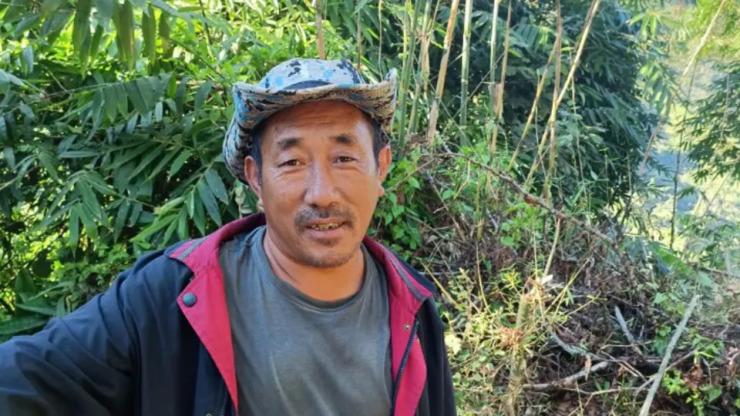
The latest crisis began on October 10, when four Naga men were killed in Kangpokpi district, an area dominated by Kukis. Ajinpou Ringkangmai, 52, a father of four from the Liangmai Naga tribe, was allegedly shot dead by Kuki militants, who then severed his head and took it away. Some reports spell his name Ajinbou. Another victim, Dibambou Ringkangmai, 48, had his face crushed with stones.
The men had gone to guard Makui 2 village, one of three Makui villages where militants burnt houses last month. Residents have since lived in relief camps. On October 9, Ajinpou and 12 to 15 other villagers went to protect what remained from looters and arsonists.
At about 7 am the next day, drones appeared over the village, according to Naga leaders. “Within minutes, they came under fire,” said Disubou Wijunamai, Ajinpou’s cousin. Survivors told him that 50 to 60 armed militants attacked and fled only when more Naga volunteers arrived. Villagers later found four bodies on the village ground.
That afternoon, an 11-second video spread on WhatsApp. It purportedly showed the beheading and the head placed at a bunker attributed to Kuki militants. For Naga groups, the removal of the head was a brutal act and a humiliation to his community.
Ajinpou’s headless body reached the mortuary of the Jawaharlal Nehru Institute of Medical Sciences in Imphal around midnight on Sunday. The Joint Tribes Council Manipur, an apex body representing the Inpui, Liangmai, Rongmei and Zeme communities, backed the family when it refused to accept the remains for last rites. The council also halted the post-mortem examinations of both men until the head was found and returned for a dignified burial.
On Monday, October 12, evening, it gave the Centre, as India’s federal government is known, and the state government 48 hours to act. A letter to the chief minister, signed by four senior members, warned that “unwanted consequences” would rest solely with the authorities. The council called the killings a grave crime against humanity.
Police and security forces searched the jungles of Kangpokpi through Tuesday and Wednesday. Deputy Chief Minister Losii Dikho said they found the head on Wednesday afternoon. The family said police informed them between 5 pm and 6 pm, ahead of the 7 pm deadline. Another account puts the discovery late on Wednesday night, after about six hours of searching near Makui Ashang. All agree on what followed: the head travelled the roughly 85 kilometres to Imphal and reached the morgue around 1.30 am on Thursday.
Doctors began the post-mortem examinations that day. The funerals of Ajinpou and Dibambou were set for Friday at their native village. The other two victims had already been laid to rest.
The council has not called off its agitation. It wants the arrest of Thangboi Kipgen, David Hangsing and Dr Sailen Haokip, whom it names as the perpetrators. They lead Kuki groups that signed a Suspension of Operations agreement with the Centre in 2008, a ceasefire pact among the Union home ministry, the Manipur government and Kuki insurgent groups. Mathiuchunbou Rimai, president of the Liangmai Students’ Union, alleged that armed groups operate with impunity under that pact. He held the Centre and the state government responsible for failing to deliver justice.
The council now wants the agreements with the Kuki National Organisation and the United People’s Front scrapped. Kuki civil society groups have countered by demanding a review of the ceasefire with the NSCN-IM, the National Socialist Council of Nagaland (Isak-Muivah).
Violence meanwhile continued in Kamjong district. On Thursday, Hatneikim Haokip of Molnoi village was killed and her husband, Jamkhongam Haokip, was seriously injured in an alleged ambush. The Kuki-Zo Council said NSCN-IM cadres attacked four villagers travelling from Molvailup to Phaikoh to buy essentials, and that two other members of the community were missing. The council says 30 Kuki-Zo civilians have now died in violence it attributes to the NSCN-IM and the Zeliangrong United Front (Kamson faction), and it demands an impartial investigation. The attack came five days after nine people were killed across three districts.
On Friday, the Eastern Command Naga Village Guard reported that its patrol came under heavy attack on October 15 at about 4.30 pm near Huimin Thana, along the Indo-Myanmar border. It blamed the Kuki National Army-Burma and the Village Volunteers of Eastern Zone. The guard said its team fired back in self-defence during an hour-long exchange. A civilian volunteer was gravely wounded and taken to Kamjong District Hospital. The group claimed the attackers suffered casualties but gave no details.
New Delhi is sending reinforcements. Home ministry officials have approved at least 30 more companies of central paramilitary forces for Manipur, and another batch of COBRA commandos, a unit trained in guerrilla warfare, is likely. About 270 companies are already deployed, and the state will soon have more than 35,000 central personnel.
Both communities blame each other for the attacks.