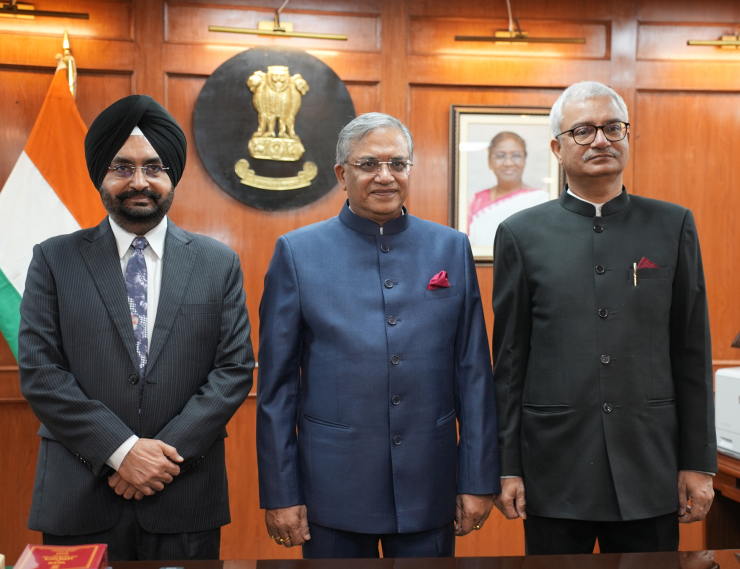
A newspaper investigation published on Wednesday revealed that two of India’s three Election Commissioners repeatedly objected, in writing, to decisions taken in the name of the Election Commission of India (ECI) without their knowledge. The revelation triggered a political storm, with opposition parties demanding the resignation and, in several cases, the arrest of the Chief Election Commissioner (CEC), Gyanesh Kumar.
The Election Commission of India is the constitutional body responsible for conducting elections across the country, the world’s largest democracy by population. It has three members of equal rank: the Chief Election Commissioner, considered “first among equals” with no power to overrule the other two, and two Election Commissioners. Under a 2023 law governing the Commission’s functioning, all decisions must “as far as possible, be transacted unanimously,” and where members differ, the matter is decided by majority vote.
According to the investigation by The Indian Express, reported by journalist Ritika Chopra, Election Commissioners Sukhbir Singh Sandhu and Vivek Joshi formally objected on record at least 14 times over the last 10 months, on one occasion filing four objections in a single day. The objections related to core functions of the Commission: the addition of new voters, deletion and restoration of names from electoral rolls, the filing of appeals in ongoing court proceedings, and control over the electoral roll database itself. All the objections were copied to CEC Gyanesh Kumar.
The disputes arose during the Special Intensive Revision (SIR), a nationwide exercise to clean up voter lists that began in the eastern state of Bihar in June 2025 and has since been carried out in 30 states and union territories. The exercise has resulted in more than 13 crore (130 million) names being struck off draft voter rolls, a figure larger than the population of most countries.
Among the objections, Sandhu called changes made to Form 6, the form used by citizens to register as new voters, “unauthorised and illegal.” According to the investigation, Sandhu first learned of the change from the Indian Express’s own reporting in July, and wrote on file in August that it was unlawful. The revised form asked new applicants whether they, or their parents or grandparents, “exist” in “the electoral roll of last SIR” before allowing them to submit the application. Both Commissioners had recorded in May, before the change was made, that the statutory form could not be altered without the government first amending the Registration of Electors Rules, 1960. The objection made no difference. As of Monday, the disputed question remained on the form.
Joshi separately flagged what he called the “gradual centralisation” of the electoral roll database, the digital system, now called ECINet, through which voter names are added, deleted or corrected. Joshi proposed an audit to confirm that only authorised statutory officers could make changes to the database. That audit never took place. When the Commission had launched ECINet in January, Kumar had said it was built in “strict accordance” with the law. Sandhu, in August, recorded that state level election officials, the frontline officers who administer polls in each constituency, were reporting they lacked “proper and complete access” to the portal used to maintain voter rolls, and questioned the legal authority of the Commission’s Director General of IT, Seema Khanna, to restrict such access.
In the eastern state of West Bengal, the Supreme Court had handed over the final stage of the SIR process to around 700 judicial officers, who were tasked with deciding the fate of voters flagged for “logical discrepancies,” essentially mismatches thrown up by the software when a voter’s details did not tally with an older roll. These officers eventually deleted 27 lakh (2.7 million) voters and retained 33 lakh (3.3 million) on the rolls. The Commission subsequently told the court that 16.10 lakh (1.61 million) appeals had been filed seeking removal of voters the officers had chosen to retain, appeals that the investigation found were mostly filed in the name of a single officer through the same software, at the click of a button. Sandhu wrote to Commission officials asking who had authorised the filing of these appeals and who had actually filed them. He recorded that neither he, nor Joshi, nor West Bengal’s own Chief Electoral Officer had been informed.
In the western state of Goa, local election officers heard cases of 97 voters flagged for logical discrepancies, as directed by the Supreme Court, and found them eligible to be restored to the rolls. But the software had no provision to record that decision. Goa’s Chief Electoral Officer wrote to Delhi eight times between February 11 and 17 seeking a rollback option that would let officers reverse the deletions, copying Seema Khanna each time. A Deputy Election Commissioner in Delhi wrote to the IT department on February 18. The requests went unanswered, and four days later, when Goa published its final electoral roll on February 21, all 97 names remained missing.
The investigation also found that Sandhu and Joshi wrote separately to the Cabinet Secretary, India’s senior most bureaucrat, in July, objecting to changes in administrative work allocation that had removed a layer of their oversight over the Commission’s IT division. Following this, on September 9, the three Commissioners held their first full meeting in four months.
The Indian Express said it sent a questionnaire to the Commission on September 21 and also wrote to and telephoned both Commissioners, but received no response before publication.
Responding to the report, the Election Commission issued a statement saying all its decisions, including those related to the SIR, “have been unanimous and with the approval of both the Election Commissioners and the Chief Election Commissioner.” It said written notes and internal queries were “standard, ongoing practices” within a multi-member body, and that highlighting specific notes over a 10-month period, while ignoring the Commission’s larger body of work, including around 40 new initiatives, gave only “one part of the picture.” It added that its digital platforms operated under “strict data security protocols” and that statutory officers continued to function under their legal powers.
The report drew a sharp political reaction. Opposition leaders, from parties that together oppose the ruling Bharatiya Janata Party (BJP) at the national and state level, including Congress’s Rahul Gandhi, Trinamool Congress leader Mamata Banerjee (a former West Bengal chief minister), DMK chief M.K. Stalin (Tamil Nadu’s chief minister), Aam Aadmi Party’s Arvind Kejriwal and Shiv Sena (UBT) leader Uddhav Thackeray, demanded Kumar’s removal, with several calling for his arrest and a court monitored investigation. Banerjee also demanded fresh state Assembly elections in West Bengal using the electoral roll that existed before the SIR was carried out. Congress MP Priyanka Gandhi Vadra said that if the CEC was aware of elections being rigged and allowed it, that would amount to “treachery to the nation” and “an act of treason,” and said those responsible must be “taken to task” following a proper investigation. Congress leader Abhishek Singhvi cited a 1995 Supreme Court ruling to argue that the CEC held no supreme authority over the other two members, and said Kumar had “no right to continue in office even for a second.”
Supreme Court senior advocate Sanjay Hegde told The Telegraph Online that if a majority based decision making process had not been followed by the Commission, its decisions would be “vulnerable to judicial review.” Former bureaucrat Jawhar Sircar, recalling past instances of dissent within the Commission involving former commissioners Ashok Lavasa and Arun Goel, said the fact that two commissioners had put their objections in writing “shows a lack of trust.”