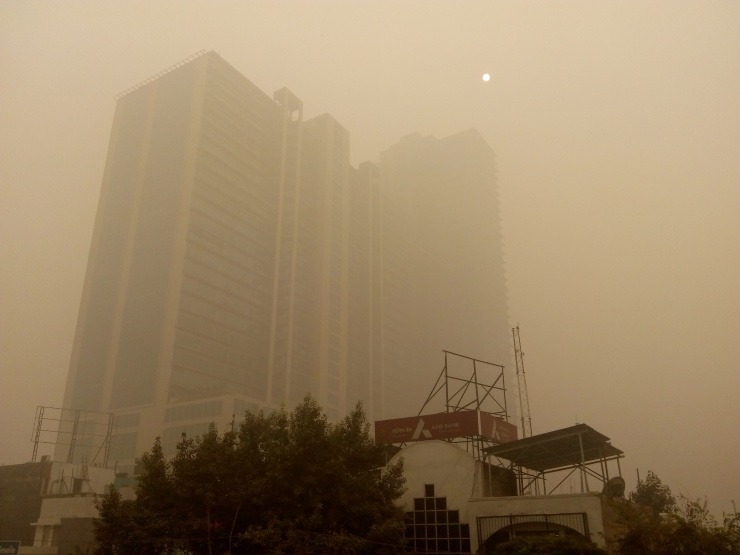
Delhi overtook Lahore in Pakistan on Friday, November 13, to become the world’s most polluted major city. Thick smog settled over the Indian capital of 20 million people and cut visibility across its roads.
IQAir, a Swiss monitoring group that bases its measurements on the level of toxins in the air, ranked Delhi first globally that day. It gave the city an Air Quality Index (AQI) score of 334, a level it classes as “hazardous”. On this index, only scores of 50 or below count as good and carry little or no health risk.
India’s Central Pollution Control Board (CPCB), the government’s official monitor, put Friday’s figure at 403 and called it “severe”. The Swiss and Indian numbers differ because each body follows its own scale and method for measuring and grading the air. India’s system treats scores from 301 to 400 as “very poor” and from 401 to 500 as “severe”.
The CPCB figure rose to 419 by 8:40 a.m. on Friday, the IANS news agency reported. Thirty-three of the city’s 58 monitoring stations were in the severe band, and several went above 450. The Indian Institute of Technology (IIT) Delhi campus registered 488, Chandni Chowk, a historic market district, 479, Delhi University’s North Campus 478 and Pusa 469. Punjabi Bagh and Burari Crossing stood at 456 each.
The smog spread into the National Capital Region (NCR), the cluster of satellite cities ringing Delhi. Noida touched 474, in the severe range. Gurugram, Ghaziabad and Greater Noida logged 352, 369 and 351 respectively, all classed “very poor”.
Footage from news agency ANI showed traffic on the city’s main roads moving through the haze, with the smog appearing to blot out street lights.
According to AQI.in, India accounted for 86 of the world’s 100 most polluted cities on Friday.
The India Meteorological Department, the national weather agency, had forecast that Delhi’s air would stay in the “very poor” to “severe” range until today, with better wind conditions possibly bringing relief after that. Maximum temperatures were expected to range between 27 and 30 degrees Celsius and minimums between 14 and 17 degrees Celsius until Sunday.
On November 6, the Commission for Air Quality Management had put Stage III of the Graded Response Action Plan into force across Delhi and the NCR as a precaution while conditions deteriorated. The plan is India’s tiered system of emergency measures, which grow stricter as the air gets dirtier.
Winter brings a recurring smog season to much of northern India and to Pakistan. Cold, heavy air traps exhaust from vehicles, dust from building sites and smoke from farm fires. In Delhi, industry, coal-fired power plants, falling temperatures and weak winds add to the burden. Burning of crop residue in the nearby states of Punjab and Haryana adds to it, as do firecrackers lit after Diwali, the Hindu festival of lights.