On the night of 24 May, armed groups opened simultaneous fire on Mongkot Chepu, a Kuki-Zo village in Manipur’s Ukhrul district, from multiple directions. The attack came after nearly a week of relative calm. The following morning, hundreds of Nagas marched through the state capital Imphal demanding the release of six men from their community missing since 13 May. Letters from Kuki-Zo organisations landed on the desk of the Union Home Minister in New Delhi, contesting allegations against one of their village chiefs and asking why the government was not talking to them.
The conflict, which erupted on 3 May 2023, pits the Meitei community, predominantly Hindu or followers of the indigenous Sanamahi faith, who inhabit the state’s central valley, against the Kuki-Zo people, tribal communities living largely in the surrounding hills who are predominantly Christian. It began over issues of land, political representation and historical tensions, and has since displaced tens of thousands, claimed hundreds of lives, and in recent weeks drawn in a third community, the Nagas, further complicating an already fragile situation.
Fresh Attack on Mongkot Chepu
According to a statement by the Kuki CSO Working Committee, Ukhrul (WCKCSOs-Ukhrul), a civil society body representing Kuki-Zo interests in Ukhrul district, the attack on Mongkot Chepu came simultaneously from Leingangching at S. Laho Tangkhul Village, the vicinity of Litan Police Station, and the Lilen Ridge of Sikibung at Sharkaphung Tangkhul Village. “The synchronised nature, timing, and direction of the assault unmistakably point to a premeditated and coordinated armed aggression against the Kuki-Zo populace of Mongkot Chepu,” it said.
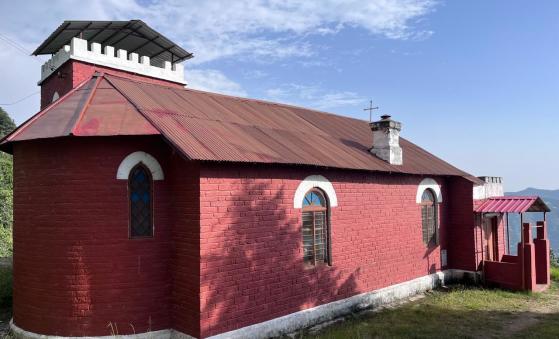
The attack had begun earlier that day when churchgoers returning from worship came under fire from the Lilen Ridge of Sikibung at around 4 PM. One villager, Mr. Ngamkhohen Khongsai, narrowly escaped death, sustaining an injury to his palm. The 8 Bihar Regiment responded to the night attack and provided timely deterrence, though WCKCSOs-Ukhrul said security forces remained constrained by a limited operational mandate. “Mere deployment without adequate mandate has emboldened armed perpetrators to operate with near impunity. Passive containment is no longer tenable,” the statement said, calling for a decisive mandate to neutralise those firing on civilian settlements.
The Kangpokpi Killings and the Hostage Crisis
The violence in Ukhrul was the latest in a series of incidents that began on 13 May in Kangpokpi district, roughly 30 kilometres north of Imphal, when three pastors of the Thadou Baptist Association India were killed in an ambush while returning from a meeting. The Thadou are the single largest tribal community in Manipur, with a distinct language, culture and history, and their apex body, Thadou Inpi Manipur, has consistently rejected being subsumed under the broader “Kuki-Zo” label used by other hill tribal organisations. When Kuki organisations described the slain pastors as “Kuki-Zo,” Thadou Inpi Manipur rejected the framing sharply, declaring the three men “Thadou Martyrs” and demanding their distinct identity be respected even in death.
The three pastors were Rev. Dr. Vumthang Sitlhou, president of the Thadou Baptist Association India and former general secretary of the Manipur Baptist Convention; Pastor Kaigoulun Lhouvum, the association’s secretary for finance, youth and music; and Pastor Paogoulen Sitlhou, its superintendent pastor. They had attended the United Baptist Convention Assembly in Churachandpur and were returning to Kangpokpi when gunmen ambushed their convoy on the Imphal-Tamenglong highway in broad daylight.
The killings set off a chain of events that brought the Naga community into the centre of the crisis. Hours after the ambush, more than 38 people were abducted by armed groups in Kangpokpi and Senapati districts. Of those, 32 have since been released, including 12 Naga women and 16 Kukis. Six Naga men from Konsakhul village remain missing nearly two weeks later. Kuki Inpi Manipur maintained that 14 members of their community continued to be held by Naga armed groups, a claim not independently verified. The Kuki-Zo Council, in its letter to the Home Minister, warned that the killing of the three pastors risked being forgotten amid the hostage crisis. “There is a growing concern that public attention is being diverted away from the brutal murder of the three pastors,” it said.
Naga Rally in Imphal
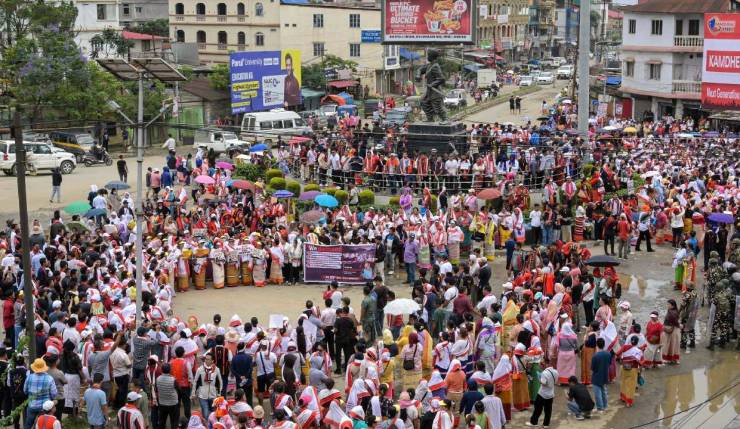
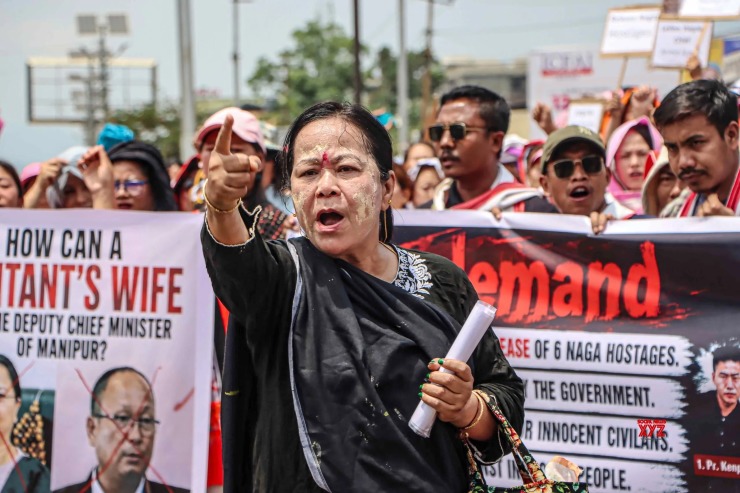
On Monday, May 25, hundreds of Nagas marched through Imphal demanding the immediate release of the six missing civilians. The rally, organised by the Naga People’s Union Imphal and joined by members of the Meitei community, began at the Tribal Market area in Imphal East and moved towards the chief minister’s bungalow before security personnel stopped it near the Palace Gate. A delegation submitted a memorandum to Chief Minister Yumnam Khemchand Singh demanding immediate action against those allegedly responsible for the abductions, the removal of Deputy Chief Minister Nemcha Kipgen, whose husband allegedly heads the Kuki National Front (Presidential), abrogation of the Suspension of Operations pact, an agreement under which certain Kuki armed groups have agreed to cease hostilities in exchange for designated camps, and deportation of what it termed “Kuki refugees.” The pact has been a persistent grievance for Meitei and Naga groups, who argue it gives Kuki armed groups institutional protection. Kuki-Zo representatives counter that demands for its abrogation would leave their communities defenceless.
Protesters raised slogans including “Release Six Nagas without condition” and “Repeal SoO.” Separately, Youth Congress chief W Anandh Singh reportedly knocked on the gate of the chief minister’s residence demanding his resignation for failing to restore peace.
Kuki-Zo Council Contests Allegations, Seeks Equal Engagement
The Kuki-Zo Council’s letter to Home Minister Amit Shah also contested allegations by certain Naga organisations against Shri Lalboi Vaiphei, Chief of Leilon Vaiphei Village in Kangpokpi District, linking him to the abductions. The Council said the allegations, widely circulated on social media, were baseless. “At the time the incident occurred, he was out of station for medical reasons,” the letter stated, warning that the circulation had placed his life at risk. The Council also appealed for the government to engage with Kuki-Zo leaders alongside the Naga groups. “Failure to do so may create a public perception that the Government is listening only to one side of the issue,” it said.
Peace Agreement Group Found Selling Looted Weapons
On 22 May, joint security forces comprising Manipur Police, Assam Rifles and the CRPF recovered 67 weapons from the United National Liberation Front (Pambei), known as UNLF(P), a valley-based insurgent outfit predominantly drawn from the Meitei community, with which the Central government had signed a peace agreement in 2023. Police said cadres were actively selling these weapons commercially, including weapons looted from state armouries when ethnic violence erupted in 2023. Around 6,000 weapons were taken in those lootings, and their recovery has been a stated security priority ever since.
Weapons recovered at an unauthorised UNLF(P) camp at Lamdeng in Imphal West and in a separate operation in Lamshang included 27 AK-series weapons, 11 M-series rifles, four 9-mm pistols, one RPG-7, and one INSAS LMG. Four cadres were arrested after associates opened fire on security forces during the operation. On interrogation, they named self-styled Lance Corporal Naorem Bijoy, alias Macha, as having instructed the sales, and admitted to earlier transactions.
The find sat uncomfortably alongside Monday’s rally. Naga and Meitei groups marched through Imphal demanding abrogation of the pact governing Kuki armed groups, while days earlier security forces had recovered an arsenal from an unauthorised camp of a Meitei armed group operating under its own peace agreement with the same Central government, in the valley itself.
Government Response
On Saturday, May 23, Chief Minister Singh announced both the killing of the three church leaders and the case of the six missing Nagas would be handed to the National Investigation Agency, India’s premier counter-terror investigation body, following a meeting with a delegation of the United Naga Council. Director General of Police Rajiv Singh said operations to trace missing persons were ongoing, with sniffer dogs deployed across the hill districts. Since June 2023, authorities have identified 5,406 sensitive or communal social media posts, taken down around 3,200, and blocked 187 pages and accounts. “I appeal to the public to extend maximum cooperation to security forces,” he said.
Voices of the Church
The crisis has placed particular strain on Manipur’s Christian communities, divided not only along the Kuki-Naga fault line that has sharpened in recent weeks, but across the longer conflict between the predominantly Christian hill tribes and the largely Hindu and Sanamahi Meitei valley community.
Rev. Vijayesh Lal, General Secretary of the Evangelical Fellowship of India, the national evangelical umbrella body and a charter member of the World Evangelical Alliance, spoke directly to that pain:
“The murder of three church leaders returning from Christian fellowship is a wound the entire Church in India must feel. One of them, Rev. Dr. Vumthang Sitlhou, had given much of his life to building peace between communities. That a man committed to reconciliation should die in this way shows how deeply Manipur needs healing.
To our brothers and sisters across the communities of Manipur, especially those who confess the name of Christ, we say this with grief and hope: the Gospel does not permit us to become enemies of one another.
For three years, Manipur has carried fear, displacement, loss, and uncertainty. Every child in a relief camp, every family separated from home, every life wounded by violence matters before God and must matter to us all.
We appeal to all communities to step back from violence and to see one another again as people made in the image of God. We urge the government to pursue a just and lasting political resolution with urgency. We ask the Church in India and around the world to continue praying for all the people of Manipur, for comfort, healing, wisdom, and peace.”
In an interview with Catholic Connect on the third anniversary of the conflict, Archbishop Linus Neli of the Archdiocese of Imphal said only around 10 per cent of displaced persons had been resettled, with the rest still in relief camps, without livelihoods, their children’s education disrupted. The Church has been providing material support, counselling and educational assistance across community lines, he said, though even among Catholic clergy some priests and sisters cannot cross community lines freely. “We are trying to build an atmosphere of coexistence and understanding of common human needs,” he said.
On what resolution requires, he was unambiguous. “This will not come unless there is a political solution. A political solution is still not forthcoming.” Even the government, he said, was finding it hard to restore normalcy given the ethnic, political and religious aspirations pulling communities apart.
“Even after three years, there are still no signs of forgiveness or reconciliation, and both sides continue in a mode of separation,” he told Catholic Connect. “It will take time, and that time is very much required because time heals. Even generations may carry forward unforgiving and irreconcilable attitudes.”