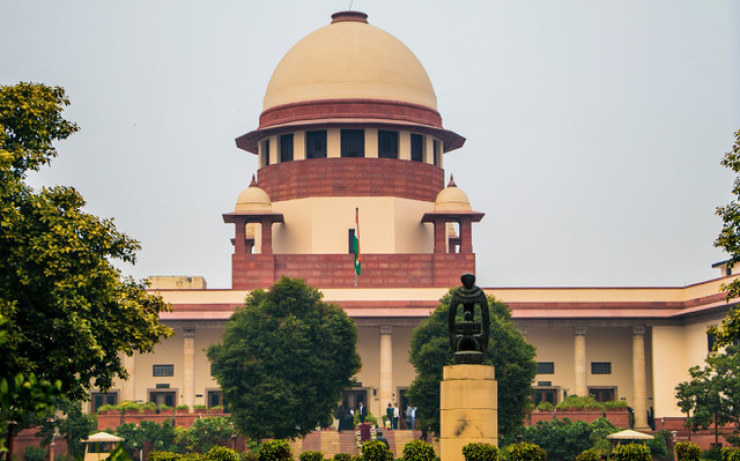
The Supreme Court on Wednesday, May 13, declared that majoritarianism cannot trump constitutionalism in a constitutional democracy, asserting that courts retain the power to interfere when faith-based customs violate “public order, morality or health.”
The declaration came during the 15th day of arguments before a nine-judge Constitution bench headed by Chief Justice of India Surya Kant, hearing a reference arising from the 2018 Sabarimala judgment that has grown to encompass questions of religious freedom cutting across virtually every major faith in the country.
The sharpest exchange of the day came when Solicitor General Tushar Mehta urged the court to limit judicial scrutiny of religious matters, arguing that reform is best left to the legislature, citing the abolition of sati as an example.
“Religion reforms from within. The question is, can the court act as a reformer of religion? My respectful and unapologetic answer would be a no,” Mehta said.
Justice Ahsanuddin Amanullah disagreed sharply, asking whether religious issues should be left to the legislature “sheerly because of majoritarianism.” When Mehta pushed back, saying “It is democracy. Democracy means majority,” Justice Joymalya Bagchi drew a firm distinction.
“It is not majoritarianism which the court is bothered about. The court is essentially bothered about majoritarianism trumping constitutionalism and that is the ‘lakshman rekha.’ We are committed to a democracy which is definitely a test of numbers, but we are also a constitutional democracy. So even if a majority feels that a particular thing is to be done, the courts have that role to test that decision from the constitutional principles,” Justice Bagchi said.
Justice BV Nagarathna added that a court equally cannot strike down a religious tradition through a writ petition under Article 32, calling such an approach “erroneous.”
The bench also observed that Hinduism is a way of life and that visiting a temple or performing rituals is not mandatory for a Hindu. “Even if an individual lights a lamp inside his hut, it is enough to prove his religion,” it said, challenging the 1966 formulation that defined a Hindu as one who accepts the Vedas as supreme authority.
The case, which began on April 7, carries stakes far beyond the Sabarimala temple in Kerala. Sixty-six matters are tagged to the reference, raising parallel questions across faiths. The All India Muslim Personal Law Board told the court that while Muslim women are not barred from praying in mosques, they cannot insist on entering through the main door or object to partitions separating men and women. The court earlier observed that excommunicating Parsi women who marry outside their community appeared discriminatory. Arguments against excommunication practices in the Dawoodi Bohra community, including female genital mutilation, also came before the bench across multiple hearing days.
At the heart of all these disputes is a single constitutional tension: how far Article 26, which protects denominational autonomy in matters of faith, can override individual fundamental rights guaranteed under Articles 14, 21, and 25. Senior Advocate Rakesh Khanna argued before the bench that denominational rules remain subject to Article 13, which bars any law that derogates from fundamental rights. The Solicitor General countered that judicial review must proceed from the perspective of a believer, not solely from constitutional tests of equality or non-discrimination.
The bench, which also includes Justices MM Sundresh, Aravind Kumar, Augustine George Masih, Prasanna B Varale, and R Mahadevan, reserved its verdict on Thursday, May 14, after 16 days of arguments. Its definition of what constitutes an essential practice, and how far denominational autonomy can shield internal customs from constitutional scrutiny, will govern not just the Sabarimala temple but mosques, fire temples, and community institutions across the country.