The eastern Indian state of Odisha has refused to release Rabindra Kumar Pal, better known as Dara Singh, who is serving a life sentence for burning to death Australian missionary Graham Staines and his two young sons at Manoharpur village in 1999. The Supreme Court, India’s top court, was told of the decision on September 17 and allowed Singh to challenge it. Christian organisations have responded, one of them welcoming the decision, while a senior journalist has questioned the state’s stated reasoning.
The State Sentence Review Board, the official panel that reviews the cases of life convicts and recommends whether they may leave prison early, rejected Singh’s plea for remission, the government’s reduction of a prison term, at a special meeting on August 31.
The Board considered a report from the Kendujhar (also spelt Keonjhar) district administration, dated August 28. The report said a crowd of 200 to 250 people linked to a group called Dara Sena had gathered outside the district jail on August 15, India’s Independence Day, over his proposed release, and that “provocative slogans” were reportedly raised.
The Board called the report inconclusive, saying it lacked specific recommendations. It cited possible societal fallout, including the risk of communal disturbance, meaning violence between religious communities.
The Board also weighed Singh’s convictions in three murder cases. “In view of all the above mentioned facts and circumstances, the Board is therefore not inclined to recommend his premature release at this stage,” the proceedings say.
Singh has reportedly served over 26 years in prison, and prison authorities had earlier recommended release for good behaviour. Authorities in Auraiya, Singh’s home district in Uttar Pradesh, had backed the recommendation in February 2026.
The United Christian Forum (UCF), a New Delhi-based group that runs a helpline guiding people to legal remedies, welcomed the decision in a press release dated September 16, which it shared with Christian Today India. The release said Christian forgiveness “cannot be confused with freedom from legal consequences”. It praised Gladys Staines, who publicly forgave those responsible for killing her husband and sons. UCF National President Dr Michael Williams said: “Forgiveness is a spiritual and personal act; remission is a legal and governmental decision carrying consequences for society as a whole.” He added that remission “cannot become a mechanism through which ideologically motivated violence is trivialised, normalised or rewarded”.
The release also recalled the anti-Christian violence of 2007 and 2008 in Odisha’s Kandhamal district, in which, it said, official records show at least 39 deaths and civil-society groups estimate many more. Church and human rights groups say about 100 Christians were killed. The release urged authorities to decide such remission cases without political or ideological pressure.
The Evangelical Fellowship of India (EFI), the national network of evangelical Christians also responded. Its General Secretary, Rev. Vijayesh Lal, told Christian Today India: “Graham Staines was well known to the Evangelical Fellowship of India, and we had longstanding links with the mission in which he served. His life of service, and Gladys Staines’ continuing forgiveness, remain a powerful Christian witness. At the same time, the passage of years must not diminish the gravity of what happened at Manoharpur, nor should those convicted of such violence be turned into figures of public honour. The Odisha government has now taken its decision, and we trust that the legal process will take its course fairly, free from political or ideological pressure.”
Singh first approached the Supreme Court in 2024, complaining that the state had not decided his remission application. On March 19, 2025, the court told Odisha to decide within six weeks. On August 19, the state told a bench of Justices Manoj Misra and Vijay Bishnoi that a report from the Kendujhar jail was still awaited. “If you don’t take a decision, we will,” the bench told the state’s counsel. On September 8, the bench warned that officials could be summoned if the state kept delaying. “You can’t keep it lingering like this,” it said.
On September 17, the bench recorded: “The state has rejected the plea of remission with order dated 31.8.26. The learned counsel for the petitioner is allowed to file an appropriate amendment application. List after 3 weeks.” It did not examine the state’s reasons. “You take whatever grounds you want to take to challenge it. Amend your petition and then argue,” Justice Misra told Singh’s counsel. Singh’s lawyers have two weeks to file the amended petition, and the court asked the state to share the Board’s proceedings.
The Board had rejected Singh’s plea five times earlier, beginning in November 2016, and deferred it repeatedly since November 2024. It meets every three months and can reconsider a rejected case.
Singh’s advocates, Hari Shankar Jain and Vishnu Shankar Jain, argue that he has served over 25 years and qualifies under the state’s remission policy. He calls his crimes a “fit of youthful rage” and says he is repentant. They rely on the reformative theory of punishment, which holds that jail should aim to rehabilitate, and on a 2022 Supreme Court judgment that freed the convicts in the assassination case of former Prime Minister Rajiv Gandhi.
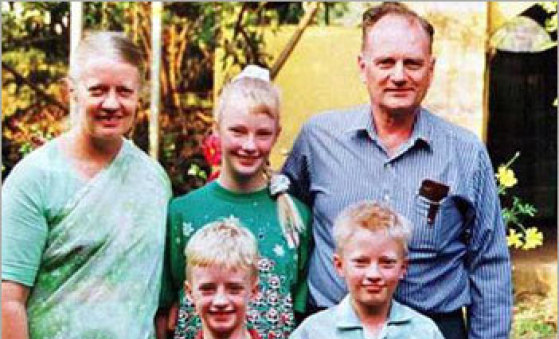
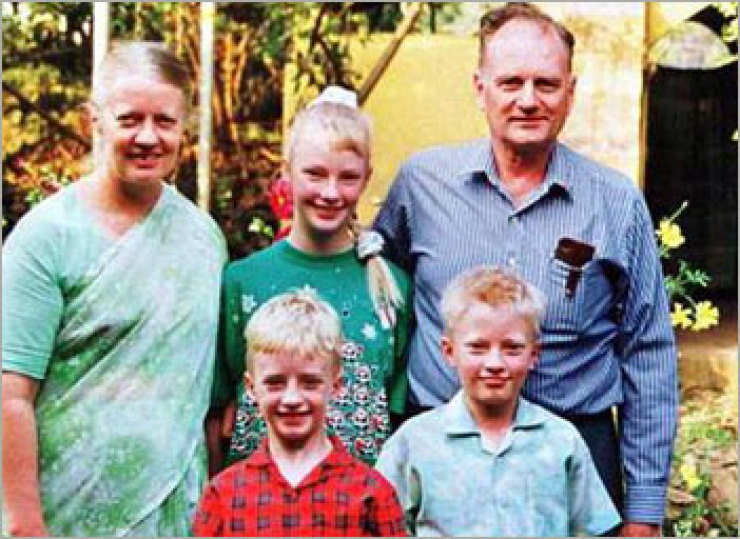
Graham Staines had worked since the 1960s with leprosy patients and tribal communities in Odisha’s Mayurbhanj district. On the night of January 22, 1999, he and his sons Philip, about 10, and Timothy, about 6, were sleeping in a station wagon when a mob set the vehicle on fire. Police records and the Supreme Court’s 2011 judgment say the attackers stopped them from escaping. The same judgment linked the killings to Staines’s alleged conversion work, but the Supreme Court expunged those remarks four days later, saying they could be misinterpreted. The Wadhwa Commission, an official inquiry set up after the killings, had found no evidence that Staines had carried out forced conversions.
Singh, then a Hindi teacher in the district, was arrested on January 31, 2000 and was reported to be a member of the Bajrang Dal. The Bajrang Dal is the youth wing of the Vishva Hindu Parishad, part of a family of Hindu nationalist organisations known as the Sangh Parivar. An analysis of the Wadhwa Commission’s record by the South Asia Human Rights Documentation Centre, a rights group critical of the Commission’s conclusions, says the Commission’s investigating team found that Singh was an activist and supporter of the Bajrang Dal, campaigned for the Bharatiya Janata Party (BJP) in the 1998 parliamentary elections and was seen at rallies of the Rashtriya Swayamsevak Sangh (RSS), another member of that family.
A special court sentenced Singh to death in 2003. The Orissa High Court commuted the sentence to life imprisonment in 2005, and the Supreme Court upheld that in 2011, ruling that the case did not meet the “rarest of rare” standard India applies before imposing capital punishment. Singh also received life sentences for the murders of Catholic priest Father Arul Doss and garment trader Shaikh Rahaman. His co-convict Mahendra Hembram was released early on April 16, 2025, after 25 years in prison, on grounds of good behaviour.
The rejection came under Chief Minister Mohan Charan Majhi of the BJP, which currently governs Odisha. In 2022, when the BJP was in opposition, Majhi was its chief whip in the state assembly. In September that year, he joined Sudarshan TV editor Suresh Chavhanke, who had been refused permission to meet Singh in jail, in a sit-in known as a dharna outside the Kendujhar jail.
The Supreme Court will hear Singh’s amended petition after about three weeks. The court will then have to consider not only the delay but whether the reasons recorded on August 31 justify the refusal.