When Dutch Prime Minister Rob Jetten told local reporters on Saturday that minorities in India were “under severe pressure” and that press freedom was a cause for concern among EU member states, the Indian government pushed back sharply.
Ministry of External Affairs Secretary (West) Sibi George said the remarks reflected “a lack of understanding of the person who asks the question.” He described India as a five-thousand-year-old civilisation of unparalleled diversity and pointed to the growth in India’s minority population since independence as proof of the country’s pluralism.
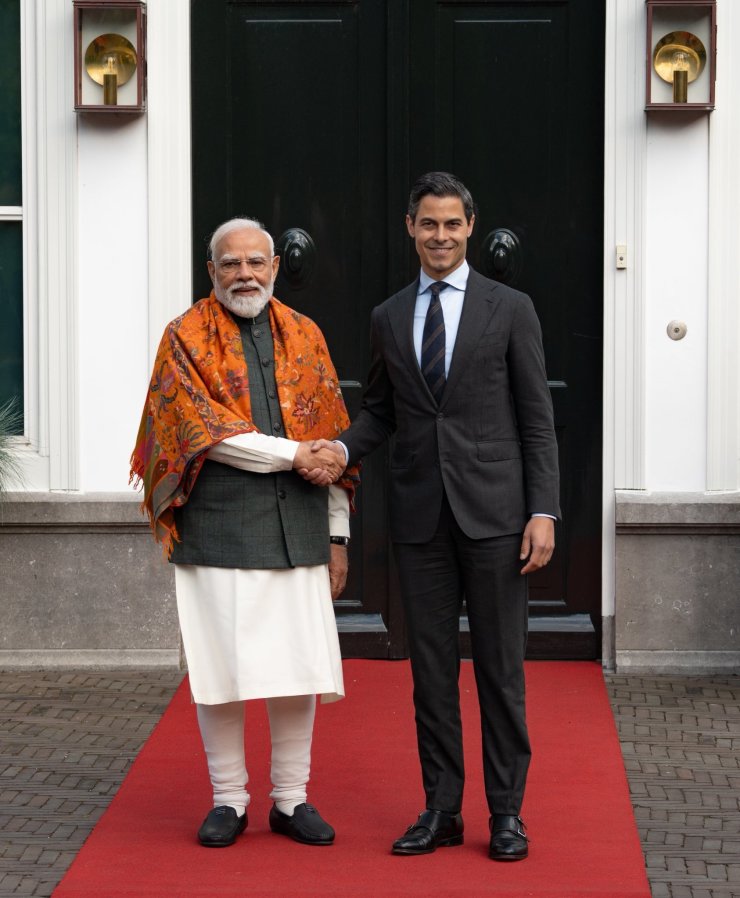
The exchange took place during Prime Minister Narendra Modi’s two-day state visit to the Netherlands, part of a five-nation European tour.
Jetten spoke to Dutch media on Saturday, before Modi arrived at Catshuis, the Dutch PM’s official residence in The Hague, for dinner and bilateral talks. According to two major Dutch newspapers, De Volkskrant and NRC, he said there were concerns among the Netherlands and other EU member states about “developments in India” under the BJP government.
“It is not only about press freedom, but also about the rights of minorities, who are under severe pressure. That applies in the first place to the Muslim community, but also to many other smaller communities,” he was quoted as saying. “The concern is to what extent India remains an inclusive society where the same rights apply to everyone.” He added that these concerns were “regularly raised” with the Indian government.
The visit had been overshadowed for weeks in the Dutch media by the case of Insiya Hemani, a twelve-year-old Dutch national who was two years old when her father took her from Amsterdam in September 2016 in a violent, planned abduction and brought her to India.
Her mother Nadia Rashid, who holds custody by Dutch court order, has had no contact with her daughter for nearly a decade. The Dutch Supreme Court last year confirmed the convictions and sentences of five men involved in the abduction, sentencing the father, Shehzad Hemani, to eight and a half years in prison. India is not a signatory to the 1980 Hague Convention on International Child Abduction, and repeated diplomatic attempts over nearly a decade have failed to bring her home.
Every Dutch member of the European Parliament wrote to Maharashtra MPs before the visit. The Dutch lower house passed a resolution asking King Willem-Alexander to raise the matter with Modi personally. When Modi arrived at the Huis ten Bosch royal palace on Saturday, Rashid stood outside the gates with dozens of supporters, holding a sign addressed to both leaders asking, “When is Insiya coming home?”
Reporters Without Borders ranked India 157th out of 180 countries in its 2026 World Press Freedom Index, released on April 30, a six-place drop from the previous year, placing it below Palestine. The index is led by Norway, the Netherlands, Estonia, Denmark and Sweden.
At India’s fourth Universal Periodic Review at the UN Human Rights Council in November 2022, 130 member states made 339 recommendations. At least 21 countries specifically urged India to improve its protection of freedom of religion and the rights of religious minorities. Human Rights Watch, Amnesty International and the International Federation for Human Rights were among the organisations that noted India had failed to implement recommendations it had formally accepted in the previous UPR cycle.
The US Commission on International Religious Freedom has recommended for several consecutive years that India be designated a Country of Particular Concern, citing rising attacks on Muslims, Christians and other minorities. India has rejected those findings each time, with the MEA calling them “biased and politically motivated.”
In The Hague, George cited India’s civilisational pluralism, the centuries-long presence of Jewish, Christian and Islamic communities, and high electoral turnout as evidence of a thriving democracy.
“When we became independent, the minority population in India was 11 per cent. Now it is more than 20 per cent. Name a country where the population of minorities has gone up? You won’t find it anywhere other than India,” he said.
Asked whether he had seen Jetten’s remarks, George replied, “I have not seen that statement,” before proceeding to address the broader question at length.
Indian sources maintained that press freedom and minority rights did not come up during the delegation-level talks. Jetten’s own post on X after the meeting made no mention of either subject. He said the discussion had covered the closure of the Strait of Hormuz, energy prices and the Insiya case, and that both countries attached “great importance to democracy, good governance and a world order based on rules and justice.”
On the bilateral front, the visit produced concrete outcomes. The two countries elevated their relationship to a strategic partnership and adopted a roadmap covering trade, defence, critical technologies, maritime cooperation, renewable energy and education.
The most significant commercial result was a memorandum of understanding between Tata Electronics and Dutch semiconductor equipment maker ASML for the supply of advanced lithography tools for Tata’s planned chip fabrication plant in Dholera, Gujarat. Leiden University formally restituted 11th-century Chola-era copper plates to India in a ceremony attended by both leaders. Modi departed for Sweden later on Sunday.