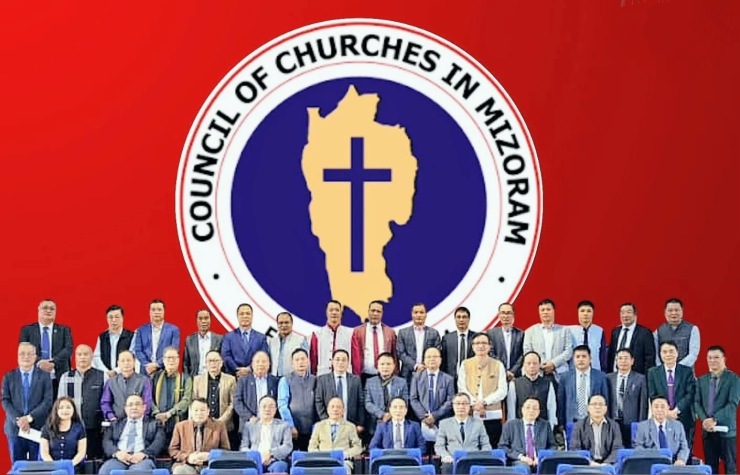
The Council of Churches in Mizoram (CCM) said on Thursday that its member churches would take to the streets of Aizawl on August 11, in what will be the first joint public show of dissent by the state’s Christian denominations against the Foreign Contribution (Regulation) Amendment Bill, 2026.
CCM president Rev. R. Lalbiakliana told reporters at the Aizawl Press Club that the call to march extended well beyond the council’s own membership, to every church in the state and to voluntary organisations as well. He acknowledged that the draft law was not without merit, but said its shortcomings outweighed the good it contained.
Nine denominations sit under the CCM’s umbrella: the Mizoram Presbyterian Church, the Baptist Church of Mizoram, the Evangelical Church of Mizoram, the Lairam Isua Krista Baptist Church, the Evangelical Free Church of India, the Isua Krista Church, the Independent Church of India, the Wesleyan Methodist Church of Mizoram and the Zomi Baptist Church.
At the heart of the churches’ objection is a clause that would allow the government to take over assets built with foreign money once an organisation’s registration lapses or is cancelled, along with tighter rules on how such funds must be reported. Congregations fear this could cripple the schools, hospitals and welfare centres they run for marginalised communities on the strength of overseas donations.
Days earlier, on July 26, congregations of the Baptist Church of Mizoram (BCM), the state’s second largest denomination, had already gathered for special prayer services over the Bill. Worshippers prayed not only for Christian institutions affected by the FCRA but also for persecuted Christians elsewhere in the country and for religious freedom more broadly.
That show of concern traced back to a sitting a day earlier, when Chief Minister Lalduhoma hosted leaders of the Mizoram Kohhran Hruaitute Committee (MKHC) and the CCM at his residence. The gathering concluded that the Bill could not be accepted in its present form, and the state government undertook to draft its own memorandum of proposed changes for the Centre. Lalduhoma is to seek a meeting with Union Home Minister Amit Shah, after which a delegation drawn from the government, MKHC and CCM would carry the memorandum to New Delhi. Should the Centre reject the state’s suggestions, the Chief Minister has indicated that ZPM’s lone Lok Sabha member, Richard Vanlalhmangaiha, would oppose the Bill on the floor of Parliament.
The state’s main opposition party, the Mizoram Pradesh Congress Committee (MPCC), wants the government to go further still, and has been pressing for a special Assembly session at which lawmakers would pass a formal resolution against the Bill. Congress general secretary Lalbiakzama, while calling the Chief Minister’s outreach to church leaders a welcome step, argued that it was not enough for the government to leave the burden of opposition to churches alone. “Rather than using church leaders as a front, the Mizoram Government and our chief minister must take the lead to fulfil the demands of the people,” he said.
This is not the party’s first show of resistance; it held a Black Day protest against the Bill on July 21, calling it an attempt to curb the rights and activities of Christian organisations. The MPCC has also asked Lalduhoma to personally head a joint delegation of church leaders, political parties and civil society groups to New Delhi, and wants the state’s Members of Parliament to speak and vote against the Bill in the House. Separately, the party objected to another central proposal, one making it compulsory to stand for or sing “Vande Mataram”, including verses invoking Hindu deities, at official functions, calling it a threat to the religious liberty the Constitution guarantees. Congress leaders pointed out that when the song was sung in the past, Mahatma Gandhi and party leaders had ensured those verses were left out.
The FCRA itself governs how individuals, associations and NGOs in India may receive and use money from abroad. Parliament’s ongoing Monsoon Session has listed the amendment bill for consideration and passage, setting the state’s churches and its main opposition party on a collision course with the Centre in the weeks ahead.