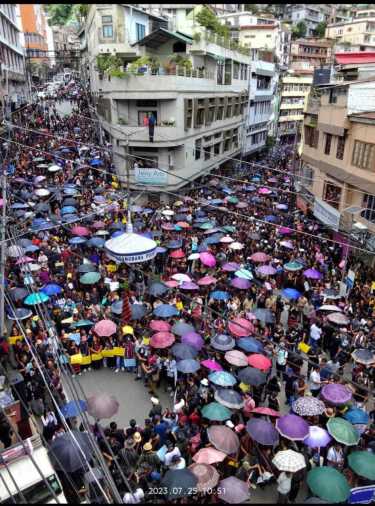
Indigenous women in Manipur have staged protests demanding justice for women killed and abused during the state’s ongoing ethnic violence. Most of the victims belong to tribal Christian communities.
The demonstrations took place on 21 and 22 January in the district headquarters of Kangpokpi and Churachandpur. Women from the Kuki-Zo indigenous communities submitted a memorandum addressed to Prime Minister Narendra Modi through local officials.
According to the memorandum, at least 29 indigenous women were killed during the ethnic conflict that began in May 2023. The victims included young and elderly women and one woman with a mental disability.
The document alleged that the violence included rape, gang rape, mob lynching, abduction, burning alive and neglect while in custody.
Protesters held placards calling for action, with slogans such as “No arrests, no justice” and “Indian women, stand with us”. They accused the authorities of allowing impunity by failing to arrest those responsible.
A church leader told UCA News that the latest protests were triggered by the death of a 20-year-old woman who had been abducted and gang raped in May 2023. She died on 10 January this year without seeing justice done.
He said the news of her death had renewed anger among women who felt the authorities had failed to act despite formal complaints and the transfer of cases to the Central Bureau of Investigation.
The violence in Manipur began on 3 May 2023, after plans to grant tribal status to the majority Hindu Meitei community were opposed by indigenous groups, most of whom are Christian.
Since then, around 260 people have been killed and more than 60,000 displaced. More than 11,000 homes and over 360 churches, schools and church institutions have been destroyed.
In February 2025, the state government led by the Bharatiya Janata Party was dismissed and Manipur was placed under direct federal rule. Despite this, peace has not yet been fully restored.
The state remains divided between the hill areas, where indigenous communities live, and the valley, dominated by the Meitei population. A buffer zone controlled by security forces separates the two sides.
Indigenous leaders continue to call for a separate administration for their territories, while Meitei leaders insist on keeping the state united.
Indigenous people, most of them Christians, make up about 41 per cent of Manipur’s population of 3.2 million. The Meiteis, who control much of the state administration, account for around 53 per cent.
Adapted from UCA News.