The Madhya Pradesh High Court has declared a medieval monument in the town of Dhar, in central India, to be a Hindu temple, ending a longstanding arrangement under which both Hindus and Muslims worshipped at the site on designated days.
The ruling, delivered on Friday, May 15, by a division bench of Justices Vijay Kumar Shukla and Alok Awasthi, declared the Bhojshala complex a temple dedicated to Goddess Vagdevi, also known as Saraswati, the Hindu goddess of learning.
It quashed a 2003 order by the Archaeological Survey of India (ASI), the government body responsible for India’s protected monuments, which had allowed Muslims to offer Friday prayers and Hindus to perform rituals on Tuesdays at the site. The Hindu petitions were allowed. The Muslim and Jain petitions were dismissed.
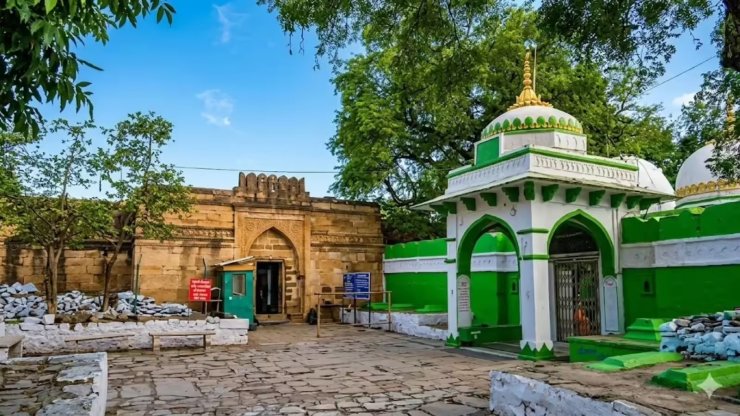
Muslims know the complex as the Kamal Maula mosque, where their community has offered prayers for centuries. Hindus claim it was originally a temple built by the medieval king Raja Bhoj in the 11th century, later altered by Islamic rulers.
The ASI, which has administered the monument since 1904, had officially listed it as “Bhojshala and Kamal Maula Mosque,” a nomenclature that itself reflected the disputed nature of the site.
The court’s 242-page judgment rested heavily on a scientific survey conducted by the ASI over 98 days in 2024, under the court’s direction. The survey recovered over 1,700 relics, including idols of Hindu deities such as Ganesha, Brahma, Narasimha, Hanuman, Saraswati and Krishna, and concluded that the current structure was built using dismantled remains of an earlier Paramara-dynasty complex.
The court also drew on the 14th century Jain scripture Prabandha Chintamani, which records that Raja Bhoj built a temple at the site in 1034 AD. Separately, the Imperial Gazetteer of India (1908) and scholar G. Yazdani’s 1929 book Mandu described the mosque structure as having been built from the remains of that earlier Hindu temple.
The Muslim side mounted a substantial legal challenge. Senior Advocate Salman Khurshid argued that questions of religious character and title require a full civil trial and cannot be determined through writ jurisdiction.
He relied on the Places of Worship (Special Provisions) Act, 1991, an Indian law that freezes the religious character of all places of worship as they existed at the time of independence in August 1947, arguing it barred any court from reopening such disputes.
The Muslim intervenors pointed to royal land grants, revenue records, and generations of imams as evidence of continuous and uninterrupted possession. A key document cited was a gazetted notification dated August 24, 1935, issued by the then Dhar State, asserting that the complex was a mosque and that Muslim prayers there should continue.
The court took the 1935 notification into cognisance and explicitly rejected it. It held that the Dhar State had no jurisdiction to pass such an order over a monument already protected under the Ancient Monument Preservation Act of 1904, and noted that the notification made no specific mention of the temple complex building itself. The Waqf claim was also rejected, with the court finding no material establishing that the land had been validly dedicated as a waqf, an Islamic religious endowment.
Advocate Vishnu Shankar Jain, who argued for the Hindu petitioners, called it “a historic verdict,” adding that the court had “granted the Hindu side the right to worship and recognised the Bhojshala complex as belonging to Raja Bhoj.”
In a measure intended to address the Muslim community’s religious rights, the court said that if the Maulana Kamaluddin Welfare Society or a duly constituted Waqf body applied for suitable alternative land in Dhar district for the construction of a mosque, the state government may consider such an application in accordance with the law.
The court additionally asked the Indian government to consider repatriating a Saraswati idol currently at the British Museum in London, as pleaded by the Hindu side. Lawyer Ashhar Warsi, who argued from the Muslim side, disputed this. The British Museum’s own records describe the idol as having been found at the City Palace ruins in Dhar in 1875, with a map marking the Kamal Maula mosque separately from that location. “Historical records clearly show that the idol was not found at the site of the Kamal Maula mosque,” Warsi told Al Jazeera. “This is an erroneous judgement. It is a clear violation of the established rule of law.”
A day after the verdict, the ASI granted Hindus unrestricted access to the complex. By Saturday, devotees had filled the site, with flower petals scattered across the stone floor and a symbol of “Om” laid out in blooms in a recessed chamber, reported the Indian Express.
At the adjoining Kamal Maula dargah, a Sufi shrine, the mood was sombre. More than 2,000 Muslims had gathered on Friday for what many feared was their last namaz at the site. Yomuddin Shaikh, a caretaker whose family has long been associated with the shrine, told the Indian Express: “My family has helped conduct the namaz here for centuries.”
The All India Muslim Personal Law Board, a prominent body representing Muslim legal interests in India, announced its support for a Supreme Court challenge. Its spokesperson S.Q.R. Ilyas called the judgment “contrary to historical facts, official records, archaeological evidence, and even the earlier stand of the ASI.”
Many shops in Dhar’s Muslim-majority older quarters remained shut on Saturday, reported the Indian Express, as the district administration appealed for calm and deployed additional police forces.