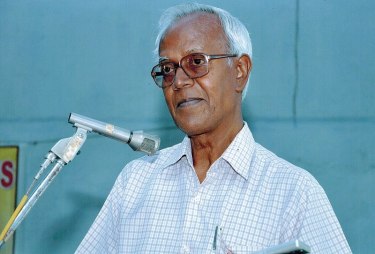
The Bombay High Court has closed a bail application filed by Catholic priest and Indigenous rights activist Father Stan Swamy, more than five years after he died in hospital while awaiting trial.
The court disposed of the application on 18 November, ruling that it had become “infructuous” because the priest had died in July 2021. Catholic leaders say the case highlights the need for courts to deal more promptly and compassionately with bail applications involving elderly and seriously ill detainees.
A division bench comprising Justices Ajay Gadkari and Ajay Sharma closed the case. Father Stan, an 84-year-old Jesuit priest, died on 5 July 2021 while receiving treatment at a private hospital in Mumbai, Maharashtra’s capital.
Born Stanislaus Lourdusamy, the priest was arrested by officials from India’s National Investigation Agency (NIA) on the night of 8 October 2020. He was taken from his home at Bagaicha, a Jesuit social work centre on the outskirts of Ranchi, capital of Jharkhand.
The NIA accused him of involvement in a conspiracy linked to violent clashes between communities at Bhima Koregaon in Maharashtra on 1 January 2018. One person was killed and several others injured in the violence.
He was also charged under the Unlawful Activities (Prevention) Act (UAPA), India's anti-terrorism law, and faced other allegations, including sedition. He was held in a Mumbai prison while the case proceeded.
During his imprisonment, Father Stan, who suffered from Parkinson’s disease and other age-related health problems, initially faced difficulties drinking water because of severe hand tremors. He was reportedly denied a sipper, despite struggling to hold an ordinary cup.
The priest was one of 16 people accused in the Bhima Koregaon case. The group included lawyers, academics and activists who had publicly criticised policies of the ruling Bharatiya Janata Party (BJP), led by Prime Minister Narendra Modi, and the BJP-led government in Jharkhand at the time.
As his health deteriorated, Father Stan applied to the special NIA court hearing his case for bail so that he could receive medical treatment. After the lower court rejected his request, his lawyers approached the Bombay High Court, citing his serious medical condition.
The high court also refused to grant bail. While in prison, the priest contracted Covid-19, further worsening his health.
After concerns about his condition were raised, the court eventually permitted him to be moved to a private hospital under police protection. However, his bail application remained unresolved, and he died while receiving treatment as an undertrial prisoner.
Father Stan was widely respected for decades of work supporting Indigenous communities in Jharkhand and other parts of India.
Father Frazer Mascarenhas, a Jesuit appointed by the court as the priest’s guardian, said the bail application had finally been closed after being listed for a routine hearing.
“We filed the application because of his poor health, but when we needed relief the most, the court did not grant it and instead kept postponing the matter,” Mascarenhas told UCA News on 20 November.
He said he planned to file a fresh petition seeking to clear Father Stan’s name of the allegations and raise concerns about prison conditions.
Mascarenhas had previously submitted a petition seeking the removal of the charges against the priest but withdrew it because of a technical error.
A.C. Michael, a Catholic leader based in New Delhi and former member of the Delhi State Minorities Commission, said the case demonstrated the need for greater sensitivity when courts consider bail requests from elderly people.
“Courts need to be more sensitive and humane when dealing with bail applications from elderly people,” Michael told UCA News on 20 November.
He added that Father Stan might have lived longer if he had been granted bail in time and allowed to receive appropriate medical care.
Source credit: UCA News.