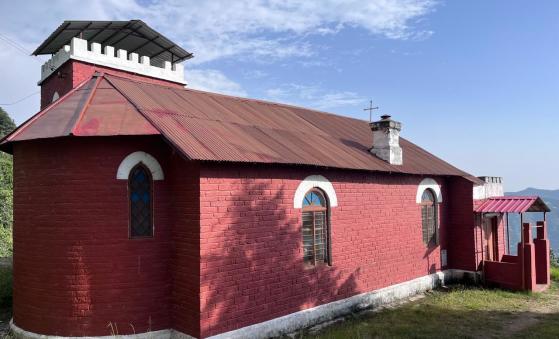
Unidentified individuals vandalised and set fire to the Executive Officer (Town) office under the District Council Administration in Churachandpur’s Hiangtam area on April 2, even as Union Home Minister Amit Shah and Manipur Chief Minister Yumnam Khemchand Singh were meeting in New Delhi the previous day to discuss restoring peace in the conflict-hit state. Police said the incident occurred between 2 pm and 3 pm and that the identities of the perpetrators remain unknown. A case has been registered.
The incident came less than a week after the Internally Displaced Persons Welfare Committee Churachandpur (IDPWCC) issued a press statement on March 27 strongly condemning remarks by State Home Minister Govindas Konthoujam, who claimed that “many families are now in a position to return home.” The committee called the statement “misleading, insensitive, and disconnected from the ground realities” faced by thousands of internally displaced persons (IDPs).
On March 25, five persons were arrested following an attack on security personnel and the burning of a security forces vehicle at Tuibong Bazar in Churachandpur. Authorities said 27 more individuals had been detained in connection with related disturbances. Separately, student bodies including the Kuki Students Organisation (Churachandpur), Hmar Students Association, and Zomi Students Federation wrote to the Chief Minister on March 29 opposing a recent transfer in the district administration, saying the new CEO/ADC appointment had prompted strong objections from community groups. These were distinct episodes; no established link between them and the April 2 arson has been confirmed by authorities.
At the Parliament House complex in New Delhi on April 1, Shah directed Singh to “accelerate the present peace process and consolidate the growing bonhomie among different communities,” and gave in-principle approval for raising a Mahila India Reserve Battalion for Manipur. The Chief Minister’s Office issued a press release on the meeting the same evening. According to reports, it was Singh’s third visit to New Delhi since assuming office on February 4.
The government’s position, as articulated by Home Minister Konthoujam on March 27, was that rehabilitation efforts were proceeding under the guidance of the Prime Minister and the Union Home Minister, and that efforts were focused on ensuring “safe, dignified, and sustainable return with proper security and essential services.” Konthoujam made the remarks after a review meeting with Deputy Commissioners, Superintendents of Police, and senior Home Department officials covering Imphal East, Imphal West, Kakching, Bishnupur, and Churachandpur.
The IDPWCC’s response highlighted three specific concerns. The committee said rehabilitation and resettlement committees at both state and district levels had been formed without including IDP representatives, thereby “undermining transparency, accountability, and participatory decision-making.” It also said the Rs. 3 lakh sanctioned per family under the Special PMAY-G housing scheme was grossly insufficient, noting that “even government school toilet constructions are being sanctioned at costs exceeding Rs. 4 lakh.” The committee further said that over 4,000 IDP families in the district who are not residing in designated relief camps had been “completely excluded from relief measures since May 2023.”
The committee demanded compensation comparable to that extended to displaced communities such as the Bru and Kashmiri Pandits, based on current market value under the Right to Fair Compensation and Transparency in Land Acquisition, Rehabilitation and Resettlement Act, 2013. It also sought free ration support of Rs. 150 per person per day for three years, a monthly stipend of Rs. 10,000 per family, Housing Building Assistance of Rs. 10 lakh, fixed deposit support of Rs. 8 lakh per family, and priority quotas in government employment.
The government had set a target of resettling over 10,000 displaced families by March 31, 2026. As of late January, authorities said 3,700 families consisting of approximately 16,500 individuals had been resettled, out of more than 60,000 people displaced since the ethnic violence broke out in May 2023. The 2026-27 state budget allocated Rs. 734 crore for rehabilitation, a figure that opposition Congress Legislature Party leader Keisham Meghachandra Singh described in the Assembly as insufficient, citing the scale of losses suffered by displaced families across communities.
Both Meitei families displaced from hill districts and Kuki-Zo families displaced from valley areas continue to live in relief camps, with no confirmed timeline for return. On March 30, the Kakching district administration ordered the closure of 11 relief camps, citing improved law and order, a move that drew concern from displaced persons. Irengbam Tombi, an IDP from Churachandpur sheltering in Imphal West, told the Assam Tribune: “We also want to return, which is why we continue to press the state government to allow us. But we also realise that Churachandpur is now entirely Kuki-dominated and our settlements have been wiped out. Who will guarantee our security? Until complete normalcy is restored, who will risk their lives?”
The IDPWCC urged the government to “engage in sincere dialogue with IDP representatives and take immediate corrective measures to ensure justice, dignity, and sustainable rehabilitation for all displaced persons.” At the time of writing, the government had not publicly responded to the committee’s specific demands.