Christians from several districts of West Bengal told a citizens’ tribunal on Monday (November 2) how mobs stormed prayer meetings in their homes, beat worshippers and assaulted women on the charge that they were converting people. Most said their attackers had not been arrested, and several said the police had failed them.
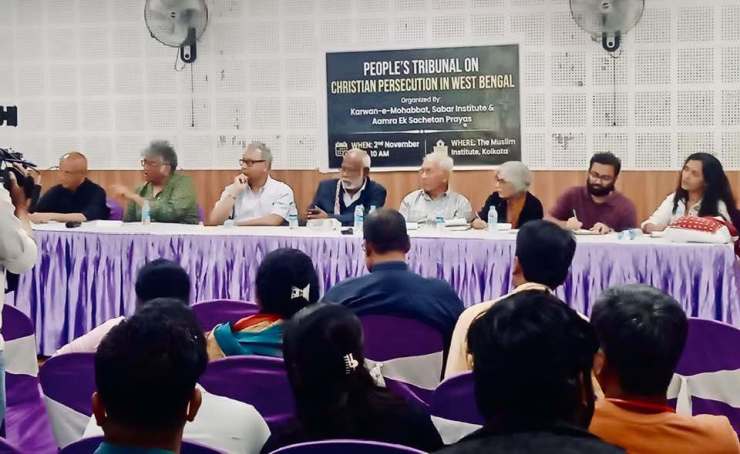
Fifteen people testified before the People’s Tribunal on Christian Persecution in West Bengal, held at the city’s Muslim Institute and organised by Karwan-e-Mohabbat, Sabar Institute and Aamra Ek Sachetan Prayas. A “people’s tribunal” is a public hearing convened by citizens rather than the government. It has no legal powers, but the organisers plan to compile the testimonies into a report for the state and central governments.
The jury included Wajahat Habibullah, a former Chief Information Commissioner of India; Jawhar Sircar, a retired bureaucrat who also served in the Rajya Sabha, the upper house of Parliament; veteran journalist and activist Dr John Dayal; historian Tanika Sarkar; researcher Omair Khan; and activists Harsh Mander, Aakar Patel and Vidya Dinker.
The Bharatiya Janata Party (BJP), the Hindu nationalist party that also leads India’s national government, came to power in the state on May 4. Several survivors said the attitude of the police had changed since then, though some had faced hostility earlier too.
Survivors’ accounts
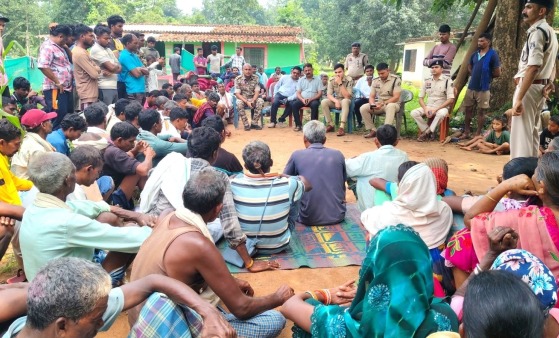
A woman from Keshpur in Paschim Medinipur district, who asked not to be named, said a mob of 80 to 100 people attacked her home during a prayer meeting on October 2. She said some of them stripped and beat her and assaulted her son, and forced her to chant “Jai Shri Ram” (“Glory to Lord Ram”), a Hindu religious slogan.
“While they were leaving after the assault, they raised slogans and said that the place had become free of Christians,” she said.
At the police station, she alleged, the officer in charge called her into a room where six or seven BJP leaders were present and told her to pray privately at home. Her First Information Report (FIR), the complaint that formally opens a criminal case in India, was registered only after a Christian forum intervened.
Mamata Joshua of Asansol in Paschim Bardhaman district said people chanting “Jai Shri Ram” vandalised her prayer hall on May 31 and broke a cross. Instead of acting, she said, the police told the congregation to stop meeting. According to her, the attackers returned on August 6 and assaulted her, her teenage daughter and an elderly member of the congregation, and she still holds prayer meetings in fear.
Tumpa Mal from Bally said people allegedly linked to the Bajrang Dal, the youth wing of the Vishva Hindu Parishad, stormed her house church on September 6, declaring that Christians would not be allowed to pray in a Hindu society. When the family went to the police, she said, a counter-complaint was filed against them.
Pastor Anup Kumar Ghosh of Midnapore town said a mob attacked during a wedding feast on July 3 and that the police watched as the family was beaten. The police then arrested Ghosh.
“I was booked under several sections, including charges of attempted murder. Though I am out on bail after spending 41 days behind bars, I have to present myself to the police station every week,” he said.
House churches targeted
Reverend Arpan Rana, state general secretary of the National Christian Council, said home fellowships, that is, small congregations that meet in private houses, had borne the brunt of the attacks. He noted that the West Bengal Religious Buildings and Places Act, 1985, places restrictions and conditions on prayers held in buildings not designated as places of worship. His council’s repeated requests to meet the Chief Minister, he said, had gone unanswered.
Herod Mullick, founder of the Bangiya Christiya Pariseba, a forum representing the state’s Christians, cited figures from India Hate Lab, a US-based research project, which recorded at least 60 hate crimes and targeted attacks on Christians in 13 districts of the state from May 13 to September 20.
What the jury said
Speaking exclusively to Christian Today India, Dayal said, that the scale of the violence had largely escaped notice. “Though the sudden onset of violence against Christians in West Bengal has become known through activists and news reports, its intensity, frequency, viciousness and the impunity or complicity of police and magistrate has gone under the radar,” he said.
The tribunal, which heard the victims in open session, “was struck by the strength of their faith, their courage and resilience, and their resolve and tenacity to pursue justice instead of immediate compromise with their assailants,” he added.
He was scathing about the attackers, whom he associated with the Sangh Parivar, the network of organisations led by the Rashtriya Swayamsevak Sangh, and about the police. “While the Sangh goons behaved with the vulgar aggression that is their wont, the behaviour of the police has been abominable. Together, it seems the political leadership has set a target to terrorise Christians, as they have done with the Muslims, and polarise the people.”
Mander asked how four months of BJP rule had been enough to brutalise society in the state and make a section of its people afraid. “This is not just a problem for Christians, it is a problem for the entire society,” he said.
Writing on social media after the hearing, Sircar said the police had refused to register FIRs in the majority of incidents. “In most cases, it was small churches and prayer groups in the homes of the poor that were the targets,” he wrote.
Karwan-e-Mohabbat (Urdu for “Caravan of Love”), a campaign Mander founded in 2017 to stand with survivors of hate crimes, has held similar inquiries this year, visiting Chhattisgarh in April and Odisha in May before a national hearing in New Delhi in June.
Church bodies speak out
The Catholic Association of Archdiocese of Delhi has also condemned the violence, listing further incidents. These include an October 26 attack on a family in Panskura, Purba Medinipur district, in which Bibles were desecrated, and a three-day ordeal in mid-October for three Christian families in Chandrakona, Paschim Medinipur district, who were forced to take part in rituals at a Durga Puja pandal (a temporary shrine for the Hindu festival). “The government must immediately restore a sense of security and send a clear reassurance to Christians living in deep fear that they are protected by the law, and that those who instigate violence will not be spared,” said the statement, signed by its president, Ephraem A. Jacob.
The Bangiya Christiya Pariseba has called a state-level prayer rally in Kolkata on Thursday (November 5).