A young Christian man in Chhattisgarh’s Kanker district says he and his family will leave their ancestral village for good rather than give up their faith in Jesus Christ, after a mob of around 150 villagers beat them with sticks on 21 September while police were slow to step in.
Vikas Salam, 24, his uncle Somji Nureti, 40, his cousin Pradeep Uike, 25, and Nureti’s 11-year-old son Rohan were taken to hospital after the attack in Bhandardigi village, Durgukondal block. Women and older family members were also beaten, according to Morning Star News, whose report this article is based on.
The three families who were targeted are related and have 18 members between them. They are the last Christians left in the village. Salam says they have followed Christ for about 10 years. Hostility from neighbours has grown over the past three years, and he blames local Hindu extremist groups for stirring it up.
The other Christian families in the village, all tribal people, have already been made to convert. “There were other Christian families in the village, but they have all been forcibly converted to Hinduism,” Salam told Morning Star News. “But we have been holding on despite extreme pressure.”
Christian leaders say right-wing Hindu groups in Chhattisgarh have spent decades blurring the line between tribal religion and Hinduism. These groups call the reconversion of tribal Christians “ghar wapsi”, or homecoming. Church leaders say it is simply forced conversion.
The families used to worship at Salam’s house. When villagers stopped them from praying there, they built a room on their own farmland outside the village. The harassment followed them there too. From 6 September, villagers broke up their Sunday gatherings three weeks in a row. Between 13 and 20 September, the families were called before the village head and council six times.
“All six times, I explicitly told them that wherever we live, we will live with Jesus Christ,” Salam said. Each time, he said, the families were abused and threatened with beatings, social boycott and expulsion. They were also cut off from the subsidised monthly government ration of rice, wheat and cooking oil that Salam’s family depends on.
On 20 September, a crowd broke up their worship again and demanded that they renounce their faith. Salam refused. The next day, around 150 people armed with wooden sticks came to where the three families live and attacked them without warning. Salam said the attackers were drunk.
“They spared nobody,” he said. Salam was choked, slapped and kicked, and was hit across the back until a stick broke. He said his whole back turned blue. Nureti was choked by the throat and neck and hurt on his ear, throat and back. Uike is very tall, so the attackers went for his back and left him badly hurt. Young Rohan was beaten on the legs so hard that he could not walk.
Salam broke away long enough to call the local police station, which is less than two miles away, but no one came. When he got free a second time, he phoned the Kanker Superintendent of Police and warned that the family would be killed. Officers then arrived.
The police took no action against the attackers, even though the injuries were plain to see. Salam said the mob had stopped the family from filming the attack. When he tried to describe what had happened, village elders cut in and told police the Christians had only been “slapped two or three times”.
Police took the four injured to hospital, where they were given painkillers and sent home. Others were treated by village doctors. Five weeks later, Salam says the family still has body pain, throat pain and hearing problems.
When they came back from hospital, they found their belongings thrown onto the road and were told to leave the village. “We overheard from the villagers that they had planned to beat us till we die,” Salam said.
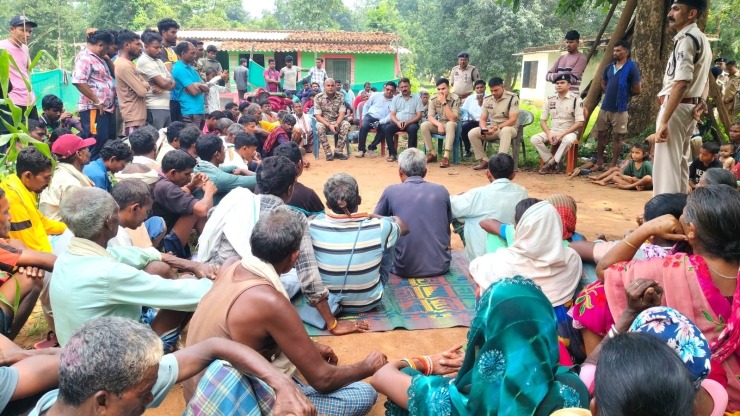
A large group of officials then came to the village and pressed the families to give in. They included revenue and sub-divisional magistrates, a land records officer, an Additional Superintendent of Police, the officers in charge of three police stations, and village council leaders.
“They told us that they will confiscate our farmland. ‘You want land or Jesus Christ? You have to choose one,’” Salam said.
His father, Ram Salam, 50, and the heads of the other two households gave in. Each agreed, on behalf of his family, to convert to Hinduism, and they made a religious offering that the villagers demanded. “We have to save ourselves, our land and property,” the elder Salam told his son.
Vikas Salam and his immediate family still refuse to join the village rituals. They remain in Bhandardigi under constant threat until they can leave.
“If we were willing to renounce Christ, there would have been no need for these high officials to come and pressure us,” he said. “They came, because we were not ready to renounce.”
He said faith had turned his family away from drinking and fighting. “Initially we started to follow Christ because we received physical healing, but when we read the Bible, we found out that the Lord gives us eternal life,” he said. “So, we do not want to forsake Christ. We have decided to leave our land, our property, our home and our ancestral village. We will live in a far-off city, where we have freedom to attend church and worship Jesus, even if we must work as a daily wage labourer.”
The case is the latest in a string of reports of Christians in Chhattisgarh being pushed out of their homes for refusing to give up their faith. These include a family evicted from Chindpal village, also in Kanker’s Durgukondal area, on 24 October.
The Bharatiya Janata Party returned to power in Chhattisgarh in December 2023, after Congress governed from 2018 to 2023. The BJP has held the Kanker Lok Sabha seat without a break since 1998.
India is ranked 12th on Open Doors’ 2026 World Watch List of the 50 countries where it is hardest to be a Christian.
This article is adapted, with permission, from a Morning Star News report, “Christians in India Lose Ancestral Home for Faith in Christ,” published on 30 October 2026.