Flash floods triggered by a suspected earthquake-induced avalanche tore through Nepal’s Rasuwa, Nuwakot and Dhading districts on Wednesday, August 26, leaving at least 18 people dead and nearly 400 others, including more than 100 Indians, unaccounted for. Across the border in Tibet, a mudslide struck the Gyirong crossing the same morning, with officials quoted by China’s Xinhua news agency warning of “major casualties.”
Nepal’s Tourism Board put the missing at 384: 291 foreign nationals and 93 Nepalese citizens, unaccounted for since the Bhote Koshi river rose suddenly around 9 am. Those from abroad include 105 Indians, 37 of them Non-Resident Indians, around a dozen Britons, and nationals of Australia, Malaysia, the Netherlands, South Africa and the United States. The Armed Police Force said four of its own personnel could not be traced in Rasuwa, while Foreign Affairs Minister Shishir Khanal told parliament that 26 police, nine armed police officers and 44 army personnel had also gone missing.
Casualty figures varied through the day as different officials and agencies issued updates, with death tolls quoted anywhere between four and 18 by the evening. Police said the bodies of three men and a woman had been recovered in Bidur Municipality in Nuwakot district, not far from the Trishuli river.
Khanal told lawmakers that a 4.4-magnitude earthquake, registered by the US Geological Survey, struck the region at 8.37 am local time and set off a mix of ice and rock that dammed the river, apparently causing the flood. Meteorological officials, however, said local rain was not to blame for the deluge. “We are still studying the matter, so the real cause is not yet known,” said Dinkar Kayastha of the Department of Hydrology and Meteorology, who added that the danger from the Tibetan side had not disappeared and that “we need to be cautious.” A glacial lake outburst on the Tibetan side is also among the causes being examined.
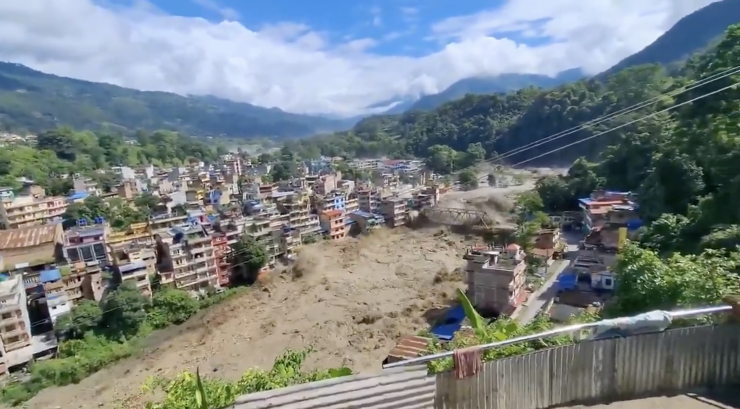
Video clips geolocated by the BBC to Trishuli Bazaar in Nuwakot district showed the Trishuli river turning turbid and swollen within moments, tearing a bridge from its foundations and bringing down several tall buildings soon after. District administrator Narendra Pariyar told Reuters there could be “heavy casualties or loss of property.” Health worker Tula Bahadur BK said, “There is devastation everywhere we look,” adding that riverside homes had been washed away and that he had lost touch with five members of his own family.
The Nepal Army sent up a dozen helicopters, though spokesperson Rajaram Basnet said they could not initially land in the badly hit areas of Syapru Besi and Timure because floodwaters remained too high. By evening, the army said 88 people had been rescued, six from Syafrubesi, two from Mailung and four from Dhunche, with a further 115 still to be pulled out of Mailung village. A medical camp was set up at the army’s Military Training Centre in Trishuli, and five drones and three sniper dogs were sent to trace those missing.
The state-run Nepal Electricity Authority said six major generation and transmission installations were damaged. By its estimate, roughly 430 MW has been knocked offline, a figure that works out to over a tenth of Nepal’s installed hydropower capacity. The Independent Power Producers’ Association Nepal said eight operational plants and five under construction were also hit, including the 111 MW Rasuwagadhi and 78 MW Sanjen Khola stations.
On the Tibetan side, Xinhua said the mudslide had knocked out roads, power supply and phone lines in the Shigatse region, and President Xi Jinping directed rescue teams to spare no effort. Yee Liang, who runs a logistics business in Kathmandu, told the BBC that seven of his company’s trucks and their Nepalese crews in the area could not be reached. “There is no signal, so we cannot reach anyone,” he said, adding that while mudslides were not unusual in the monsoon, this one “seems much more serious.”
Citing the Foreign Ministry, South Korea’s Yonhap news agency reported that eight of its citizens employed at a hydropower site in the area were missing, while ten more workers were stuck there, waiting for Nepal to fly them out by helicopter.
India moved quickly. Prime Minister Narendra Modi telephoned Nepal’s PM Balendra Shah, conveying condolences and pledging humanitarian help, while the Indian Air Force kept a C-17 and a C-130 on standby with relief material ready for dispatch. Fearing the Gandak, fed by the Bhote Koshi via the Trishuli, could swell into Bihar and Uttar Pradesh, the Water Resources Department, as a precautionary step, raised every one of the Gandak Barrage’s 36 gates at Valmikinagar. Home Minister Amit Shah spoke to Bihar Chief Minister Samrat Choudhary, promising support and confirming the NDRF was being mobilised, while the Sashastra Seema Bal alerted units along the 1,751-km border with Nepal and sent 18 relief teams. About 50 stranded Tamil Nadu pilgrims, cut off by landslides, were being assisted by the state government, and the Indian Embassy in Kathmandu shared two helpline numbers, +977 985 131 6807 and +977 970 910 7500, for affected families.
Rasuwa district sits roughly 125 km northeast of Kathmandu, hard against the Tibetan frontier, and has flooded before: a Bhote Koshi flood last year swept away a bridge linking Nepal and China and held up cross-border trade for several months.