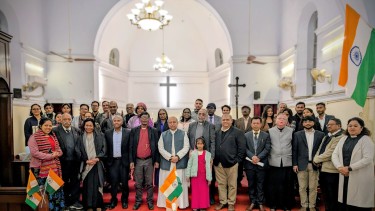
Christian communities from various denominations across the Delhi National Capital Region gathered for eight consecutive evenings from 18 to 25 January 2026 to observe the Week of Prayer for Christian Unity, responding to a formal invitation issued jointly by the National Council of Churches in India, the Evangelical Fellowship of India, and the Catholic Bishops’ Conference of India.
The observance, coordinated by the North West India Council of Churches, brought together believers from Methodist, Catholic, Orthodox, Marthoma, Church of North India, Believers Eastern Church, and Salvation Army congregations at different venues each evening at 6:30 PM.
The week commenced on 18 January at the Evangelical Church of India in Janakpuri with Rev Samuel Richmond from Caleb Institute as the main speaker. On 19 January, worshippers gathered at St Mary’s Orthodox Cathedral at Hauz Khas, where Rev Ashwani Francis from the Methodist Church preached. The third day shifted to Centenary Methodist Church on Lodhi Road, with Fr Dr John Mathew from the Eastern Believers Church speaking at the service.
On 21 January, Fr Rajkumar V, Principal of Vidyajyoti Seminary, addressed participants at Jerusalem Marthoma Church in Safdarjung Enclave. Sacred Heart Cathedral at Gole Dak Khana hosted the fifth evening with Rev Dennis S Lall from the Church of North India. The sixth day brought worshippers to St Thomas Eastern Believers Church at Hauz Khas, where HG Dr Youhanon Mar Demetrios, Orthodox Bishop, delivered the message.
The Free Church on Parliament Street welcomed participants on 24 January, with Rev Asir Ebenezer, General Secretary of NCCI, serving as the main speaker. Archbishop Anil J T Couto, Secretary General of CBCI, and Rev Vijayesh Lal, General Secretary of EFI, brought special greetings during this service. The week concluded on 25 January at the Salvation Army Church in Green Park Extension with Rev Jyoti Singh Pillai from NCCI.
Various bishops and clergy including Archbishop Anil JT Couto, Archbishop John Mor Irenaeus, Bishop Yohannan Mar Demetrius, and Rev Asir Ebenezer guided prayers throughout the week.
Fr Afilash T Issac, Unity Octave Coordinator for the past three years and Secretary of the Ecumenical Relations Department, Diocese of Delhi, Malankara Orthodox Syrian Church, described the experience as blessed. “The Unity Octave has truly encouraged me by witnessing genuine bonds of fellowship across denominations,” he said. “In a divided world, seeing priests, pastors, and laity from Catholic, Orthodox, Protestant, and Pentecostal traditions pray together for Christian unity fills me with hope.”
Fr Afilash noted that collaborative worship sessions bridged cultural gaps, though logistical challenges arose. He emphasised that early planning and inclusive communication with church heads proved essential for smooth execution.
Fr Norbert Herman SVD, Director of Ecumenism for the Catholic Archdiocese of Delhi and Ecumenical Coordinator, acknowledged the demands of organising such an event. “For me it was a challenging task to get across to various ecclesial communities to participate in this annual unity octave mandated by CBCI and NCCI and EFI to stand together under the umbrella of Christ in times of persecution and profession of our faith in the present scenario in India,” he said.
Fr Norbert expressed hope for strengthened unity with better participation from church leaders and laity in future observances.
Organisers reported that a good number of faithful attended the gatherings and were inspired to be rooted in their faith and in professing the Nicene Creed. Feedback from participants was overwhelmingly positive, with many sharing how the octave deepened their faith and sparked new inter-church friendships. A youth-led choir proved particularly popular, with participants calling it “transformative.”
The 2026 theme, “One Body and One Spirit, Just As You Are Called to the One Hope of Your Calling,” drawn from Ephesians 4:4, was prepared by an ecumenical group from Armenia including the Armenian Apostolic Church, Armenian Catholic Church, and Armenian Evangelical Church. The materials reflected Armenia’s rich liturgical heritage, drawing upon centuries-old prayers and hymns from ancient Armenian monasteries and churches, some dating to the fourth century. Armenia was the first nation to adopt Christianity in 301 AD.
Organisers thanked clergy from different denominations who provided their church facilities, making the rotating venue model possible. The observance continued a practice that has united Christians globally since 1908. The consistent 6:30 PM timing allowed working professionals and students to participate after daily commitments.