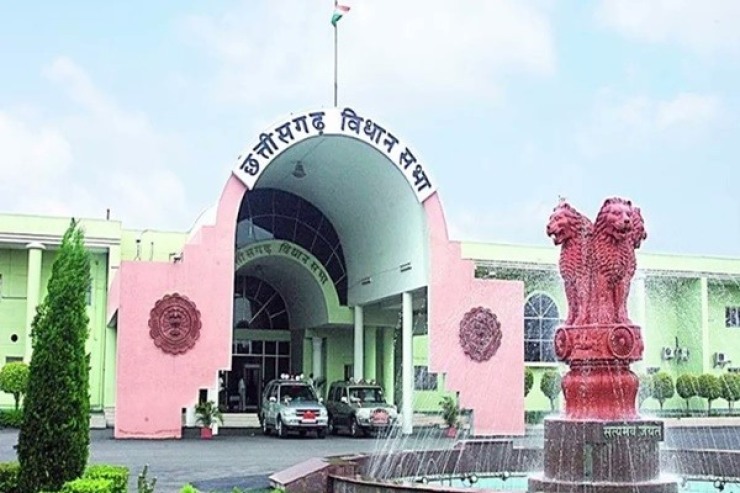
The Chhattisgarh Legislative Assembly passed the Freedom of Religion Bill, 2026 on Thursday amid an Opposition walkout, replacing a 58-year-old law and introducing some of the stiffest penalties for unlawful religious conversions seen in any Indian state.
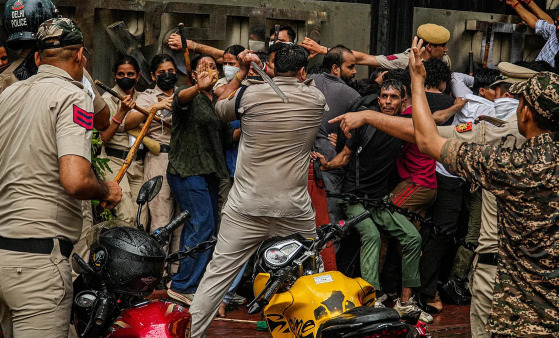
Deputy Chief Minister and Home Minister Vijay Sharma introduced the Bill in the House, triggering an immediate confrontation. Congress legislators staged a walkout, with Leader of Opposition Charan Das Mahant demanding the Bill be referred to a Select Committee. Mahant pointed out that similar laws from 11 states were currently under consideration before the Supreme Court, and argued that the legislation should not be taken up hastily. The Speaker rejected the demand, after which Congress members protested outside the Assembly premises.
The new law replaces the Chhattisgarh Dharm Swatantraya Adhiniyam of 1968, originally enacted in undivided Madhya Pradesh and adopted by Chhattisgarh when it was carved out as a separate state in 2000. Speaking to reporters after the Bill was passed, Chief Minister Vishnu Deo Sai said the measure was needed to stop conversions “carried out by taking advantage of people’s poverty, and lack of education and knowledge.” Sharma told the Assembly that the older law had become inadequate “to effectively control the use of force, greed and fraudulent practices for conversion from one religion to another.”
The legislation bars any person from converting, or abetting the conversion of, another person “by use or practice of glorification, misrepresentation, force, undue influence, coercion, allurement, by physical or digital means, or by any other means.” The Bill extends the reach of these prohibitions to digital platforms, reflecting what Sharma described as the increasingly digital character of inducement.
The Bill significantly widens the definition of “allurement” to cover monetary benefits, gifts, employment offers, free education or medical facilities, promises of a better lifestyle, and marriage. “Coercion” under the new law includes psychological pressure, physical force, threats, and social boycott. “Undue influence” covers the use of any position of authority or trust to override a person’s free will.
The penalties prescribed are among the harshest in the country. General illegal conversions attract seven to ten years in prison. Conversions involving minors, women, persons with mental illness, or members of Scheduled Castes, Scheduled Tribes, and Other Backward Classes carry a minimum fine of Rs 10 lakh and imprisonment of ten to twenty years. For mass conversions, defined as the conversion of two or more persons, the law prescribes a minimum ten-year jail term extendable to life imprisonment, with fines of Rs 25 lakh or more. Repeat offenders may face life imprisonment. All offences under the law are classified as cognizable and non-bailable.
The law also introduces a formal procedural framework. Anyone wishing to convert must submit a prior declaration to the District Magistrate or an authorised officer of equivalent rank. The religious functionary conducting the conversion must similarly provide advance intimation. Within seven days of receiving a complete application, the competent authority must publish the details of the proposed conversion on its official website and display them at the offices of the tehsildar, gram panchayat, and the local police station. Objections can be filed within a month, following which an inquiry will be conducted. Applications lapse if the conversion does not take place within 90 days of approval. Conversion certificates issued under the Act will not serve as proof of citizenship or identity.
Conversions conducted solely for the purpose of marriage, or marriages undertaken to facilitate a conversion, will be treated as invalid unless due legal procedures are followed. However, reconversion to one’s ancestral religion will not be treated as a conversion under the Act. The government has also proposed the establishment of special courts in every district, along with the appointment of Special Public Prosecutors, to ensure speedy trials.
Responding to the Opposition’s charge of haste, Sharma said during the Assembly debate that the issue was relevant to the state, and pointed out that conversions had gone unreported in several districts of Bastar between 2004 and 2021 despite the older law being in force. He dismissed the Congress walkout, saying the Opposition was not boycotting but “escaping.”
Even before the Bill came up for a vote, the Chhattisgarh Christian Forum (CCF) had raised pointed objections. At a press conference on 9th March, CCF President Arun Pannalal said the Christian community had no objection to legislation targeting illegal conversions, but questioned the very basis of the law. “Not a single case of illegal conversion has been proven since independence,” he said, adding that false accusations were being used to label tribals as Hindus under the guise of Ghar Wapsi. The Forum demanded that conversion to Hinduism be brought under the same legal framework, arguing that any other position would violate the constitutional right to equality. In a separate letter to the Assembly Speaker, the CCF asked the government to clearly define what constitutes conversion under the proposed law, asking whether keeping a Bible, interacting with Christians, or praying could be treated as conversion. The Forum also sought a provision for filing FIRs against persons who lodge fabricated complaints, in line with existing Supreme Court directions on false accusations.
Rev. Vijayesh Lal, General Secretary of the Evangelical Fellowship of India, the country’s principal umbrella body for evangelical Christians, was unequivocal in his response. “The Constitution of India guarantees every citizen the freedom of conscience and the right to profess, practise, and propagate religion. Laws that burden the exercise of that freedom with criminal liability, bureaucratic oversight, and penalties that apply unequally across religions do not strengthen the republic -- they weaken it. The Supreme Court is already examining similar legislation from several states, and the Evangelical Fellowship of India has challenged such laws before the High Courts. We will not hesitate to do so again. We ask that the Constitution remain the final arbiter, not political convenience.”
With this legislation, Chhattisgarh joins a growing list of BJP-governed states, including Uttar Pradesh, Rajasthan, Madhya Pradesh, Karnataka, and Haryana, that have enacted or strengthened anti-conversion laws in recent years. Maharashtra passed a comparable bill recently, again amid Opposition objections over potential misuse. The matter of several such state laws remains pending before the Supreme Court.
India does not have a central anti-conversion law. Religious freedom is protected under Article 25 of the Constitution, which guarantees the right to profess, practise, and propagate religion, subject to public order, morality, and health. Regulation, therefore, continues to happen at the state level.