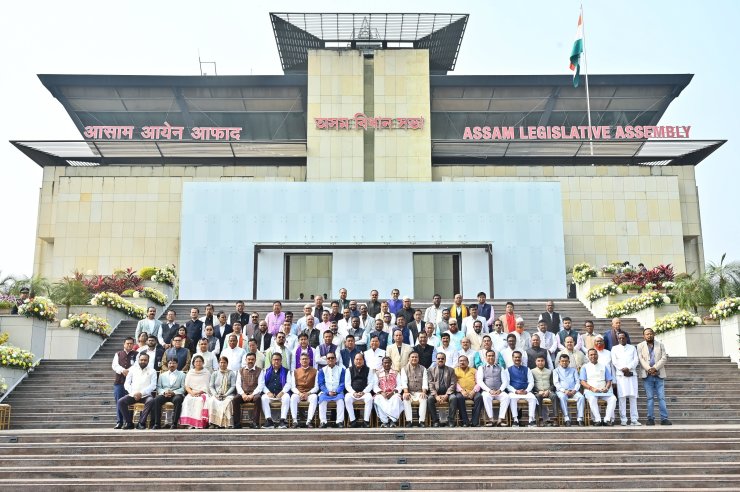
The Assam Legislative Assembly passed the Uniform Civil Code, Assam, 2026 Bill on May 27, making the state the first in the northeast and the third in the country, after Uttarakhand and Gujarat, to enact a uniform civil code. The law, which comes into effect after the Governor’s assent, dismantles religion-based personal law frameworks governing marriage, divorce, succession, and live-in relationships for all residents of Assam except Scheduled Tribes. For the state’s Muslim and Christian communities, the change is not incremental. It is wholesale.
The Bill was passed by voice vote after roughly five hours of debate. Speaker Ranjeet Kumar Dass rejected the opposition’s demand to refer the Bill to a select committee for wider consultations, following which Congress and other opposition MLAs entered the Well of the House and continued sloganeering during proceedings. Despite the protest, Chief Minister Himanta Biswa Sarma formally moved the Bill for passage. “I declare that the Bill is passed,” the Speaker announced, triggering loud applause from ruling party legislators.
Sarma, defending the Bill, told the House: “There can’t be a better start of our five-year tenure than passing the UCC in the first assembly session of our new government. Prices of gas can decrease and increase, but no government can return the dignity of women once lost.”
What the Law Does
The government’s brief sets out four pillars: monogamy made mandatory; a uniform minimum marriage age of 21 for men and 18 for women; equal inheritance rights for daughters; and compulsory registration of live-in relationships.
The penalties are specific. Marriages must be registered within 60 days of the ceremony; deliberate non-registration attracts a penalty of Rs 10,000. Live-in relationships must be registered within 30 days, failing which partners face up to three months’ imprisonment or a fine of Rs 10,000. Polygamy draws up to seven years’ imprisonment under Section 82 of the Bharatiya Nyaya Sanhita, 2023. Fraudulent or deceptive marriages carry the same sentence.
On inheritance, the law creates a gender-equal order for Class-1 heirs, covering spouse, children, and parents, and grants daughters equal shares in parental property. For testamentary succession, any adult of sound mind may write a will distributing their entire estate to whomever they choose. Divorce grounds are standardised, including cruelty, desertion, and mutual consent, with a mandatory six-month cooling-off period before a mutual consent divorce decree is granted.
The law also repeals the Assam Compulsory Registration of Muslim Marriages and Divorces Act, 2024, folding its functions into the uniform framework.
The Muslim Community: Three Specific Collisions
For Assam’s Muslims, who account for 34.22 per cent of the state’s population, the law creates three direct collisions with Islamic personal law.
The first is polygamy. Under the Muslim Personal Law (Shariat) Application Act, 1937, Muslim men may take up to four wives. That ends with the UCC. Only marriages contracted before the law’s commencement are protected under a savings clause; no new polygamous marriages will be valid.
The second is divorce. The Supreme Court banned instant triple talaq in 2017. The six-month mandatory separation period under the UCC’s mutual consent provision now further displaces Islamic divorce practice, replacing it with a uniform civil procedure.
The third is inheritance through wills. Under Islamic law, a person may bequeath through a will only up to one-third of their property; the rest must pass to prescribed heirs in fixed Quranic shares. The UCC grants individuals unrestricted testamentary power over their entire estate.
AIMIM chief Asaduddin Owaisi, speaking at an Eid Milap event in Hyderabad after the law was passed, articulated each of these objections in sequence. “Regarding Islam, you said triple talaq is wrong and you abolished it. But now, you have essentially abolished the entire concept of divorce. Why should there be a mandatory six-month separation period? Is there no Article 25 anymore? What are you doing? Are you trying to detach these people from their religion? Furthermore, under the provision of a Will, anyone can leave their entire property to whomever they want. But in Islam, you cannot give away more than one-third of your property through a Will; it must rightfully go to the legal heirs. Now, under the UCC, you have introduced full willing power. Tell me, what exactly do you want to achieve? This is simply not acceptable to us,” he said.
Owaisi also argued that while the UCC allows anyone to write a will denying daughters their fair share, Islamic law explicitly prevents this. “In Islam, no one could exclude an heir from inheritance nor write a will to give their whole property to one son or deny their daughter inheritance,” he said, calling the UCC’s testamentary provisions “far from a gender just law.”
On X, Owaisi posted: “This is a backdoor imposition of Hindu law on Muslims. On succession, inheritance and divorce, the Hindu principles are being imposed. Only Hindu culture is being protected, while Muslims have to comply with these so-called uniform rules.”
Congress MLA Jakir Hussain Sikdar recalled in the Assembly that the Law Commission in 2018 had opined that there was no need for a UCC and had recommended wider consultation among all stakeholders if the government intended to pursue it. “The Assam government introduced the Bill without discussing it with different groups of religious organisations. Many religions and social groups are not represented in the Assembly. Unity in diversity is our motto,” he said.
The Christian Community: Church Covenants vs. State Registration
For Assam’s non-tribal Christians, the Indian Christian Marriage Act, 1872, which grants ministers of religion authority to solemnise marriages, formally remains in place for the ceremony. But the civil legal framework governing those marriages, including grounds for divorce, inheritance, and rights arising from the union, now falls under the UCC rather than existing Christian personal law.
Allen Brooks, spokesperson of the Assam Christian Forum, the ecumenical body representing all Christian denominations in Assam, reacted sharply after the law was passed.
“The Assam UCC has superseded the Christian Marriage Act, shifting marriage authority from church covenants to state-regulated civil structures, which threatens religious autonomy,” Brooks said. “While aiming for uniformity, the law exempts Scheduled Tribes. This contradiction violates Article 44’s absolute equality, excludes tribal women from gender justice, and risks deepening tribal divisions.”
He added: “Uniform means equality, but here there appears to be discrimination against certain sections of society.”
Brooks drew a sharp distinction between tribal and non-tribal Christians. Tribal Christians in Karbi Anglong, Dima Hasao, the Bodoland Territorial Region, and the hill areas fall entirely outside the UCC under Section 2 of the law. Non-tribal Christians across urban and rural Assam do not.
The Assam Christian Forum had earlier described the Healing (Prevention of Evil) Practices Act, 2024, as creating “an atmosphere of fear and intimidation,” with Brooks saying it led to innocent church personnel being “harassed and booked for praying for the sick and their well-being” in what he called “a clear infringement of their constitutional rights.” The UCC is the latest in a line of legislation the Forum says has altered the environment for minority communities in the state.
The Structural Contradiction: Uniformity That Is Not Uniform
The three-state comparison is instructive. Uttarakhand, Gujarat, and Assam are near-identical in their marriage provisions: minimum age, polygamy ban, mandatory registration. All three exclude tribal communities. But across all three states the same structural contradiction holds: a law claiming to deliver “absolute equality” explicitly carves out roughly 12 per cent of Assam’s population on the basis of tribal identity.
Owaisi put the contradiction directly: “Every community has the right to protect its culture under Article 29, but why is only the tribals’ autonomy being protected?” The question has a dimension beyond political point-scoring. Tribal women, many of whom live under patriarchal customary law on matters of inheritance and divorce, gain nothing from the gender-justice provisions the UCC promises to non-tribal women. The exemption that protects tribal culture simultaneously denies tribal women the law’s protections.
Congress Legislature Party leader Wajed Ali Choudhury put it plainly in the Assembly: “The BJP brought it only for politics. It’s not democratic to intervene in the personal issues of people. And how can a law excluding the tribals be called uniform?”
Opposition members also questioned the need for the legislation, arguing that several issues in the Bill were already addressed under existing laws, and criticised the government for failing to hold wider consultations with religious bodies, civil society groups, and the public before introducing it.
The Sarma government’s consistent position is that the UCC protects women rather than targets any religion. The law now awaits the Governor’s assent. Whether it will survive constitutional scrutiny on the grounds of its conflict with Articles 25 and 26, which protect religious freedom, and the internal inconsistency of a uniformity that exempts 12 per cent of the population, will ultimately be a matter for the courts.