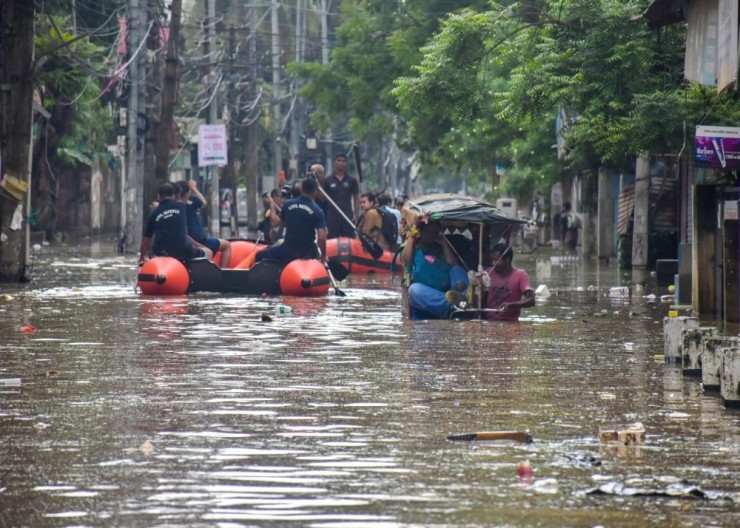
Assam’s flood death toll has risen to 87, up from the 68 this publication reported on July 27, after the Assam State Disaster Management Authority (ASDMA) recorded two more deaths in Sivasagar district over the past day. The population still affected has fallen sharply too, from 4,45,495 across six districts on July 27 to nearly 1.3 lakh across six districts now, as floodwaters recede through most of Upper Assam.
Sivasagar remains the worst hit district, home to more than 55,000 of those still affected; Charaideo follows with nearly 35,000 and Jorhat with over 20,000, a steep drop from the 1,88,404 and 1,44,461 recorded in Charaideo and Sivasagar respectively in late July. Relief camps and distribution centres have scaled down too, from 90 camps and 94 centres sheltering 28,695 people to 55 facilities across five districts now caring for 11,250. The Dhansiri (South) river continues to flow above the danger mark at Numaligarh in Golaghat district, where ASDMA has repeated its earlier warning that “citizens are advised to stay away from the river.”
Even as Upper Assam recovers, the IMD has forecast fresh extremely heavy rainfall over the next two to three days, with the most intense spell expected over Meghalaya. It has placed a red alert on East Khasi Hills, West Jaintia Hills and East Jaintia Hills districts of Meghalaya, and issued similar warnings for Papumpare, Kurung Kumey, East Kameng, East Siang, Lohit and Changlang districts of Arunachal Pradesh, cautioning that the rain could worsen conditions in Assam’s Cachar, Dima Hasao, West Karbi Anglong, Biswanath, Lakhimpur, Dhemaji and Tinsukia districts downstream. Union Health Minister J P Nadda began a tour of Assam, Nagaland and Arunachal Pradesh on August 4, running through August 6, to assess cloudburst and flood damage and review relief work. He will hold a review meeting in Itanagar before returning to New Delhi via Guwahati.
In Nagaland, the landslide that struck Mon town on July 19 has left six confirmed dead, down from the eight or nine officials cited in the first days after the disaster. Search teams recovered four bodies on the day of the landslide and two more on July 20, before authorities called off the search on July 24 with two people still unaccounted for.
In Himachal Pradesh, the toll from the July 24 landslide near Kadhu Nala in Lahaul-Spiti, which buried a vehicle travelling from Kullu to Pangi, stands at 13 dead and two injured, with no fresh casualties reported from the state since.
In Jammu and Kashmir, cloudburst deaths across the union territory have climbed to 31 this summer, out of 35 cloudbursts recorded so far, officials said in Srinagar on Tuesday, up from the 21 rain-related deaths recorded in Poonch, Rajouri and Doda as of July 20. Poonch, Rajouri, Kathua, Doda and Kishtwar remain worst affected, with scattered incidents also reported in Kashmir’s Shopian, Kupwara, Bandipora and Anantnag. The most recent cloudburst struck Kishtwar’s Chatroo area on August 1, sending debris, uprooted trees and rocks into homes and a local market.
Gujarat has faced two distinct waves of flooding of its own this season. Heavy rain in the last week of July killed 35 people over two days in the south of the state, 29 of them in Valsad and Navsari districts alone. Authorities evacuated more than 40,500 people during that spell, while NDRF, SDRF, Army and Coast Guard teams rescued over 6,300, as the Ambika, Par, Auranga and Daman Ganga rivers crossed danger marks. Relief Commissioner Gaurang Makwana said the toll reflected cases where “bodies washed away in flood waters were recovered” once the rain eased. The state government announced Rs 40 crore in cash assistance for affected households.
A fresh spell from August 1 has brought renewed trouble. Electrocution and drowning have claimed four more lives, and authorities have evacuated over 16,500 people. The IMD has issued a red alert for Ahmedabad, Anand, Surendranagar, Rajkot, Bhavnagar, Morbi, Vadodara, Patan, Sabarkantha, Gandhinagar and Botad districts, with orange alerts covering 18 more districts and yellow alerts in ten others.