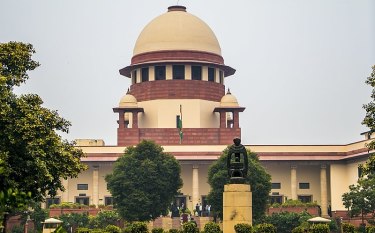
The Supreme Court on Monday issued notices to the central government and 12 state governments on a petition challenging the constitutional validity of anti-conversion laws, marking a significant step towards an authoritative judicial review of legislation that Christian groups say has been systematically misused to target religious minorities.
A bench headed by Chief Justice of India Surya Kant and Justice Joymalya Bagchi issued formal notice to the Union Government through the Ministry of Law and Justice, along with the governments of Himachal Pradesh, Odisha, Karnataka, Uttar Pradesh, Uttarakhand, Haryana, Arunachal Pradesh, Madhya Pradesh, Chhattisgarh, Gujarat, Jharkhand and Rajasthan. The court directed the respondents to file a common counter affidavit within four weeks.
The petition was filed by the National Council of Churches in India, which claims to represent approximately 14 million Christians through its network of 32 member churches, 17 regional councils, 18 national organisations and seven allied agencies. Senior advocate Meenakshi Arora appeared for the petitioner.
Recognising the constitutional importance of the issues raised, the court tagged the fresh petition with other similar pending matters and ordered that they be heard together by a three-judge bench. This procedural move signals the court's intent to deliver an authoritative judgment that could settle the law across multiple states.
Claims of Systematic Misuse
Arora submitted before the court that the state laws incentivise vigilante groups to take action against religious minorities through reward systems. "The Acts which are in challenge, they are structured in such a manner that it incentivises certain vigilante groups to take action, because there are rewards out there. So even if there is really no case at all, someone will make a case, somebody will be arrested, etc., because there is a reward for those on the vigilante side," she argued.
The petitioner has sought an immediate stay on the operation of these laws, citing what it describes as rampant abuse and harassment of minorities through false complaints. The NCCI argues that the laws allow unrelated third parties to file complaints without procedural safeguards, resulting in routine arrests, prolonged detentions and social stigma even in the absence of preliminary evidence.
Speaking to Christian Today India, Rev. Asir Ebenezer, General Secretary of NCCI, said the petition was prompted by "rampant atrocities against vulnerable Christian communities in different parts of the country" and that it was the council's duty to protect the interests of Christian communities in India. He added that the laws violate fundamental human rights and constitutional rights.
Government's Position
Solicitor General Tushar Mehta, appearing for the central government, opposed the petition and said the government's response was ready and would be filed shortly. He contended that the submissions made by the petitioner were not "factually correct" and that the challenge was already covered under a five-judge Constitution Bench judgment.
Mehta referred to the 1977 case of Rev. Stainislaus versus State of Madhya Pradesh, in which a five-judge bench had examined the constitutionality of the Madhya Pradesh Dharma Swatantraya Adhiniyam, 1968 and the Orissa Freedom of Religion Act, 1967. The 1977 verdict had held that the word "propagate" in Article 25 of the Constitution did not give "the right to convert another person to one's own religion, but to transmit or spread one's religion by an exposition of its tenets". The Constitution Bench had held there was "no fundamental right to convert another person to one's own religion".
However, responding to the Solicitor General's reliance on the 1977 judgment, Rev. Ebenezer told CT India that the petition seeks to affirm a citizen's freedom to embrace a religion of their choice without state intervention, particularly by third parties unrelated to the matter. He added that laws enacted after the original statutes in Odisha and Madhya Pradesh have introduced more stringent provisions, and therefore the 1977 judgment "cannot have settled the matter once and for all and for all times to come".
Grounds of Constitutional Challenge
The petition challenges the anti-conversion laws on multiple grounds, arguing they are discriminatory, arbitrary and vaguely worded. The NCCI contends that these laws proceed on an unconstitutional presumption that religious conversions involving adults are inherently coerced or fraudulent.
By mandating prior intimation, inquiry and permission from the district magistrate, the laws compel individuals to justify deeply personal decisions to the state, thereby violating rights to liberty, privacy and freedom of religion, the petition argues. The requirement effectively creates what petitioners describe as a regime of prior permission and bureaucratic oversight over matters of personal conscience.
The statutory definitions of "conversion", "allurement", "inducement" and "undue influence" are challenged as vague and overbroad, lacking objective standards. This vagueness, the petition argues, grants arbitrary discretion to authorities, enables discriminatory enforcement and produces a chilling effect on free speech and religious propagation.
The petition further argues that the laws undermine core principles of criminal jurisprudence by imposing a reverse burden of proof on the accused, thereby eroding the presumption of innocence. Certain provisions singling out women as inherently vulnerable to unlawful conversion rest on gendered and paternalistic assumptions that deny women equal decisional autonomy and violate Articles 14 and 21, it adds.
The NCCI has sought directions to declare several provisions across various state laws as invalid, along with an interim stay on the challenged laws. It has also sought directions to police authorities not to carry out arrests or actions under these laws and a stay on criminal proceedings corresponding to FIRs registered under these laws.
On whether NCCI is hopeful of obtaining a stay, Rev. Ebenezer said, "Citizens cannot be victimised till constitutional questions are decided, therefore a stay is required."
Broader Legal Challenge
The NCCI petition is part of a wider legal challenge to anti-conversion laws that has been building in the Supreme Court since 2020. The lead petition in the consolidated batch was filed by Citizens for Justice and Peace, questioning the constitutional validity of anti-conversion laws enacted by several states.
In December 2025, the Catholic Bishops' Conference of India filed a separate petition specifically challenging the Rajasthan Prohibition of Unlawful Religious Conversion Act, 2025, which the Supreme Court has now tagged with the broader batch of cases. The Rajasthan law, passed in September 2025, has been described by petitioners as among the most stringent, with provisions allowing property demolition and confiscation without judicial oversight and penalties extending up to 20 years imprisonment.
Rev. Vijayesh Lal, General Secretary of the Evangelical Fellowship of India, told CT India, "Concerns around anti-conversion laws have been before the courts for several years, and different Christian bodies, including EFI, have engaged these questions in various legal and institutional ways. We welcome the Supreme Court's scrutiny of these laws, especially to ensure that measures meant to prevent coercion are not applied in ways that restrict freedom of conscience, ordinary religious practice, or humanitarian service."
EFI had previously successfully challenged similar provisions in the Himachal Pradesh anti-conversion law in 2012, when the High Court declared it illegal for citizens to be required to inform authorities about their wish to change religion.
Constitutional Framework
Article 25(1) of the Constitution states that "subject to public order, morality and health, all persons are equally entitled to freedom of conscience and the right to freely profess, practice and propagate religion".
The core constitutional question before the court is not whether states can prohibit conversions by force or fraud, which was largely settled in the 1977 Stainislaus judgment, but whether modern anti-conversion laws have crossed into what petitioners describe as a de facto regime of permission, suspicion and criminal process around voluntary religious choice and interfaith relationships.
The Supreme Court, in the 2018 case of Shafin Jahan, had held that "the choices of faith and belief, as indeed choices in matters of marriage, lie within an area where individual autonomy is supreme". Petitioners have relied on this precedent to argue that anti-conversion laws, by imposing procedural barriers and criminal penalties, infringe upon individual autonomy in matters of faith.
The matter is expected to come up for substantive hearing once the states and the Centre file their responses. The outcome is likely to have far-reaching implications for religious freedom, minority rights and the constitutional balance between state authority and individual liberty across India.