The editorial of the latest issue of the prestigious ‘Economic and Political Weekly’ (Vol. 61, Issue No. 22, 30 May, 2026) has a very incisive lead. It is entitled ‘The Great Nicobar Project: A Holistic Folly’: Its claims of strategic significance are questionable, while environmental harm is certain. The article fires in its opening salvo, “The Project for Holistic Development of Great Nicobar Island, an ₹81,000 crore mega infrastructure project, is more folly than national gain. With growing opposition to the project, including legal challenges, the government has cloaked the project in the language of national security. This is despite the fact that the original project documents, including the 2021 request for proposal issued by the NITI Aayog, hardly refer to defence or security, making it clear that, in its actual intent, the project is a purely commercial endeavour built on large-scale destruction of the ecologically pristine islands and the alienation of their indigenous people”.
A National campaign says that the project is ‘a disaster in the making’ and demands an end to the Modi-Adani scam being foisted on the nation. It is without doubt that this corrupt duo has looted the nation lock, stock and barrel and together with their other corrupt crony capitalist friends have caused unbelievable damage to the environment and to our fragile eco-systems. In this Nicobar project there is ample evidence that 160 sq. km of rain forest will be destroyed; one crore trees will be cut down; that it is a crime against natural and tribal heritage; that the tribal communities particularly the Shompen and Nicobarese who are distinct indigenous groups and Particularly Vulnerable Tribal Groups (PVTGs) native to the Andaman and Nicobar Islands; they possess unique cultures, languages, and traditional ways of life, largely centred on Great Nicobar Island; above all a threat to the fragile ecosystem.
The EPW further states, “the project envisions an international container trans-shipment terminal at Galathea Bay, a greenfield international airport, a township and tourism project, and a power plant. The primary trunk infrastructure of the programme alone is slated to destroy 130 square kilometres of primarily tropical rainforests, which, by the government’s underestimation, will involve felling 8.65 lakh trees, a fraction of the likely millions. This will, in a hare-brained plan, be compensated by planting a few lakh trees in distant Haryana and Madhya Pradesh. The Nicobars are the only region in India to fall in the Sundaland global biodiversity hotspot, home to rare and endemic species and globally unique flora and fauna. The notion that the destruction of this ecological hotspot can be compensated for by tree plantations in semi-arid central and northern India is foolish fiction. The Galathea Bay—where the trans-shipment terminal is proposed—is among the most important nesting sites of the endangered leatherback turtle. In January 2021, contradicting the government’s own National Marine Turtle Action Plan, the Galathea Bay was denotified as a protected sanctuary to make way for the infrastructure project.” Scathing points indeed to prove that the regime, cares two hoots about what is happening to our environment!
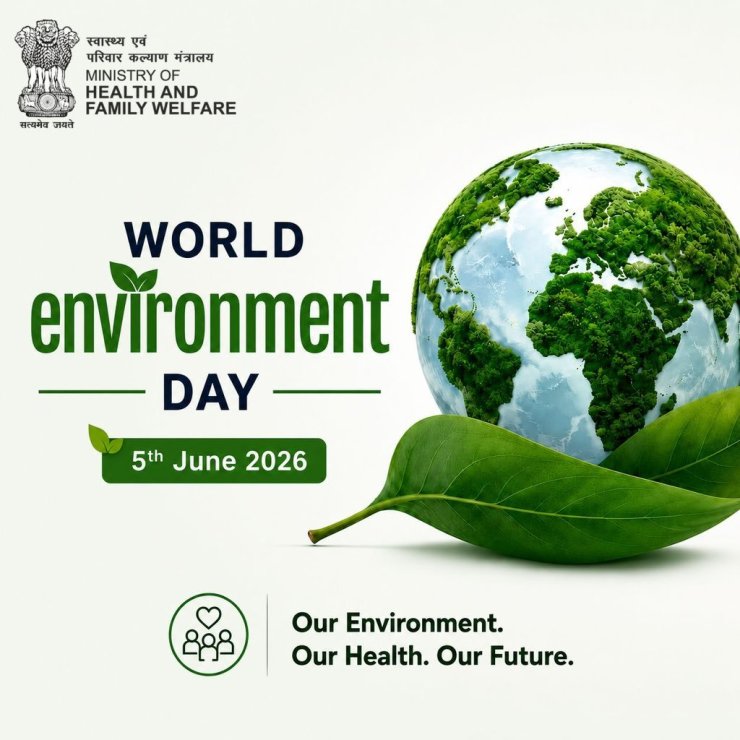
Today was yet another ‘World Environment Day.’ There was a flurry of activities. The morning newspapers (some of them had their front page in ‘green’) had full page advertisements about the environment with several of them sponsored by government agencies, the very ones responsible for destroying the environment! In the ‘events’ there was the usual jostle to plant saplings, the plethora of long, boring speeches on the importance of the environment repeated 'ad nauseam' and plenty of photo-ops with faces beaming towards the cameras. Yes, indeed plenty of 'tokenism' and 'cosmetic' action. And the ‘temporary concern’ for the environment will soon be forgotten!
India is in the grip of a serious environmental crisis. A lead article in the popular online portal ‘Countercurrents’, (dtd 3 June 2026) and titled, ‘The Scorching Heat and Silent Death: India’s heat crisis is killing the poor in silence’ says, “A single day of extreme heat, the study estimates, causes around 3,400 excess deaths across India. A five-day heatwave causes nearly 30,000. Uttar Pradesh alone accounts for more than 8,100 of those deaths. The number 30,000. In five days. That is more than ten times the official annual toll. That is a catastrophe without a name. The five states that bear two-thirds of India’s heatwave deaths are Uttar Pradesh, Bihar, Madhya Pradesh, Rajasthan and Gujarat.” Several parts of the country are in the midst of an unprecedented heat wave with several casualties, especially among the poor and marginalised sections of society. On 13 and 14 May, devastating unseasonal storms, tore through Uttar Pradesh killing at least 120 people and injuring several more. The Aravalli hills continue to be pillaged despite the Supreme Court order that all mining activity in the area should be halted.
Fossil fuels account for almost 75% of India’s total energy supply. We are highly dependent on fossil fuels despite the global commitment to transition away from their use. It is common knowledge that fossil fuels are the principal driver of the climate change currently damaging human health, wellbeing, and ecosystems, and posing a severe threat to overall planetary health. They are also a major source of particulate matter and ozone. These air pollutants are responsible for a wide range of adverse health outcomes, including an estimated 6.7 million deaths globally in 2019. Deaths however, are only one part of the problem. Improved air quality would reduce the burden of several major diseases leading to healthier and longer lives, fewer patients requiring admission to hospital and other treatments, and decreasing the burden on health systems worldwide.
The theme for ‘World Environment Day’ this year is, 'Inspired by Nature. For Climate. For Our Future'.This obviously is a follow-up of the UN Climate Summit COP30 which took place in Belém, Brazil from 10 to 21 November 2025. COP30 focussed heavily on forest conservation, the transition from fossil fuels and the implementation of the Paris Agreement Goals. Sadly, as we experience in India today, those who rule, do not care about what is happening to our environment!
Public awareness of the importance of the environment is a prerequisite – but then words ring hollow, when the ones who wax eloquent are the very ones who are in nexus with the land mafia who dry up our water bodies for their high-rise buildings and who cohort with the mining mafia to plunder our precious natural resources. It is important to note that in the most recent 'Environmental Performance Index'(EPI), India was ranked 176 out of 180 countries. A pathetic indicator by any standards on the environmental situation in our country!
About ten days ago, on 26 May, India lost one of her great environmentalists, in the untimely death of Fr Bolmax Pereira of Goa. Fr Bolmax was not afraid in standing up against the powerful, vested interests, who were destroying the fragile ecosystem of Goa. He launched a successful #SaveMollemForest campaign against the Adani –led double tracking through the Mollem reserved forest. He constantly spoke about the reality that the average Goan was breathing coal-dust all the time, thanks to the nexus between the politicians and the mining mafia. He once said, "The wilful damage being inflicted on our environment and ecology is so very colossal. There is a dire need to stay united to save our state from any further destruction... We all need to be very concerned about the air, water and sound pollution that is battering our little Goa."
Are we serious about following the legacy of Fr Bolmax? Or do we say “who cares”? Like to what is happening in Nicobar today? We must come out now and challenge this anti-people, anti –environment regime and the entire system, and ask them, “whose environment is it, anyway?”
Fr Cedric Prakash SJ is a renowned human rights, reconciliation and peace activist. He is also a prolific writer. Contact cedricprakash@gmail.com.