Supreme Court of India has dismissed an appeal concerning village-level restrictions on Christians in tribal areas of Chhattisgarh, making clear that its decision was based on procedure rather than a ruling on the constitutional validity of the bans.
The bench, comprising Justices Vikram Nath and Sandeep Mehta, said the petitioner had not first pursued remedies available under the state’s Panchayat (Extension to Scheduled Areas) framework before approaching the court.
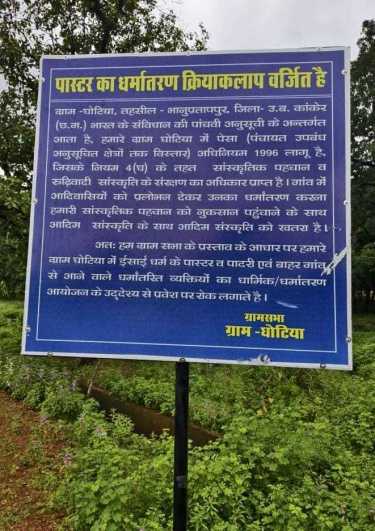
The case was brought by Digbal Tandi, a Christian from Kanker district, who challenged resolutions passed by several gram sabhas (village councils) that had installed signboards barring Christian pastors and converts from entering their villages.
During proceedings, Senior Advocate Colin Gonsalves argued that the High Court had made critical observations about missionary activity without sufficient evidence on record. He questioned why petitioners should be required to return to the same local bodies whose actions they were contesting.
However, the Supreme Court pointed to the High Court’s direction allowing petitioners to approach the relevant authority under the PESA Rules. The justices indicated that such statutory remedies should be exhausted before constitutional relief is sought.
Importantly, the Supreme Court did not examine whether the village restrictions themselves violate constitutional guarantees of religious freedom or equality.
In earlier petitions before the Chhattisgarh High Court, Tandi and a second petitioner had claimed that pastors attempting to visit villages were assaulted and that Christian homes had been damaged. The High Court dismissed those petitions in October 2025, describing the village measures as precautionary steps intended to safeguard tribal customs and cultural heritage.
The High Court also rejected arguments that a state Panchayat Department circular had been misused to encourage anti-Christian resolutions. State authorities maintained that the circular was designed to protect traditional tribal resources and identity.
The dispute arises amid broader debates over religious conversion laws in India. Chhattisgarh already enforces legislation regulating conversions, and the state government has announced plans to introduce stricter provisions requiring prior notification before any change of religion.
Appearing for the state, Solicitor General Tushar Mehta told the court that additional factual claims had been introduced at the appellate stage and that the petitioner could file a fresh case if necessary.
Meanwhile, petitioners’ counsel informed the bench of other matters pending before the Supreme Court relating to alleged attacks on Christian prayer gatherings and burial disputes involving tribal converts.
A pastor from the Bastar region, speaking anonymously, said the village restrictions have created serious hardship for Christian families, including limits on visits from relatives and increased social pressure.
Chhattisgarh Home Minister Vijay Sharma welcomed the court’s order, stating that village councils in Scheduled Areas have authority to protect local culture. The Supreme Court’s ruling, however, did not provide endorsement of the substance of the village bans, addressing only the procedural path taken by the petitioners.
Observers say the case reflects ongoing tensions between tribal self-governance structures, anti-conversion legislation and constitutional protections for religious minorities.