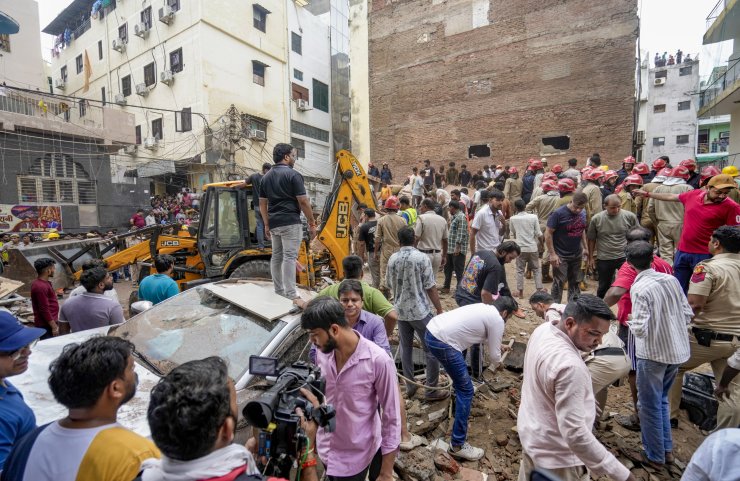
A five storey building housing a boys’ paying guest (PG) hostel collapsed in south Delhi’s Satya Niketan area on September 6, killing seven people and trapping dozens of others under the debris. Two days on, a First Information Report, or FIR, the document Indian police file to open a criminal case, has accused the building’s owners of adding illegal floors despite knowing the structure could not bear the load, while a Supreme Court appointed amicus curiae, a legal expert asked by the court to assist it, has urged the top court to widen its ongoing building inspection drive to cover paying guest accommodations and private hostels across the capital.
The structure, near Delhi University’s South Campus, caved in around 1.30 pm on Sunday. Eyewitness estimates of how many were inside ranged from two to four dozen, though police have not confirmed an exact number. Many of those living there were students, and a number of them were reportedly in their rooms because the university had no classes scheduled that day.
Police, fire personnel and National Disaster Response Force teams worked through the rubble overnight and into Monday, using earthmovers, sniffer dogs and cutting equipment to clear away steel and concrete debris. Twelve people were taken to hospital and seven died, while others remain under treatment. An adjacent building was evacuated as a precaution. Chief Minister Rekha Gupta said the collapse was caused by “accumulation of water, combined with ongoing repair work in the basement.”
The All India Institute of Medical Sciences Trauma Centre said five of ten patients brought in were declared dead on arrival, while another who was critical later died. Among the dead was a 75 year old man. The police FIR named three of the injured taken to the hospital as Neeraj, 19, Aaditya Kumar and Krishna, along with four others who were not immediately identified. Families of the missing gathered outside the hospital through the night seeking word of their loved ones.
An eyewitness who ran a nearby shop told the news agency ANI that the collapse sounded “like the rumble of an earthquake,” and that he could hear students crying out from under the rubble for help.
A local police inquiry found that the structure, built as ground floor plus four storeys, was being run as a PG. The FIR names the owners as Hari Bansal and his brother, and alleges that they added four extra floors over the years to earn more rental income, even though they knew the building’s foundation was not designed to bear that much weight. Construction work was reportedly still going on inside the building when it came down, which police believe added to the strain on the structure.
Additional Deputy Commissioner of Police (DCP) Abhimanyu Poswal said Hari Bansal, now in custody, has told investigators he was in charge of the renovation, and that an injured labourer separately confirmed there was construction happening in the basement. Police said Hari Bansal, his wife Urmila and son Mahesh have been arrested in the case. Hari Bansal is reported to have been in Gurugram when the building came down; he switched his phone off and left town soon after, and was traced and detained the next day in Bhiwadi, Rajasthan.
Chief Minister Gupta, who visited AIIMS to meet the injured, said her government would ensure proper treatment for the injured and provide financial support to the bereaved families. She has also announced a policy requiring structural audit reports and safety certificates for buildings used for public purposes, regardless of age, and directed that PG accommodations and coaching centres, private institutes that tutor students for entrance exams, be inspected across the city on a priority basis.
Five officials of the Municipal Corporation of Delhi (MCD), the civic body responsible for construction and buildings in the city, were suspended over the incident, including a deputy commissioner and four engineers from the south zone.
The Delhi High Court has issued notice to the Delhi government, the MCD and Delhi University on a public interest litigation filed by law student Aniket Kumar Gupta seeking compensation and rehabilitation for affected students, and has asked the university to specify what share of its students get hostel accommodation.
Separately, Supreme Court amicus curiae Ajit Kumar Sinha has told the court that Satya Niketan saw an earlier collapse in April 2022 that killed two and injured four, and that the recurrence raises concerns about enforcement of building inspection and safety mechanisms. He has sought a time bound inspection of PGs and private hostels around colleges and universities across Delhi, covering sanctioned plans, floor counts, basement alterations and structural and fire safety. The Supreme Court had earlier ordered inspections in Lajpat Nagar, Saket and Malviya Nagar, but not Satya Niketan.
The MCD has since identified 62 buildings across Delhi as dangerous. Sixteen of these have already come down and four have been sealed shut, with the remaining 42 lined up for one or the other in order of priority. An adjacent building next to the collapse site, currently held up by iron guardrails, is set to be demolished, and six neighbouring buildings have been sealed.
Lieutenant Governor Sardar Taranjit Singh Sandhu, the centrally appointed head of Delhi’s administration who holds authority alongside the elected Chief Minister, ordered structural audits of all PG accommodations within a week, while cautioning against what he called “mindless sealing drives” that could leave students without a roof over their heads.
Executive engineers across the MCD’s zones have been told to inspect buildings in their areas and report back by September 10, findings that will feed into an affidavit due before the Delhi High Court ten days from now. A pre-monsoon survey the civic body carried out in June, however, flagged only 189 buildings as dangerous out of roughly 2.8 million structures it inspected across the city.
The MCD’s own record puts the building’s age at roughly three decades, built on a 55 square yard plot in what was originally a resettlement colony, though some people living nearby insist it has stood there since the 1970s. Such colonies were meant to have only ground-plus-one structures, officials said. The civic body has no sanctioned plan for the building on file, nor any past complaint against it.
Delhi University Vice Chancellor Yogesh Singh has directed affiliated colleges to speed up hostel projects that are still in the pipeline, so fewer students are forced into private PGs. A video of a Delhi University student praising an ambulance sent by Blinkit, an Indian quick-delivery app, for reaching the site ahead of government ambulances also went viral on social media.
Fire department figures show Delhi has logged over a thousand such collapses across the city in the past three years. A residential building collapse in the north east of the city last April killed eleven people, among them three children, and in a separate 2024 incident, three students lost their lives when the flooded basement of a coaching centre trapped them inside.