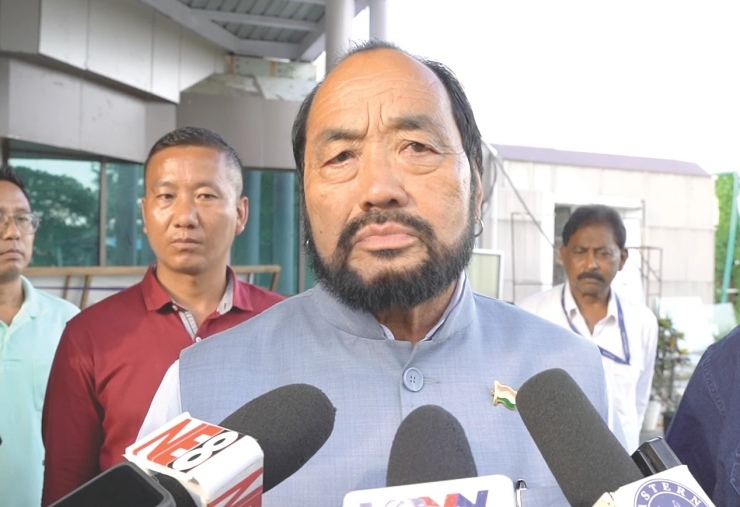
Nagaland’s Deputy Chief Minister and Home Minister, Y. Patton, said on August 21 that the state government would not compel anyone to sing Vande Mataram, India’s National Song, as opposition continued to a Union government directive making the complete six-stanza version of the song compulsory at official events, including this year’s Independence Day ceremonies.
Speaking to reporters at Dimapur Airport, Patton said the state government could not commit to enforcing the directive issued by the Union Home Ministry, India’s federal interior ministry, commonly referred to in India as “the Centre.” Participation, he said, should remain a matter of individual choice: no one would be forced to sing, and “nobody can stop anyone from singing” who wished to.
At issue is not Vande Mataram in general, but its fifth stanza. While the opening two verses, sung at official events since 1937, describe the motherland’s beauty in largely secular terms, the fifth stanza personifies the nation as the Hindu goddesses Durga, Kamala (Lakshmi) and Vani (Saraswati), traditionally associated respectively with strength, wealth and learning. The Nagaland Baptist Church Council (NBCC) has objected on behalf of Christians specifically, while the Naga Students’ Federation (NSF) has framed its objection more broadly, citing concern for students from non-Hindu backgrounds whose beliefs the devotional imagery may conflict with.
Patton indicated that the matter could come up for discussion when the Ninth session of the Nagaland Legislative Assembly opens on September 1. Asked whether the state government would examine the directive in light of Article 371(A), a special constitutional provision that protects Naga customary law, religious practice and social identity from unilateral central legislation, Patton said the provision would not be affected by the issue.
The church council’s statement, issued days before Patton spoke, came from the apex body of Baptist churches in a state where Baptists form the majority. The NBCC opposed any directive compelling citizens to sing Vande Mataram at events marking India’s 80th Independence Day, saying patriotism should arise from willing participation rather than compulsion.
The NBCC said compelling citizens to take part in an expression tied to faith or conscience could not strengthen national unity, adding that this unity would be strongest when every citizen’s conscience is respected, “irrespective of faith, community, culture, or conviction.” The council also urged all sides to express their positions peacefully, cautioning against communal tension.
Days before that, the NSF, an influential student body active across Nagaland, Manipur, Assam and Arunachal Pradesh, had asked educational institutions not to send students to the Independence Day events. Its concern, the NSF said, was compulsory participation where the song’s devotional imagery conflicted with the “sincerely held beliefs of students belonging to non-Hindu communities.” It directed its units to ensure no student faced disciplinary action, discrimination or academic consequences for declining on grounds of conscience or religious belief.
The controversy traces back to a ten-page directive issued by the Union Home Ministry on January 28, mandating that the six-stanza version be played or sung at official occasions, including flag-unfurling ceremonies and before and after speeches by the President and Governors. The NSF first objected in February. In March, the Nagaland Legislative Assembly referred the matter to a select committee to examine its applicability in the state. Last month, Parliament passed the Prevention of Insults to National Honour (Amendment) Bill, 2026, making insult to Vande Mataram a punishable offence. Prime Minister Narendra Modi and Home Minister Amit Shah then sang it in Parliament for the first time since the law’s passage.
Vande Mataram, written by Bankim Chandra Chattopadhyay and included in his 1882 novel Anandamath, was adopted as India’s National Song in 1950, a status distinct from the National Anthem, Jana Gana Mana. Only its first two stanzas had customarily been sung at official events, following a 1937 decision of the Congress Working Committee under Mahatma Gandhi and the Nobel laureate poet Rabindranath Tagore, seconded by Sardar Vallabhbhai Patel, India’s first home minister, precisely to keep the song free of sectarian imagery. Patel is today honoured by the ruling Bharatiya Janata Party as a founding icon, including through the Statue of Unity, the world’s tallest statue, built in his memory in Gujarat in 2018.
The constitutional guarantee most often cited in commentary on the dispute is Article 25 of the Constitution of India, which promises all persons, citizens and non-citizens alike, “freedom of conscience and the right freely to profess, practise and propagate religion.” In the 1986 case of Bijoe Emmanuel versus State of Kerala, the Supreme Court ruled that the expulsion of Jehovah’s Witness students who had stood respectfully without singing the National Anthem, because their faith forbade it, violated their constitutional rights.
Similar objections have been reported in the neighbouring Christian-majority states of Meghalaya and Mizoram. The question of how to observe the directive has surfaced elsewhere in India too: on this year’s Independence Day, the Kerala state government, led by the Congress party, left the song out of its official flag-hoisting ceremony altogether.