The Madras High Court has restrained the construction of a church near a hundred-year-old Mariyamman temple in Kalapatti, Coimbatore, holding that mala fide intentions could not be ruled out if a large church came up so close to the shrine.
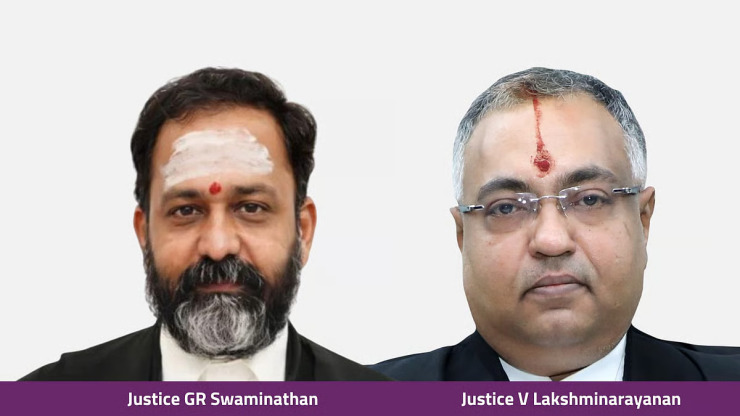
A Bench of Justices G R Swaminathan and V Lakshminarayanan passed the interim order on May 29 in a writ petition filed by Balasubramaniyam N, a resident of Kalapatti, against the Collector and other authorities [Balasubramaniyam Vs Collector].
The petitioner sought quashing of official communications that arranged police protection for the CSI Christ King Church, and removal of what he called illegal construction on government poramboke land and a public road.
The case came up during the Bench’s vacation sitting. When counsel sought urgent listing on May 21, the Court asked why such urgency was warranted. Counsel submitted that “following the change of Government headed by the Hon’ble Chief Minister Shri C.Joseph Vijay, certain fundamentalist organisations have become emboldened.” He referred to Speaker JCD Prabhakar quoting biblical verses in his Assembly address, to Leader of Opposition Udhayanidhi Stalin’s remarks calling for “annihilation of Sanatana dharma,” and to a statement by Madurai MLA V M S Mustafa describing this as party policy. He also cited posters calling for a church in every village. Notice was then ordered to the contesting respondent, returnable on May 29.
Counsel for the church sought time to file a counter when the matter was taken up again. The Bench noted it could have disposed of the petition, since the issue had already been settled by an earlier order, but allowed the church to respond. The petitioner pressed for interim relief, which required a closer look at the facts.
The Bench recorded that the Mariyamman temple in Survey No.155/1 has existed for over a hundred years. The petitioner stated that the village originally had about 350 families, of whom only three were Christian; the number has since grown to roughly 1,000 families, with 950 professing Hinduism, 15 Islam and a handful Christianity. Permission for a church in adjoining Survey No.155/2 was first granted by the Collector in 2010 despite opposition, leading to a civil suit by temple worshippers still pending before the District Munsif Court, Coimbatore. Construction did not proceed for thirteen years; when it resumed recently, an earlier writ petition was disposed of in April, with liberty to seek fresh permission only after the civil suit concluded.
Examining revenue records, the Bench found Survey No.155/2 recorded as a tar road, and observed that “title cannot vest in a private body when the revenue record indicates that it is a public road.” It further noted that Supreme Court orders bar religious structures on roads and road margins, and that under the Tamil Nadu Combined Development and Building Rules, 2019, a religious structure needs a no-objection certificate from the Collector.
The Bench observed: “Coimbatore is a communally sensitive city. It witnessed bomb blasts and bloody religious riots. The proposed church would come up within a stone’s throw from the existing Mariyamman Temple. There are only a handful of Christian families. If a large church is proposed to be constructed in the vicinity of the Mariyamman Temple, mala fide intentions cannot be ruled out.” It added that when an overwhelming Hindu majority vigorously opposes a church near a temple, “the authority must not casually brush the objection aside.”
The Court clarified this did not mean the State must yield to majority opposition in every case, stating that the State should uphold a religious right where it is established or opposition is unreasonable. In this case, however, the Bench held that a prima facie case existed and that irreparable harm to social amity would follow without an interim order. “The political scenario may change. But so long as the position of law remains what it is, it is our duty to give effect to the same,” it added, granting the interim injunction restraining construction.