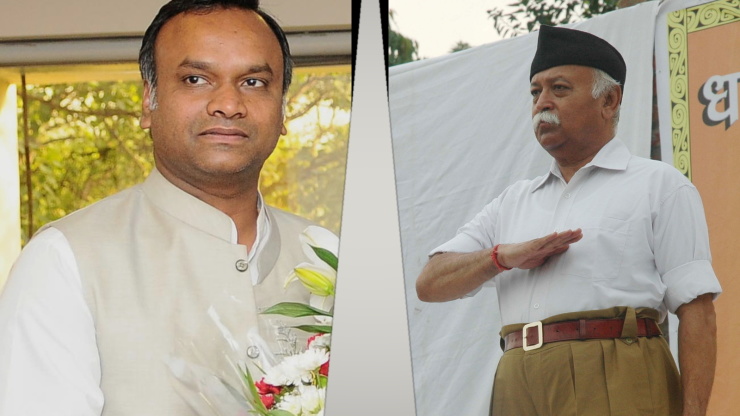
Karnataka Home Minister Priyank Kharge’s demand that the Rashtriya Swayamsevak Sangh (RSS) register itself and disclose its finances has triggered a sustained exchange between Congress leaders and the RSS-BJP combine over the past week, playing out through letters, public remarks and social media posts.
The exchange traces back to June 10, when Kharge told media that the RSS could not remain above the law. “Let the RSS call me to its Keshava Krupa headquarters. Let them show me the law under which they are exempted from being accountable to the government,” he said, adding that he would apologise if proven wrong. He also asked who had funded Prime Minister Narendra Modi’s foreign travels before he entered politics, when Modi was “a self-proclaimed Fakir” and RSS pracharak.
RSS chief Mohan Bhagwat has long defended the organisation’s structure on a different footing, describing it as a “body of individuals” recognised under existing law, and pointing to a court ruling that exempted its guru dakshina contributions from income tax.
Responding to questions during a programme in Thrissur, Kerala, Bhagwat said the RSS had “always functioned openly and transparently.” “We are not secretive; we are working on open ground. Our shakhas are held in public spaces, our karyakartas live in localities, and people see them daily,” he said.
On June 15, Kharge made public a detailed letter to Bhagwat, citing the RSS’s own 2025-26 Akhil Bharatiya Pratinidhi Sabha report to argue that an organisation claiming over 60,000 shakhas and crores of swayamsevaks could not avoid scrutiny. The letter pointed to the RSS’s footprint in Karnataka alone, 4,127 daily shakhas, 1,389 weekly milans and 60 monthly mandalis, along with 2,194 Samajotsavas drawing 19.61 lakh participants and 562 route marches involving 2.21 lakh uniformed participants. The same day, Bhagwat said he would “not respond” to the letter, dismissing it as politics. “The Hindu religion is not registered, many things are not registered,” he said, adding that registration was needed only by organisations seeking government funds.
Fuller details of the letter’s contents emerged on June 16, with Kharge asking the RSS to depute authorised office-bearers to explain the legal grounds on which it functions without being formally registered, and seeking disclosure of its legal status, office-bearers, sources of income, expenditure, taxation and permissions for public events.
Kharge rejected Bhagwat’s comparison between the RSS and religion as “flawed and absurd,” and said the RSS could not wield social and political influence while claiming no public accountability. Karnataka Urban Development Minister Yathindra Siddaramaiah backed him on June 16, saying no organisation could claim exemption from registration laws and questioning the source of RSS properties worth crores across the country. Former minister HK Patil demanded that Bhagwat apologise for comparing the RSS to a religion, while Rajya Sabha MP Pawan Khera called the comparison “absurd,” asking how a shopkeeper could refuse GST registration by citing Hinduism’s unregistered status.
The BJP responded sharply. Leader of the Opposition R Ashoka called the questioning of the RSS’s legality “laughable” and “shameful,” and separately alleged that Kharge’s campaign was a strategy to counter Chief Minister D K Shivakumar’s 2028 chief ministerial ambitions, terming Kharge the most “utter flop” minister in Karnataka’s history. Karnataka Legislative Council Opposition Leader Chalavadi Narayanaswamy asked why Kharge had not sought the Congress party’s own dissolution, referring to Mahatma Gandhi’s post-Independence suggestion to that effect. State BJP president B Y Vijayendra said transparency demands amounted to hypocrisy coming from a party facing questions over the National Herald case.
Commentator S Gurumurthy defended the RSS’s position, arguing that Jawaharlal Nehru’s lifting of the ban on the organisation, after it submitted a written constitution to the government in the 1950s, was itself a form of legal recognition, and that courts had long upheld the tax-exempt status of guru dakshina under the principle of mutuality. He cited dairy cooperative leader Verghese Kurien as an example of the RSS’s financial integrity being acknowledged even by ideological opponents.
As of June 17, neither the RSS nor the Karnataka government has indicated further steps following the exchange of letters and public statements.