The so-called Islamic State group has launched a series of fresh attacks in Syria, describing the violence as a “new phase of operations” against the country’s current leadership.
The attacks come at a time of significant change in the region. The United States is withdrawing from a number of military bases in north-east Syria, including its largest facility in the area, according to recent reports. Analysts suggest that this drawdown may create gaps in security that extremist groups could seek to exploit.
Recent clashes between Syrian government forces and Kurdish fighters previously allied with the United States have further destabilised the region. In January, government troops took control of the city of Raqqa from the Kurdish Syrian Democratic Forces (SDF). Around the same time, fighting affected the area surrounding the Al-Hol displacement camp.
The camp, which had long been guarded by Kurdish forces, reportedly saw a mass escape after those forces withdrew under pressure. Estimates from Western diplomatic sources suggest that more than 20,000 of the camp’s 23,000 residents may have fled. Many of those living in Al-Hol had alleged links to Islamic State.
Security experts warn that the departure of international forces and the dispersal of former detainees could provide new opportunities for militant networks to reorganise.
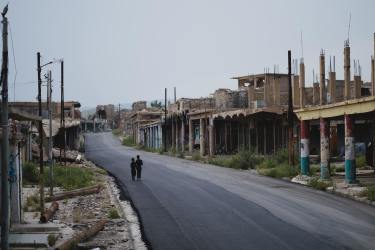
Earlier this week, Islamic State fighters reportedly killed four members of the Syrian security forces at a checkpoint west of Raqqa. The group also claimed responsibility for further attacks in Raqqa and in the city of Mayadin, where at least one soldier was killed. These incidents mark a noticeable rise in activity after several years of relative quiet in Syria.
Although Islamic State lost its territorial control in 2019, it has remained active in various forms. In recent years, much of its violence has shifted towards parts of Africa, where affiliated groups have expanded their reach.
Concerns about renewed instability are not limited to Syria. A memorandum circulated by Cyprus, which currently holds the presidency of the Council of the European Union, warned member states that extremist organisations could take advantage of rising tensions in the region to recruit new followers.
Al-Hol camp has long been described by observers as a breeding ground for radical ideology. Efforts to deradicalise and reintegrate residents have struggled to match the scale of the challenge. Local communities have often resisted accepting former camp residents, fearing further instability.
Reports indicate that many of those who escaped travelled towards Idlib, while others are believed to have crossed into Türkiye or other neighbouring areas.
The renewed violence highlights the lasting consequences of Islamic State’s earlier rise and fall. Though the group no longer controls major territory in Syria or Iraq, security analysts caution that the movement of thousands of individuals once connected to it may complicate counter-terrorism efforts for years to come.
Meanwhile, concerns continue to be raised about the treatment of ethnoreligious minorities within Syria. Civil society leaders and human rights monitors have reported ongoing incidents of violence, marginalisation and insecurity affecting vulnerable communities.
Christian organisations have repeatedly called for prayer, protection for innocent civilians, and renewed international efforts to promote justice, stability and genuine peace in the region.
This is a rewritten version of the original article from ICC.