

Jerusalem, Middle East – Pilgrims celebrated the Orthodox Easter ''holy fire'' rite Saturday as a flame believed by some to be miraculously ignited illuminated thousands of torches and candles at Christianity's holiest site.
Security was tight as visitors from around the world flocked to the Church of the Holy Sepulcher, where tradition says Jesus was crucified and buried.
Tempers flared as thousands of worshippers waited to pass through security barricades into Jerusalem's Old City. Some priests and pilgrims shoved and punched police. Inside the church, people scuffled with each other and with officers as they waited for the ceremony to begin.
The Greek and Armenian Orthodox patriarchs in the Holy Land descended into the church's underground tomb to bring out the flame. Worshippers clutching bundles of unlit tapers and torches waited in the darkened church for the church leaders to emerge.
When they reappeared with lighted torches, church bells pealed. Worshippers cheered, shrieked "Christ, Christ," and ululated. The flames were passed around to the thousands of faithful and light and smoke filled the cavernous church within seconds.
The ritual dates back at least 1,200 years. The precise details of the flame's source are a closely guarded secret, but some believe it appears spontaneously from Christ's burial area as a message from Jesus on the eve of the Orthodox Easter that he has not forgotten his followers.
"My connection to Jesus is stronger, my connection to Jerusalem is stronger now," said Jeanette Gennetian, 66, of Watertown, Mass, a member of the Armenian Apostolic church.
Religious observations historically have touched off clashes over protocol among the different Orthodox denominations. Groups of people Saturday shouted, "Armenia, Armenia" in Armenian, and "Greece, Greece" in English.
On Friday, screaming Coptic priests threw punches over where and how long different sects would stand during the Good Friday service.
In Istanbul, Turkey, Ecumenical Patriarch Bartholomew I delivered an Easter message decrying the trivialization of life and the destruction of nature.
Bartholomew, the spiritual leader of the world's more than 200 million Orthodox Christians, said the same fanaticism that once called for the crucifixion of Jesus was still calling for death and destruction, and said cowardly leaders still denied their responsibility to stop it.
"We call for an end to the killing of one another, and we denounce the violence and fanaticism that threatens life," Bartholomew said. "The victory of the resurrection must be experienced as a victory of life, of brotherhood, of the future, of hope."
The holy fire ceremony in Israel took place without serious incident despite talk that the ousted Greek Orthodox patriarch of the Holy Land, Irineos I, might put in an appearance in an attempt to challenge the authority of his successor, Theofilos III.
Church officials deposed Irineos last year over accusations he leased prime church properties in east Jerusalem to Jews seeking to bolster Israel's claim to that largely Arab section of the city. Irineos has refused to recognize his dismissal and still commands a band of loyalists.
Palestinians claim east Jerusalem as the capital of a future state, and the church's mostly Palestinian flock in the Holy Land denounced the leases as weakening the Arab presence in the disputed city.
Israeli security was heightened last year because of showdowns over the land deal. This year, police said the heavy security was standard practice at large public events.
Dimitri Diliani, who leads a coalition of Palestinian Christians, said Israeli police blocked Palestinian Christians from entering the Old City, allowing in only foreign worshippers.
Most Popular
-
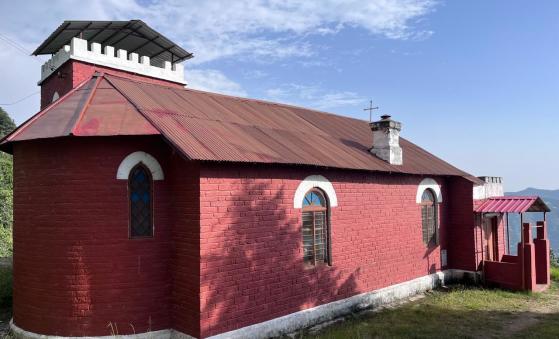
A Hilltop Church in Kumaon Turns 94
-
Evangelical Fellowship of India Calls Churches to Pray for Persecuted Christians on 1 and 8 November
-

Catholic priest and school principal seriously injured in attack by masked men in Jharkhand
-
Fresh Violence in Manipur Leaves Four Dead as Security Is Tightened
-

Myanmar Military Accused of Destroying Two Churches in Christian Regions