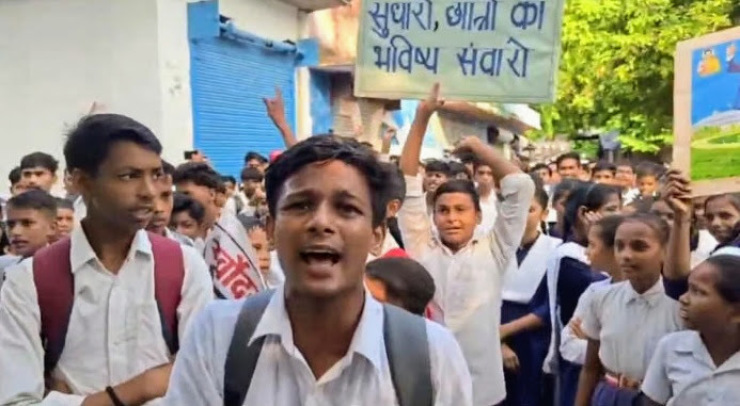
Students of a government residential school in Uttar Pradesh’s Unnao district staged a protest on Wednesday, August 19, blocking traffic at Mohan crossing over poor quality food, inadequate drinking water and a shortage of teachers. Hasanganj Sub-Divisional Magistrate Shalini Singh Tomar said the students’ problems had been resolved and the school was calm again after officials intervened.
The Unnao demonstration is the latest in a wave of protests by school-age children, now commonly referred to in Indian media as “Gen Alpha protests,” that has spread across Uttar Pradesh, Rajasthan, Madhya Pradesh, Bihar, Jharkhand and Maharashtra since late July.
The trend traces back to July 28, when around 1,500 students of Sarvodaya Inter College in Fatehpur’s Kishanpur town walked out of class and sat in protest for several hours, seeking clean water, working fans and better hygiene on campus. Similar agitations followed elsewhere. In Rajasthan’s Barmer and Jalore districts, students shut school gates to press for teacher appointments. In Bihar’s Gaya district, students at a school in Tikari refused to negotiate with a junior official and insisted the district magistrate meet them directly, which he eventually did.
Uttar Pradesh saw the most sustained unrest. Students of Jai Prakash Narayan Sarvodaya Vidyalaya in Lucknow blocked roads twice within four days this month. On August 14, over 100 boys halted traffic near the Agra Expressway. Three days later, around 200 girls from the same school marched through heavy rain and blocked the Dubagga-Kanpur bypass, chanting “Call the DM... Call the CM.” State minister Asim Arun met the students and promised additional guest lecturers and better exam coaching support. Earlier in August, children from Classes 1 to 12 in Hamirpur walked to the district collectorate with their parents, carrying the tricolour, to demand repairs to a road connecting their village to school. In Kannauj, around 100 students of Jawahar Navodaya Vidyalaya went on a hunger strike over poor hostel food.
In Madhya Pradesh’s Ujjain, more than 300 schoolgirls staged a sit-in outside the Collectorate after officials proposed shifting their government school 10 to 12 kilometres away under a plan to merge six urban schools. A video of the protest shared on X quoted the students saying the move would mean a 25-kilometre daily round trip and could force many girls to drop out altogether.
In Jharkhand’s Garhwa, students blocked highways for three days after a popular teacher was transferred ahead of examinations.
These protests have unfolded against the backdrop of a larger student movement in India this year. In May, the Cockroach Janta Party, founded by political strategist Abhijeet Dipke after Chief Justice of India Surya Kant referred to unemployed youth as “cockroaches” and “parasites,” led a weeks-long sit-in at Delhi’s Jantar Mantar demanding accountability for a leak in the NEET-UG medical entrance exam. The protest ended after Union Education Minister Dharmendra Pradhan resigned on July 25. PM Modi then set up a task force headed by Infosys co-founder Nandan Nilekani to recommend reforms to the examination system.
After the resignation, the Cockroach Janta Party said it would function as a pressure group rather than a political party, and on August 15 launched a campaign called “School Thik Karo,” urging parents to inspect government schools and document missing facilities. The campaign turned tragic in West Bengal’s Bankura district, where CJP volunteer Sheikh Abdul Hafeez was allegedly attacked after filming the condition of his old primary school. His father died of his injuries two days later. West Bengal Chief Minister Suvendu Adhikari denied any party involvement, saying, “There is no BJP connection here. They are all criminals.” Police have made arrests in connection with the case.
In his Independence Day address from the Red Fort, PM Modi announced free online coaching for competitive examinations, a plan to train one crore young people in artificial intelligence, and a nationwide sports talent hunt for children between five and fifteen years. Uttar Pradesh Chief Minister Yogi Adityanath has cited the state’s Operation Kayakalp scheme for school infrastructure in response to the protests, while Samajwadi Party chief Akhilesh Yadav and other opposition leaders have criticised the government’s record on education.
District officials in most affected areas have responded with promises of new teacher postings and infrastructure repairs. Students in Lucknow have warned they will resume their protest if the assurances are not honoured.